
The 65% Problem: New Data Shows AI Is Making Small Business Sales Teams 3.7× More Likely to Hit Quota
Sales reps spend 65% of their time on activities that have nothing to do with selling — research, data entry, follow-up scheduling, CRM updates. That is the finding from Salesforce's 2026 survey, and it explains why most small businesses feel like they are always chasing growth but never quite reaching it. AI sales automation changes the math — and the results in the data are hard to argue with.
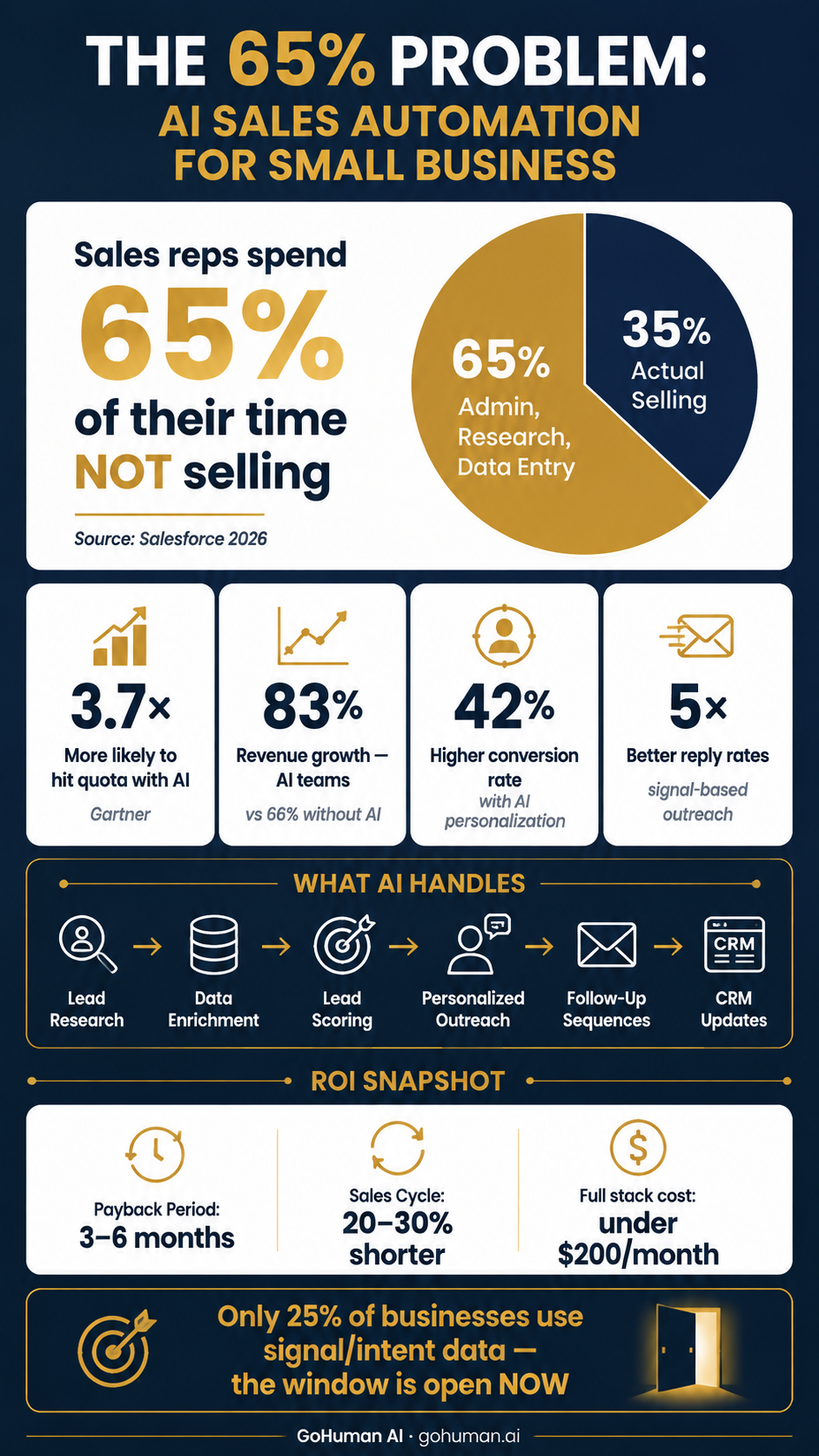
Picture a sales rep who works a 40-hour week. According to Salesforce's 2026 survey data, only 14 of those hours — 35% of the total — are actually spent on selling. The other 26 hours are consumed by research, manual CRM entry, drafting follow-up emails, scheduling calls, cleaning contact data, and building prospect lists. That is the equivalent of more than three full working days every week spent on tasks that generate zero direct revenue.
For a small business owner who is also the sales team, or who manages a small team of one or two salespeople, that ratio is not just inefficient — it is a structural revenue ceiling. And unlike pricing strategy or marketing spend, it is largely invisible. You feel the output (missed quota, slow pipeline, deals stalling in follow-up) but rarely trace the cause back to where the time is actually going.
AI sales automation addresses this problem at the root. It handles the 65% — not partially, not occasionally, but systematically — so the time spent with actual prospects increases without adding headcount. The 2026 data on what happens when small businesses make this shift is compelling enough to change how you think about your next sales hire.
What the Numbers Actually Show
Salesforce's 2026 research tracked performance across thousands of sales teams — small businesses included — and broke down results by AI adoption. The gap between AI-using and non-AI teams was not subtle.
3.7×
More Likely to Hit Quota
Reps using AI vs not — Gartner 2026
83%
Revenue Growth — AI Teams
vs 66% for non-AI teams — Salesforce
42%
Higher Conversion Rate
AI-assisted personalization
30%
Shorter Sales Cycles
AI-assisted qualification
Gartner's 2026 research adds a quota attainment angle that is particularly striking: sales representatives who partner with AI tools are 3.7 times more likely to meet quota than those who do not. That is not a marginal improvement — it is a transformation in the probability of success at the individual rep level. For a small business owner managing a team, it means the difference between a sales function that reliably performs and one that consistently underdelivers despite effort.
LinkedIn's 2026 research reinforces the pattern from a different angle: among sales professionals who use AI daily, 56% report being twice as likely to exceed their targets. The daily-use distinction matters. Occasional AI use — running a prompt here and there — delivers modest gains. Systematic, daily use of AI in the sales workflow is where the compounding effect takes hold.
The Six Tasks AI Handles — Starting Today
The practical question for any small business owner is not whether the data is real — it is what AI actually does in the sales workflow that produces these results. The answer is six specific categories of work that currently consume most of your team's non-selling time.
1. Prospect research and enrichment. Before any outreach, a sales rep typically spends 20–40 minutes researching a prospect: company size, recent news, decision-maker identification, technology stack, recent funding or hiring signals. AI tools automate this entirely, pulling from dozens of data sources and delivering a complete prospect brief in seconds. A prospect list that took a week to build manually now takes hours.
2. Lead scoring and qualification. Which leads in your pipeline are most likely to convert? Traditional approaches use gut instinct or static scoring models (industry, company size, title). AI scoring models analyze behavioral signals — website visits, email opens, content downloads, timing patterns — and update dynamically as new signals come in. Autobound's 2026 research found that accounts with three or more active signals convert at 2.4 times the rate of single-signal accounts. The leads your AI flags as high-priority are materially better quality than the ones your spreadsheet sorted by company size.
3. Personalized outreach at scale. This is where AI sales automation delivers the most visible improvement in raw output. Generic cold outreach currently achieves 3–5% reply rates — meaning 95–97 out of every 100 prospects ignore your message. Signal-personalized outreach, where AI crafts messages referencing a prospect's specific recent activity (a funding round, a job posting, a product launch, a public comment), achieves 15–25% reply rates according to Autobound's 2026 analysis. Multi-signal personalization — where the message references several concurrent signals — pushes reply rates to 25–40%. That improvement does not require more volume. It requires smarter targeting and AI-generated personalization on each message.
The outreach math:
At 3% reply rate: 1,000 outreach messages = 30 conversations. At 20% reply rate: 300 outreach messages = 60 conversations. With AI, you send less and get more — because relevance beats volume every time.
4. Follow-up sequences. Research consistently shows that 80% of sales require five or more follow-up touches — but most salespeople stop after one or two, either because they forget or because manual follow-up across a large pipeline is logistically overwhelming. AI-powered follow-up sequences run automatically: if a prospect opens your email twice but does not reply, the system triggers a different-angle follow-up. If they click a link, it logs the signal and adjusts the next message. The result is that no qualified lead falls through the cracks because a rep ran out of bandwidth to follow up.
5. CRM data entry and maintenance. Sales reps consistently rank CRM data entry as their most-hated administrative task — and the least valuable use of their time. AI tools now auto-log call summaries, update deal stages based on email conversations, and enrich contact records continuously. The practical benefit is twofold: your pipeline data is always accurate (which improves forecasting, a problem addressed in AI cash flow forecasting), and your reps spend that recovered time actually selling.
6. New rep onboarding. For small businesses, every hire is high-stakes — and a slow ramp-up is expensive. AI sales tools accelerate time-to-productivity for new reps by 30–40%: objection handling libraries, deal coaching based on past successful conversations, and AI-generated call preparation briefs mean new hires reach full output faster. A rep who would typically take six months to fully ramp becomes productive in three to four.
The Signal Intelligence Edge — And Why 75% of Businesses Are Missing It
Beyond the operational efficiency gains, there is a second-order advantage that most small businesses are not yet capturing: signal-based intent data. Only 25% of B2B companies currently use intent or signal data tools, according to 2026 research — which means 75% of your market is doing outreach blind, without knowing which prospects are actively researching solutions like yours right now.
Intent signals are behavioral indicators that a prospect is in an active buying mode: visiting competitor websites, searching for specific solution keywords, downloading industry reports, hiring for roles that indicate a strategic shift, or engaging with relevant content. Businesses using signal-qualified leads report 47% better conversion rates compared to those running volume-based outreach without intent data. The reason is straightforward — you are reaching people when they are already looking, rather than hoping your timing happens to align with their readiness.
For small businesses with limited sales bandwidth, this prioritization is not a nice-to-have — it is a structural necessity. You cannot afford to spend time pursuing leads who are 12 months from a buying decision when AI can identify the ones who are 12 days out.
This connects to the same pattern behind the 55-point productivity gap between connected and disconnected AI users: the businesses generating the biggest gains are not simply running AI tools in isolation — they are connecting those tools to their existing data and workflow context. In sales, that means connecting intent signals to your CRM, your outreach tool, and your follow-up sequences so that a single high-intent signal automatically triggers a coordinated, personalized response rather than waiting for a rep to notice.
The ROI Case: What It Costs and What You Get Back
The financial case for AI sales automation is unusually accessible for small businesses because the tool costs are low relative to the productivity gains.
AI Sales Stack — Typical Monthly Cost
The cost comparison is stark. A single entry-level sales development representative (SDR) costs $55,000–$75,000 annually in salary alone — before benefits, tools, management time, and ramp-up costs. An AI sales stack that handles the research, enrichment, scoring, outreach, and follow-up that role would perform costs under $200 per month, or roughly $2,400 per year. The SDR who remains on your team, freed from those administrative tasks, then spends their time on the human-facing work AI cannot replace: building trust, navigating complex objections, and closing deals.
First-year ROI for AI sales automation typically runs 280–520%, with a payback period of three to six months. That range reflects significant variance by business type: higher-ticket sales with longer cycles see the largest absolute gains because each recovered deal has more value. Service businesses report some of the fastest payback periods because AI follow-up sequences directly prevent the most common failure mode — losing a warm lead who was never contacted a third time.
This pattern is consistent with what the broader data on AI adoption shows. Businesses that treat AI as a productivity tool for their existing team — rather than a headcount replacement — consistently outperform those that view the decision as one or the other. The largest study on AI and jobs found that businesses using AI are four times more likely to hire than cut — and in sales, the reason is clear: AI creates more qualified opportunities than the existing team can handle, which drives a need for more relationship-oriented sales capacity, not less.
Where to Start: The 4-Week AI Sales Pilot
Week-by-Week Rollout
- 1 Week 1 — Audit where time goes. Track your current sales activities for five days using a simple time log. Most business owners are surprised to discover their actual selling-to-admin ratio. Quantifying the 65% problem for your specific situation gives you a concrete baseline to measure against.
- 2 Week 2 — Set up a free CRM with AI built in. HubSpot's free tier includes AI-powered email drafting, contact enrichment, and deal tracking. Connect it to your Gmail or Outlook and begin logging your pipeline. This gives the AI system its data foundation — you cannot score leads or automate follow-up without a structured pipeline to work from.
- 3 Week 3 — Automate your follow-up sequence. Define your five-touch follow-up flow: what happens if a prospect opens but does not reply, clicks a link, or goes dark for seven days. Build this sequence in your CRM or a sequencing tool. Running this manually once gives you the logic; running it automatically thereafter gives you a system that never forgets.
- 4 Week 4 — Add signal-based prospecting. Test one intent data source — Apollo.io, Instantly.ai, or similar — to identify prospects actively researching your category. Run 100 AI-personalized outreach messages based on actual signals and compare your reply rate to your previous baseline. The gap between 3% and 15% is visible in 100 outreach messages.
The Window Before It Closes
AI sales automation is following the same adoption curve as every other AI category: a period where early movers capture a disproportionate advantage, followed by a period where the approach becomes standard and the advantage normalizes. The 25% of businesses using signal/intent data today are operating in a low-competition environment — their personalized, signal-triggered outreach is competing against generic cold email from the 75% still running volume approaches. That window is narrowing.
The same dynamic applies across AI adoption more broadly. Research consistently shows that most small businesses are stuck at AI Horizon 1 — using AI for isolated tasks rather than embedding it in core workflows. Sales is one of the highest-leverage workflows to embed AI in, because the output of that investment shows up directly in pipeline and revenue, usually within a single quarter.
At GoHuman AI, sales workflow automation is one of the most requested implementations we build for small business clients — precisely because the gap between current performance and AI-augmented performance is so large and so measurable. If your sales team is spending more time on admin than on prospects, the 65% problem is already costing you. The question is whether you measure it before or after you fix it.
Related Reading
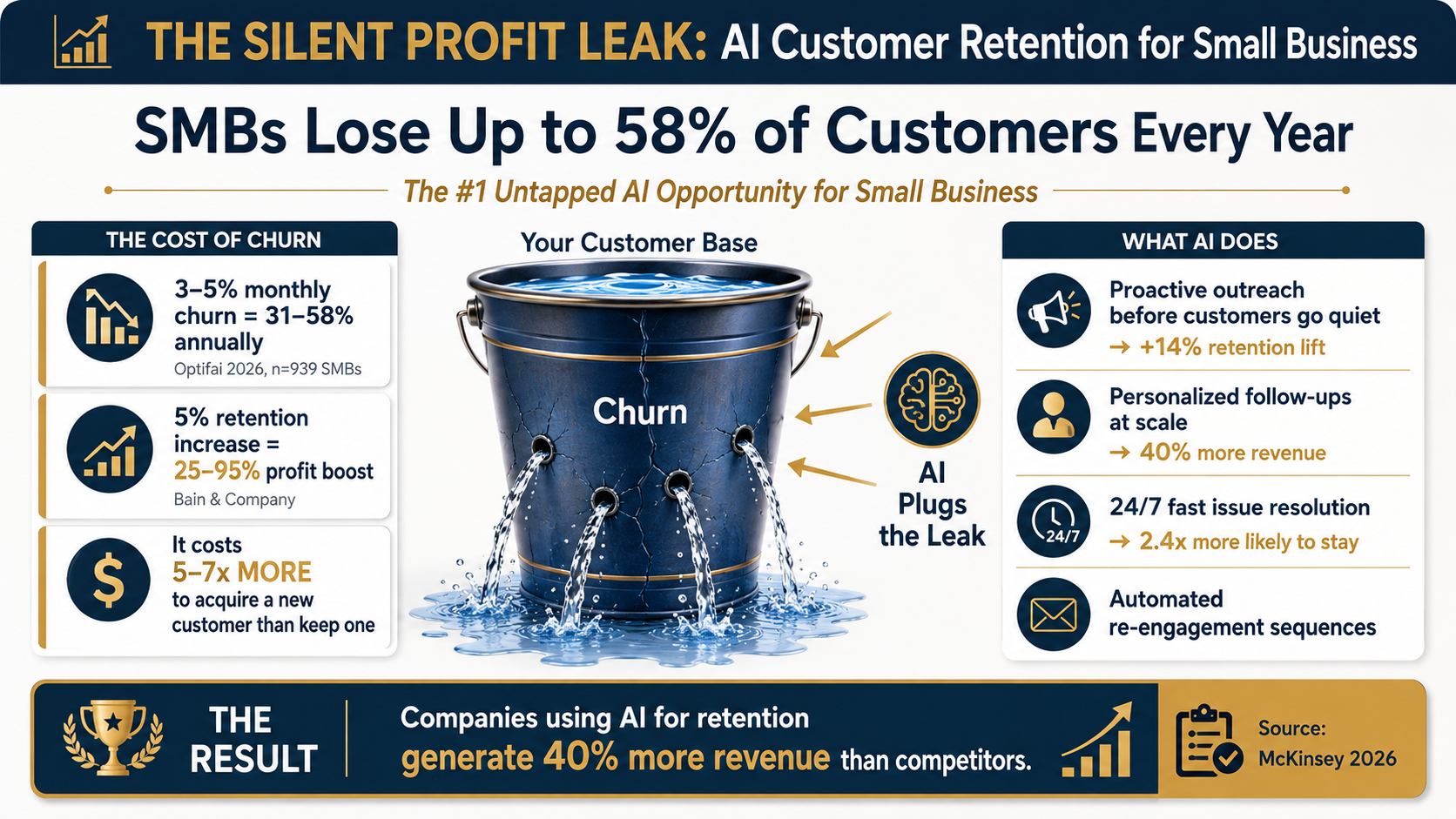
The Silent Profit Leak: How AI Is Helping Small Businesses Stop Losing the Customers They Already Have
Close more deals — then use AI to keep those customers longer.
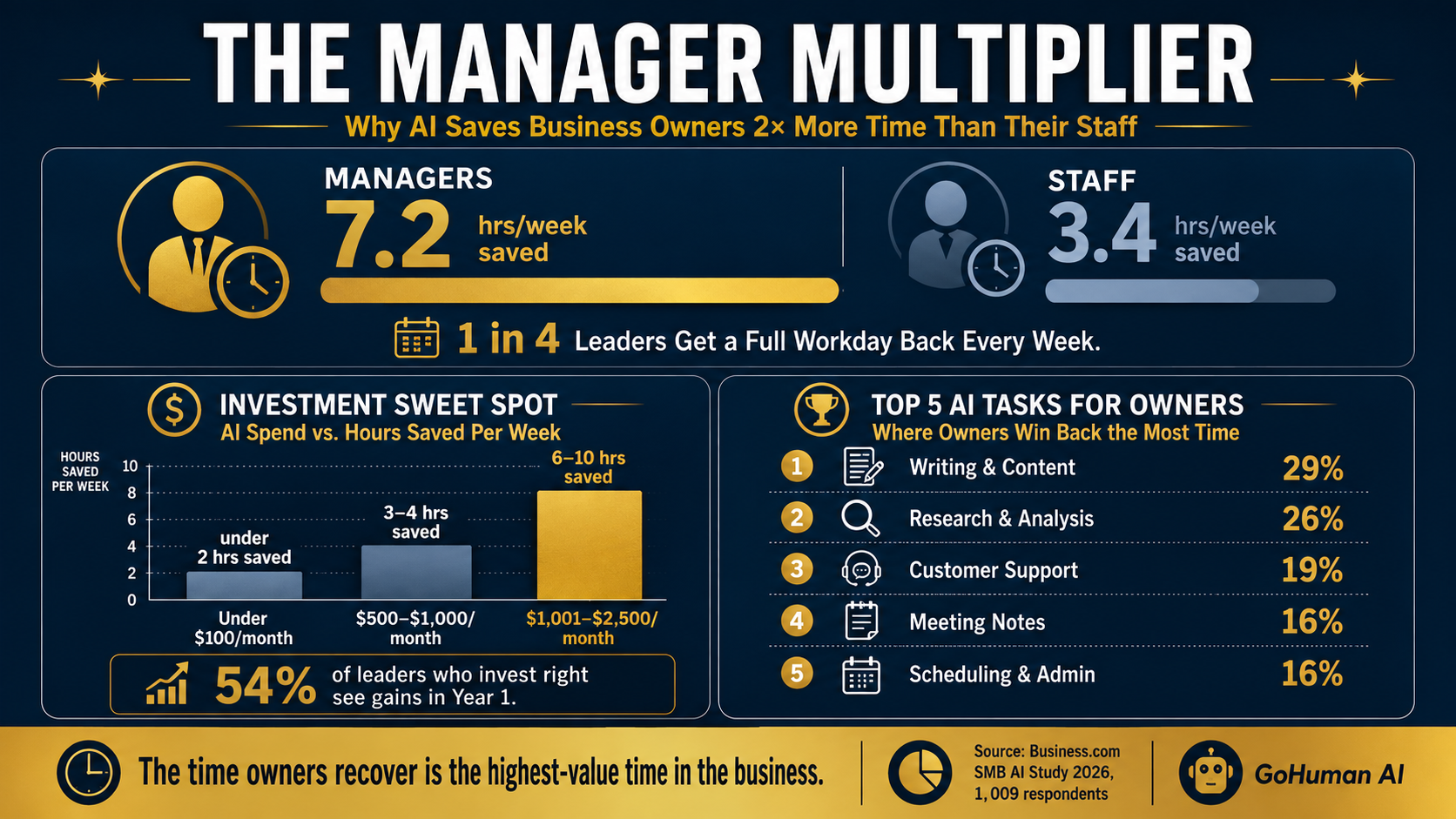
The Manager Multiplier: New Data Shows AI Saves Business Owners 2× More Hours Per Week Than Their Staff
Sales is where the time savings are highest — here is the broader productivity picture.
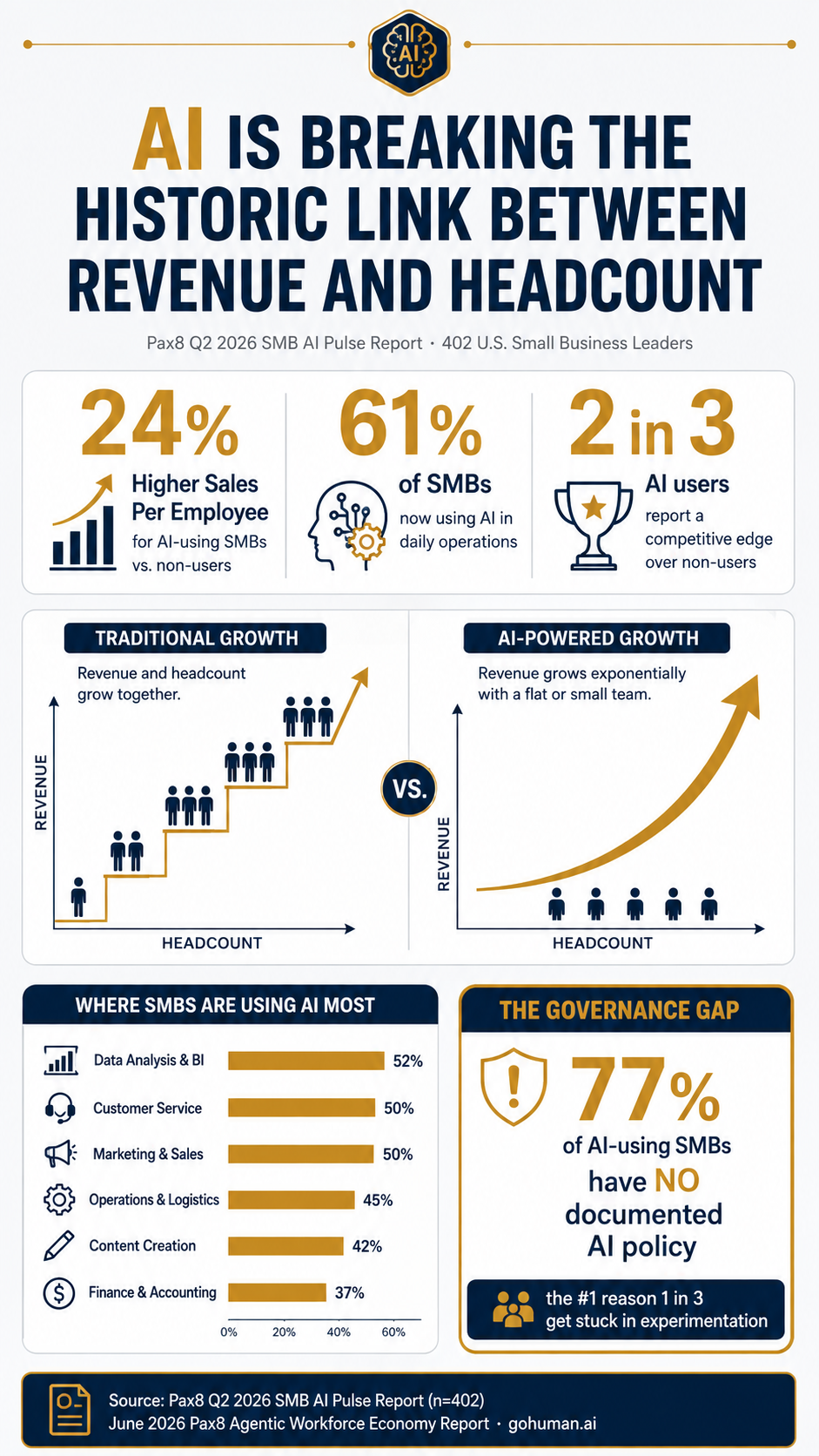
The End of Hire-to-Grow: New Data Shows AI-Using SMBs Generate 24% More Revenue Per Employee
How AI sales automation fits the broader pattern of doing more without adding headcount.
Your sales team is spending 65% of their time on tasks that have nothing to do with selling. Let us show you how AI sales automation closes that gap — and what a 3.7× improvement in quota attainment looks like for your specific pipeline.