
The $17,500 Blind Spot: New Data Shows AI Fixes the #1 Killer of Small Businesses
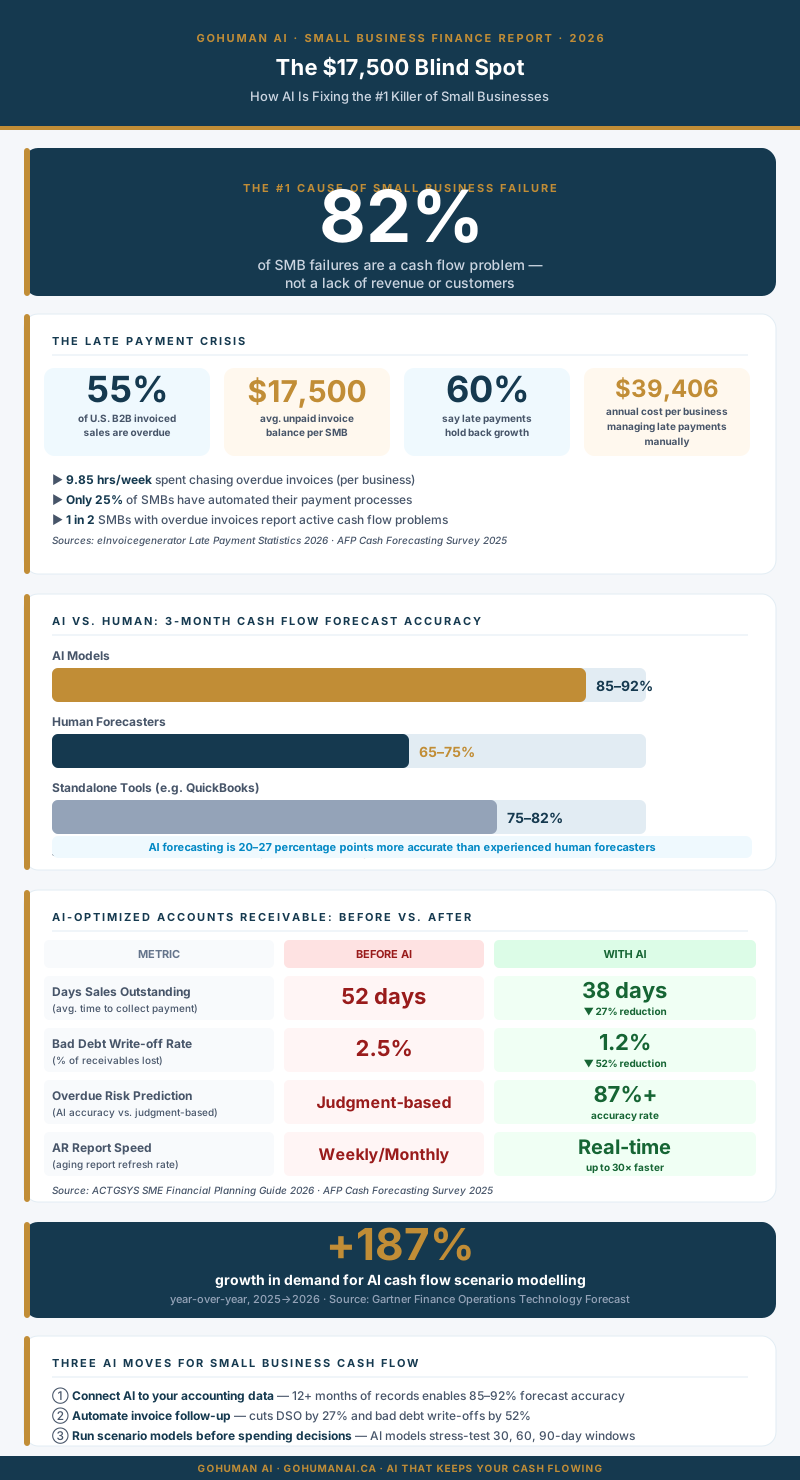
82% of small business failures come down to cash flow — not a bad product, not a weak market, not the wrong team. The money was there on paper. It just was not there in the bank at the right moment. AI cash flow forecasting now predicts payment timing with 85–92% accuracy, cuts the time it takes to collect by 27%, and reduces bad debt write-offs by more than half. Here is what the top 25% already doing this know.
Most conversations about AI and small business focus on the same territory: save time, cut costs, grow revenue. Those are real outcomes, and they matter. But there is a more urgent use case that rarely makes the headline — one that, for many small businesses, is the difference between survival and closure. It is not a productivity win. It is a life-support system. And the data behind it is hard to ignore.
According to a body of research now spanning thousands of businesses, 82% of small and medium-sized enterprise failures are directly linked to cash flow problems — not a bad product, not a shrinking market, not poor management in the traditional sense. The revenue was often there. The orders were often coming in. But the timing mismatch between money owed and money available killed the business before the picture could correct itself. AI cash flow forecasting is now changing that equation — not incrementally, but structurally.
The Late Payment Crisis Every Small Business Owner Knows
Late payments are not a new problem, but the scale of the crisis in 2026 has reached a point that makes the status quo indefensible for any business trying to grow. According to eInvoicegenerator's 2026 Late Payment Statistics report — which aggregated data across more than 52 studies — 55% of U.S. business-to-business invoiced sales are currently overdue. More than half of all the money owed to small businesses has not arrived when it was supposed to.
$17,500
Average Unpaid Balance
Outstanding invoices per U.S. small business
60%
Say It Holds Back Growth
Of SMBs reporting late payments as an active constraint
$39,406
Annual Cost Per Business
Managing late payments manually
The downstream effects are predictable and compounding. Businesses with overdue invoices are 1.4 times more likely to need emergency loans or credit lines — borrowing money at a cost to cover money that was already earned. Owners spend an average of 9.85 hours per week chasing overdue invoices. The 52% of small businesses that occasionally forfeit overdue payments rather than pursue collection are not being generous — they are calculating that the cost of collection exceeds the recovery value. That math gets worse every year without automation.
What makes this particularly frustrating is that most of the data needed to predict these problems already exists inside the business. Payment history, customer behavior patterns, invoice ages, seasonal cycles — it is all there. It is just not being analyzed in a way that creates foresight instead of hindsight. That is exactly the gap AI is now closing.
What AI Forecasting Actually Changes
The core value of AI cash flow forecasting is not the forecast itself — it is the lead time the forecast creates. When an experienced human forecaster looks at a 90-day cash flow picture, they achieve 65–75% accuracy on a 3-month horizon according to the AFP Cash Forecasting Survey. AI models running the same analysis consistently reach 85–92% accuracy, and some specialized platforms achieve higher still. That is not a minor improvement. It is a 20-point accuracy advantage that translates directly into fewer surprises, fewer emergency decisions, and fewer moments where a business owner is transferring personal savings into the operating account to make payroll.
The core insight:
AI cash flow forecasting does not eliminate cash flow problems — it converts surprises into decisions. A business that knows three weeks in advance that receivables will fall short has options. A business that discovers the gap on payday has no options.
The demand for this capability is growing rapidly. According to Gartner's Finance Operations Technology Forecast, demand for AI-powered cash flow scenario modelling grew 187% year-over-year between 2025 and 2026. This is businesses voting with their wallets for a tool that previously required a full-time financial analyst to approximate manually.
Three Specific Ways AI Addresses the Problem
The most effective small business applications of AI for cash flow fall into three distinct areas — each targeting a different part of the timing mismatch.
1. Predictive payment timing. AI analyzes your historical invoice data to identify which customers pay early, which pay late, and by how much. It then applies that pattern to your current receivables to forecast, at a customer level, when specific invoices are likely to actually arrive — not when they are due. This converts your accounts receivable aging report from a backward-looking document into a forward-looking cash position model. Independent testing shows AI models can predict which specific invoices will be paid late with up to 94% accuracy, enabling targeted follow-up before the due date rather than reactive collection after it.
2. Automated receivables follow-up. The most measurable impact of AI in accounts receivable is not in the analysis — it is in the action. Businesses that deploy AI-driven automated follow-up sequences for overdue invoices reduce their Days Sales Outstanding from 52 days to 38 days on average — a 27% reduction in the time it takes to collect. Bad debt write-offs drop from 2.5% of receivables to 1.2% — a 52% reduction. These are not projections; they are measured outcomes from businesses already running AI-optimized AR workflows. This is the same logic that drives AI agents for multi-step business workflows more broadly: automate the sequence, eliminate the manual lag, capture the result consistently.
3. Scenario modelling for spending decisions. The third application is the one most small business owners have never had access to before. Enterprise finance teams use scenario models constantly — running projections on what happens to the cash position if a key customer pays 30 days late, if a supplier payment must be advanced, if a new hire is added mid-quarter. AI makes this available without a CFO. You describe the scenario. The model runs the projection against your actual data. You make the decision with a clear picture of the downstream cash effect rather than a gut estimate.
The 75% Gap and What It Costs
Despite the availability of these tools, only 25% of small businesses have automated their payment processes in any meaningful way, according to the 2026 late payment research. The remaining 75% are still running manual or semi-manual receivables workflows — chasing invoices by email, updating aging reports weekly, and discovering cash shortfalls in the same week they need to cover them.
This gap has a direct cost. The average business manually managing late payments spends $39,406 per year on the administrative overhead of collection — staff time, software friction, write-offs, and the interest cost on emergency credit when timing mismatches hit. For a business doing $2M in annual revenue, that is roughly 2% of revenue going toward a problem that AI largely solves. This mirrors the pattern described in research on SMBs replacing legacy software with AI: the tools being replaced are often not just expensive — they are generating ongoing costs through the inefficiencies they leave unsolved.
The businesses closing this gap are not necessarily more sophisticated. They are simply connected. AI cash flow tools draw on data that already exists inside your accounting software, your invoicing system, and your customer history. The difference between the 25% and the 75% is not access to better data — it is having the AI layer that makes that data predictive. This connects directly to the 55-point productivity gap research: the businesses generating dramatically better outcomes from AI are the ones whose data and systems are connected, not siloed.
The Cash Flow AI Audit: 4 Questions to Ask This Week
- 1What is your current Days Sales Outstanding — and what would a 27% reduction mean for your monthly cash position?
- 2How many hours per week does someone on your team spend chasing overdue invoices — and is that a good use of their time?
- 3Do you have 12+ months of historical invoice and payment data sitting in your accounting software unused for forecasting?
- 4When you make a spending decision — a new hire, a supplier contract, a marketing campaign — do you have a 90-day cash model, or are you working from intuition?
The Structural Shift
Cash flow management used to be one of those areas where small businesses were simply at a structural disadvantage. Large companies had finance teams, ERP systems, and analysts who could model scenarios and identify risks weeks in advance. Small businesses had a spreadsheet and hope. That gap is closing fast — faster than most small business owners realize.
AI cash flow tools now give a 10-person business access to forecasting accuracy and receivables intelligence that would have cost $150,000 a year in senior finance talent five years ago. This is consistent with what the data shows more broadly: businesses using AI are generating 24% more revenue per employee not because they are working harder, but because they are operating with better information and fewer avoidable losses.
At GoHuman AI, cash flow visibility is one of the first AI workflows we configure for small business clients — because it is the one that prevents the emergencies that derail everything else. A business that can see its cash position clearly three months out makes better decisions about every other part of the operation: hiring, marketing, capital investment, and pricing. If your current forecasting process is a spreadsheet updated on Fridays, that gap is costing you more than you know.
Related Reading
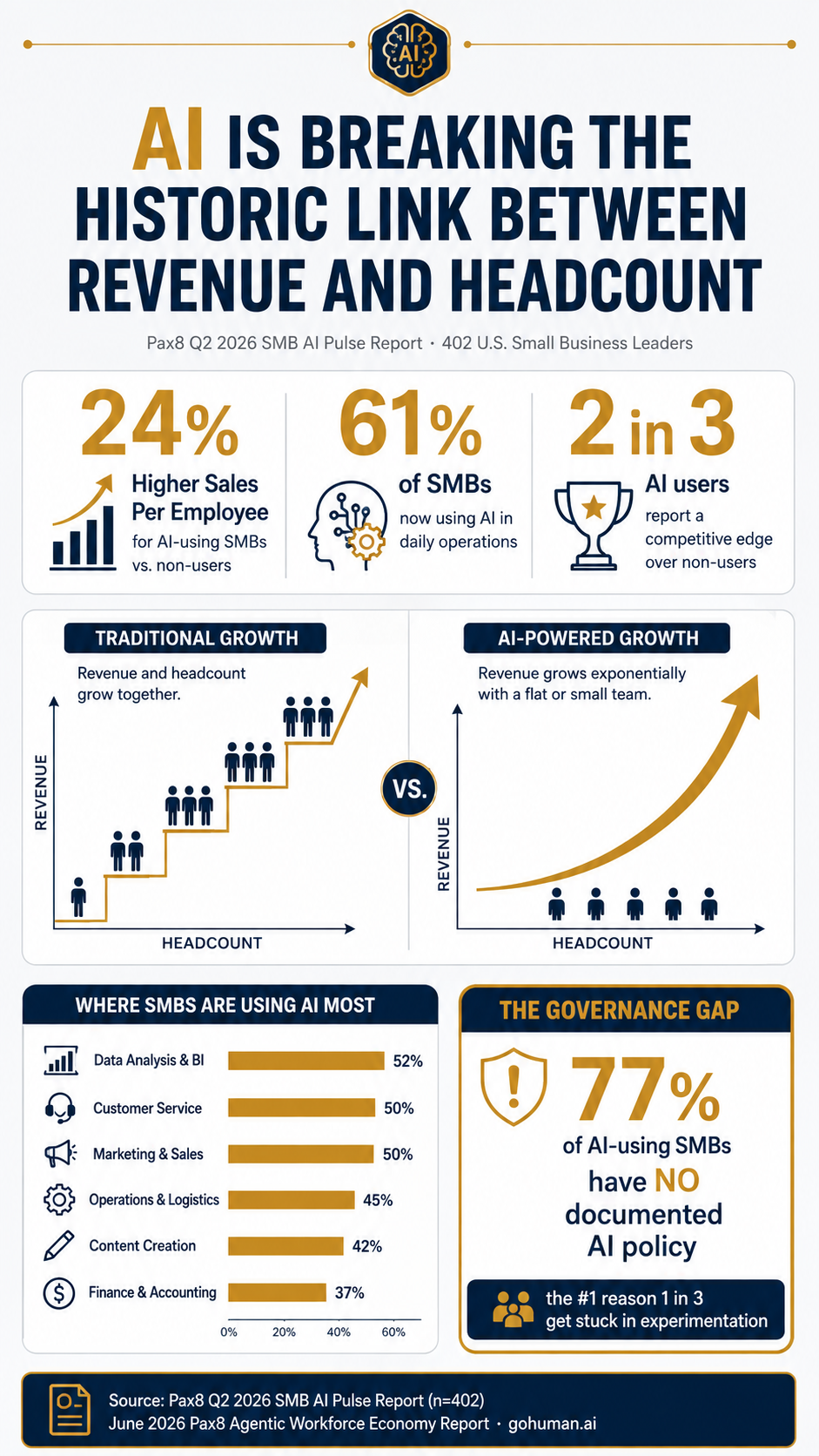
The End of Hire-to-Grow: New Data Shows AI-Using SMBs Generate 24% More Revenue Per Employee
How better AI-driven decisions — including financial ones — drive revenue without headcount.
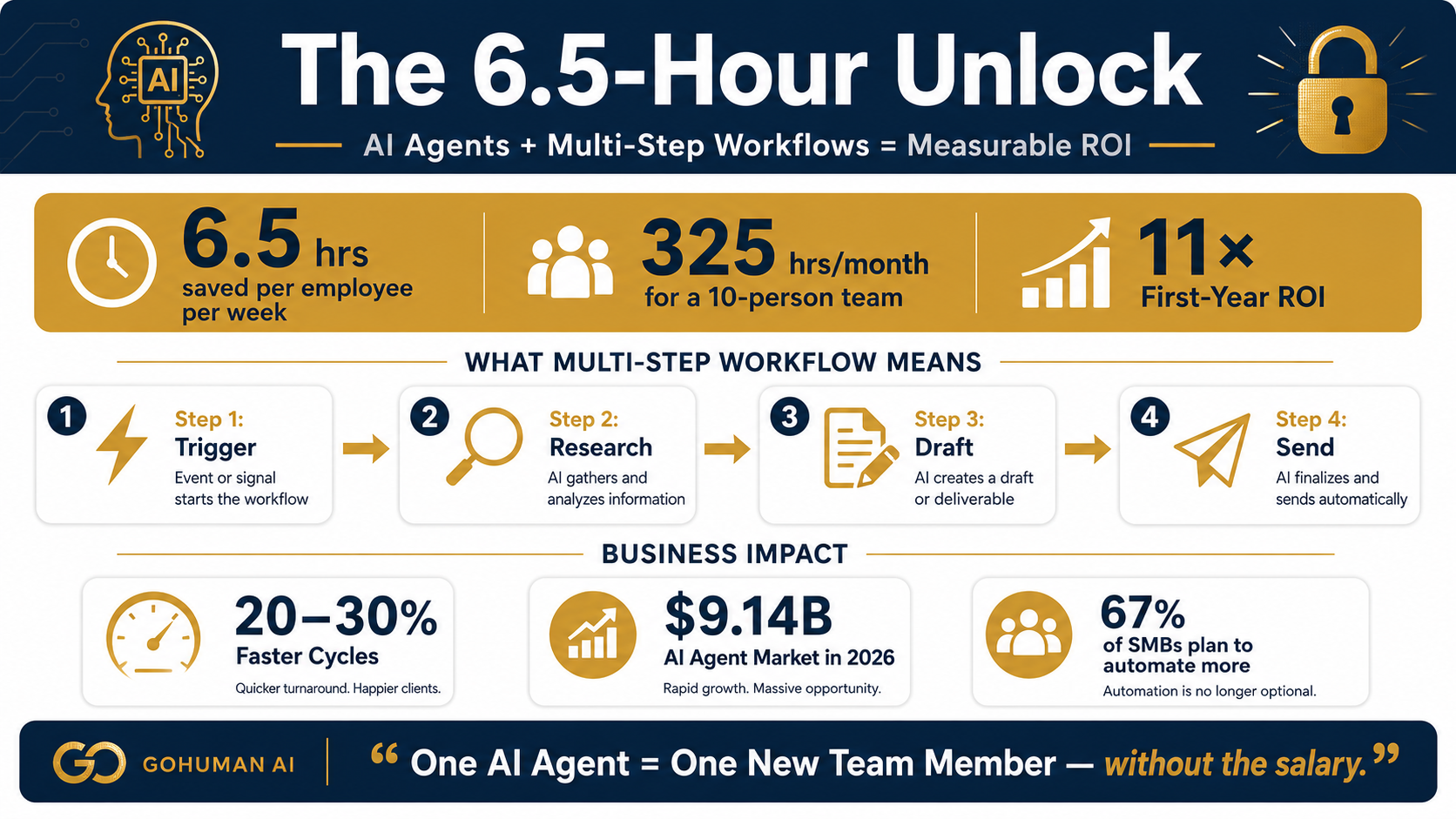
The 6.5-Hour Unlock: How Small Businesses Are Using AI Agents for Multi-Step Workflows
The same agent logic that automates receivables follow-up — applied across your whole operation.
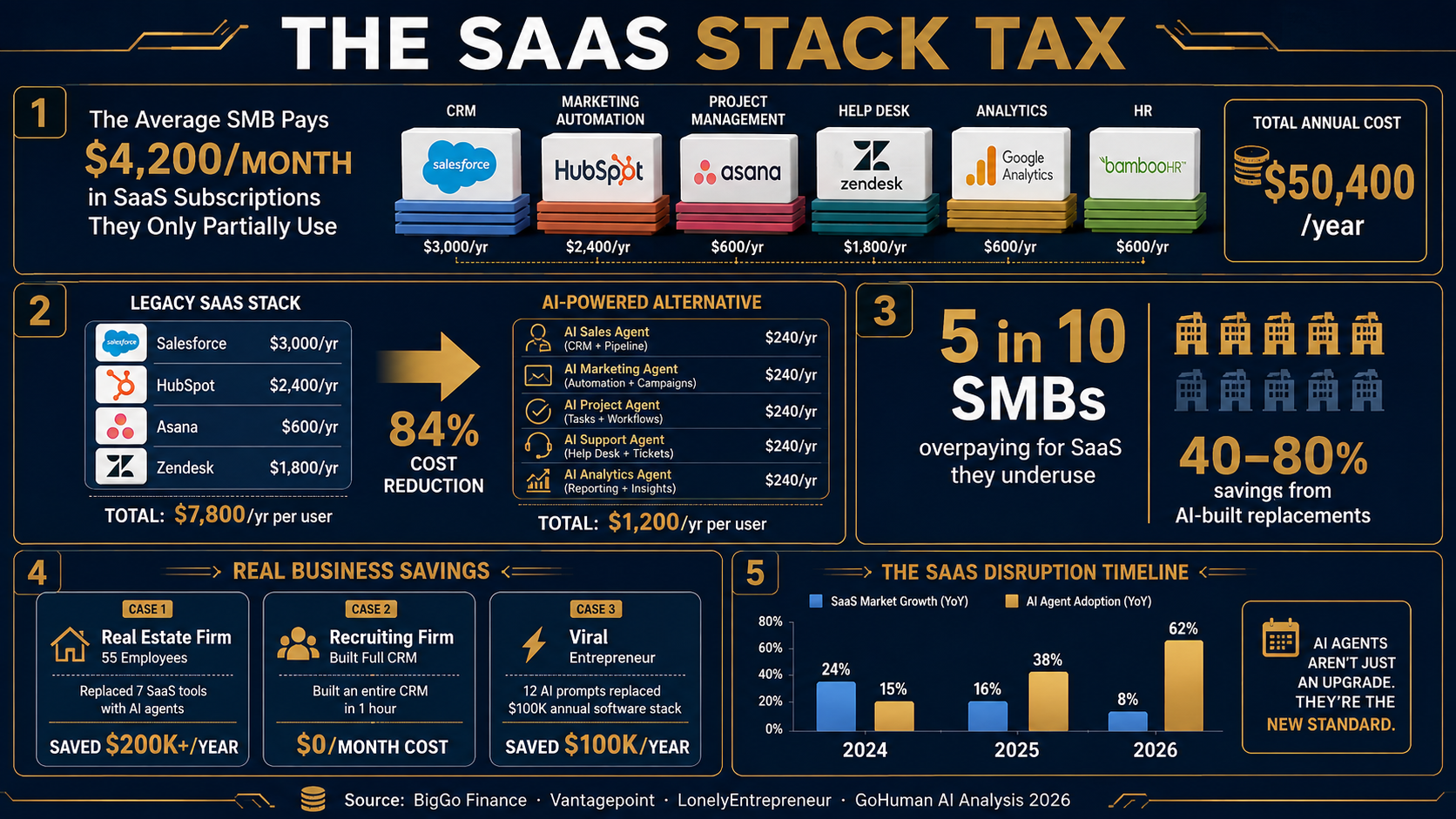
The SaaS Stack Tax: How Small Businesses Are Cutting $50,000–$200,000 by Replacing Legacy Software With AI
Including accounting and invoicing tools being replaced by AI-native alternatives.
Carrying $17,500 in outstanding invoices while your cash position sits uncertain? Let us show you how AI cash flow forecasting and automated receivables can change the picture — starting this month.