
The 55-Point Productivity Gap: Why Two Businesses With the Same AI Tools Get Completely Different Results
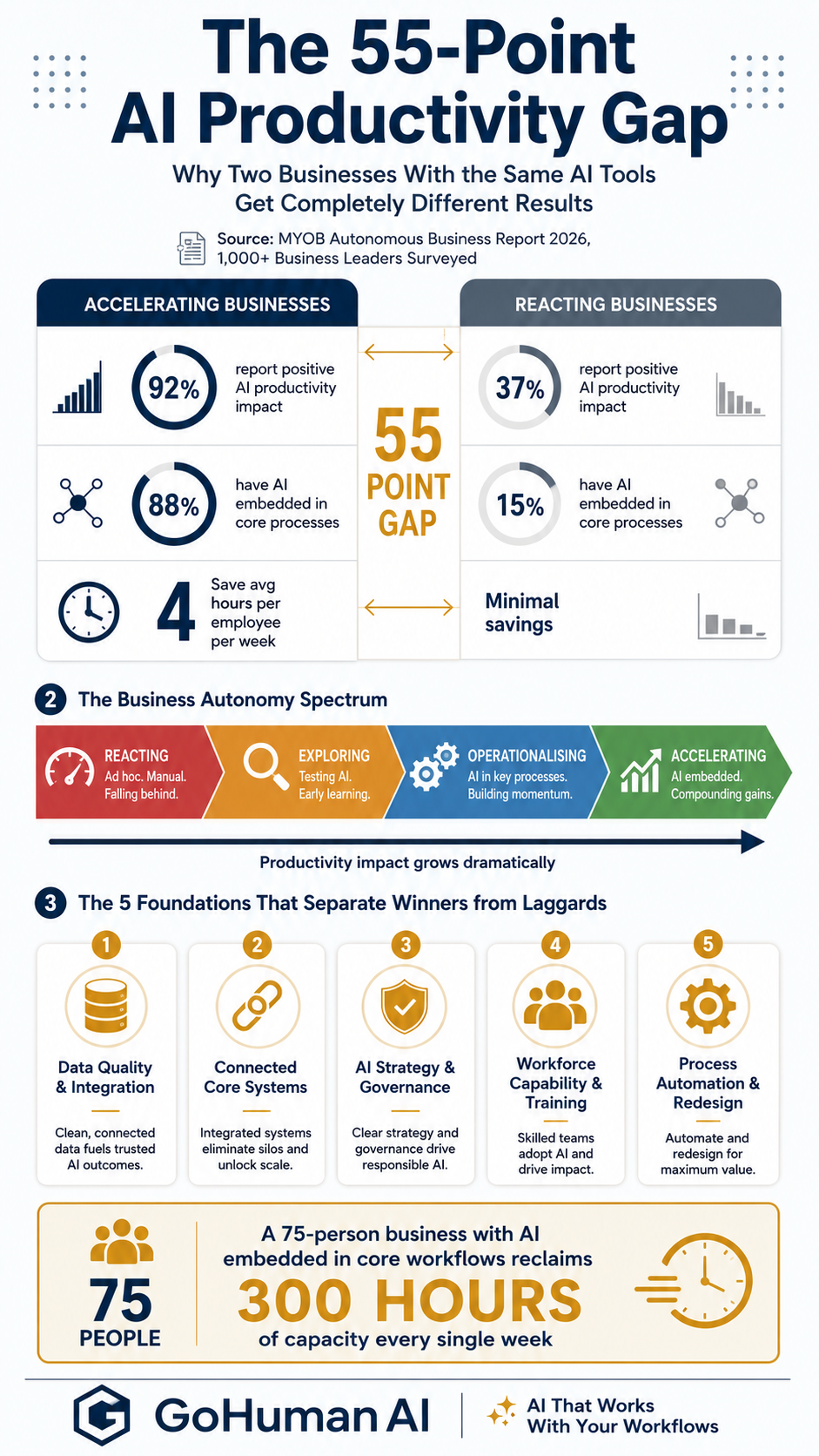
A new survey of 1,000+ business leaders reveals that 92% of the most AI-advanced businesses report a positive productivity impact — while only 37% of the least advanced say the same. Both groups have access to similar AI tools. The 55-point gap comes down to something else entirely: whether AI is woven into the fabric of how work actually happens, or just bolted on top of it.
Imagine two businesses in the same industry, in the same city, with the same headcount. Both invested in AI tools last year. Both have staff using those tools every day. Twelve months later, one is reporting dramatic gains in output quality, faster decisions, and measurable revenue growth. The other is struggling to point to any real improvement and quietly wondering whether the AI hype is overblown.
This is not a hypothetical. It is the central finding of MYOB Acumatica's Autonomous Business Report 2026, a survey of more than 1,000 mid-sized business leaders. The researchers found a 55-point gap in AI productivity outcomes between the most advanced businesses and the least advanced — and after digging into what separates them, they reached a conclusion that should reframe how every small business owner thinks about their AI investment: the gap is almost entirely explained not by which tools a business uses, but by how deeply AI is integrated into the systems and workflows where real work happens.
What the 55-Point Gap Actually Looks Like
The Autonomous Business Report 2026 classifies businesses into four cohorts based on their AI readiness and ambition: Reacting, Exploring, Operationalising, and Accelerating. The productivity numbers across these cohorts tell a stark story.
Among Accelerating businesses — those that have fully committed to embedding AI across their operations — 92% report a positive productivity impact. Among Reacting businesses — those still treating AI as an occasional add-on or low-priority experiment — that number drops to just 37%. Not a small difference in outcomes. A chasm.
The most telling comparison, however, is not the productivity headline. It is what drives it. Among Accelerating businesses, 88% report that AI is already embedded in their core processes — the actual daily workflows that drive revenue and serve customers. Among Reacting businesses, only 15% have reached that stage. The gap in integration directly explains the gap in results.
55pts
productivity gap between AI leaders and laggards — Autonomous Business Report 2026
88%
of top-tier businesses have AI embedded in core processes — vs 15% of the lowest tier
4 hrs
saved per employee per week at businesses with AI in core workflows — MYOB 2026
300 hrs
reclaimed every week for a 75-person business with integrated AI workflows
The Real Bottleneck Is Not the AI — It Is Your Data
Most small businesses that invest in AI tools do so with a sensible-sounding approach: find a problem, find a tool that solves it, subscribe, and hand it to the relevant team member. The trouble is that AI tools, unlike traditional software, need context to be useful. They need to understand your customers, your products, your history, and your workflows. And in most small businesses, that information is scattered across disconnected systems that do not talk to each other.
A customer service AI that cannot see the customer's order history produces generic answers. A marketing AI that cannot access your sales data cannot identify which customers to target. A scheduling AI that has no visibility into your team's actual workload creates conflicts instead of solving them. The tool is not the problem. The fragmentation is.
The Autonomous Business Report 2026 identifies five foundations that distinguish the businesses getting extraordinary AI outcomes from those still waiting for results to materialize. None of them is about choosing a better AI tool. All of them are about building the environment in which AI can actually do its job.
"The biggest gains did not come from chasing a shiny new tool. They came from routing work properly, fixing the system around the model, and tightening the data that AI could actually see."
— Pattern observed across the 2026 AI productivity research cycle
The 5 Foundations That Actually Drive AI Productivity
The report's framework is directly useful for small business owners trying to understand why their AI investments are or are not paying off. Businesses that invest across all five foundations consistently report stronger, more commercially significant AI outcomes than those addressing only one or two in isolation.
-
1
Data quality and integration. AI is only as good as the information it can access. If your customer data lives in one place, your sales history in another, your communication logs in a third, and your accounting in a fourth — and none of those systems talk to each other — every AI tool you deploy is working with partial information. The first foundation is ensuring that your core data is clean, consistent, and accessible across systems. This is where most AI implementations quietly fail before they start: not because the tools are wrong, but because the data feeding them is fragmented.
-
2
Connected core systems. The report highlights that 75% of business leaders plan to change or upgrade their core systems within two years — a direct signal that integrated infrastructure is now seen as the prerequisite for scaling AI effectively. For small businesses, this does not mean expensive enterprise software. It means ensuring that the tools you use daily — your CRM, your inbox, your scheduling system, your accounting — are connected well enough for information to flow between them without manual re-entry. Every time someone copies data from one system to another by hand, that is a point where AI could be doing something valuable instead.
-
3
Workflow redesign, not workflow addition. The businesses getting the worst results from AI are typically those that added AI as an extra step on top of existing workflows. The businesses getting the best results redesigned workflows around what AI actually makes possible. That is a fundamentally different mindset. Instead of asking "how can AI help us do this task faster?", winning businesses ask "if AI could handle this entirely, how would we redesign the whole process?" AI agents represent the next step in this direction — autonomous systems that handle entire multi-step workflows without human intervention at each stage.
-
4
Workforce capability and training. AI tools do not improve workflows automatically. They improve workflows when the people using them understand how to apply them well. The most advanced businesses in the survey invest deliberately in building AI literacy across their teams — not deep technical knowledge, but practical fluency with the specific tools that touch each person's daily work. This is often the most underestimated gap: a business can have excellent AI tools and well-connected data, and still see minimal productivity gains if team members default to their old manual approach because the AI version feels unfamiliar or uncertain.
-
5
AI governance and oversight. Counter-intuitively, the businesses getting the most from AI are also the ones most deliberate about where AI should not make autonomous decisions. They define clear boundaries, set up human review at the right moments, and maintain visibility over what AI is doing on their behalf. This governance layer is what allows them to deploy AI more broadly with confidence — because they have the guardrails in place to catch issues before they become problems.
What This Means for Small Businesses Right Now
The Autonomous Business Report 2026 focuses primarily on mid-sized companies, but its findings apply with equal force to small businesses — and in some ways with more urgency. A 75-person business with AI embedded in core workflows reclaims an average of 300 hours of capacity every single week. For a 5-person business, the proportional impact is even more significant: those reclaimed hours represent a meaningful fraction of total working time, redirected from repetitive manual work to the customer relationships, sales conversations, and strategic decisions that actually grow the business.
This connects directly to what the AI maturity research shows about businesses stuck at the earliest adoption stage: the problem is almost never a lack of AI tools. It is a lack of integration depth. Moving from Reacting to Accelerating does not require a bigger AI budget. It requires a different approach to how AI fits into the actual fabric of daily operations.
The practical starting point is simpler than most business owners expect. Map the five highest-friction handoffs in your business — the moments where information gets manually copied, retyped, or emailed between systems. Each of those points is a potential integration that could eliminate manual work while giving AI tools better data to act on. Start there, prove the value, and expand from that foundation. This sequential approach — fix the plumbing before adding more tools — is consistently what separates the businesses generating more revenue without adding headcount from those that are adding tools without adding results.
The diagnostic question worth asking this week:
"Name one piece of customer or operational information that currently lives in more than one place, and has to be manually moved between them." Every business has at least three. Each one is both a friction cost today and a direct constraint on what your AI tools can do for you tomorrow.
The 55-point productivity gap is not a technology gap. It is a systems and workflow gap — and that is actually good news for small businesses. It means the advantage available to you is not locked behind an enterprise software budget. It is locked behind a decision: to treat AI not as a collection of individual tools, but as an integrated layer that runs through how your entire business operates. The businesses that make that decision in 2026 are building a compounding advantage that will be difficult to close in 2027 and beyond.
At GoHuman AI, this integration-first approach is exactly how we work with small business owners — connecting AI across the workflows that matter most, not just adding point tools and hoping for results. If you want to understand where the real productivity gaps are in your specific business and what connected AI looks like in practice, the call below is the right starting point.
Related Reading
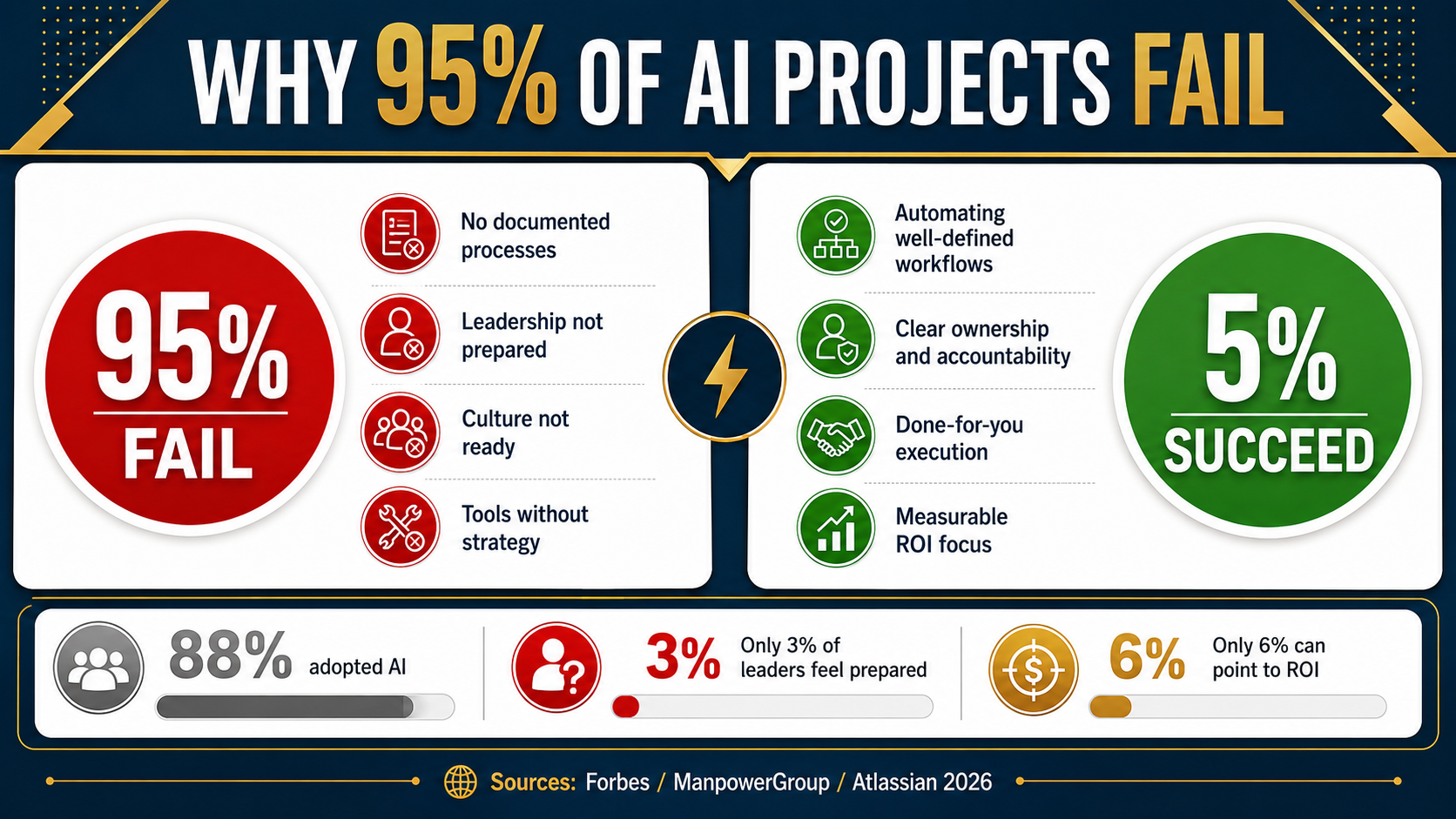
Why 95% of AI Projects Fail — And What the Successful 5% Do Differently
Integration depth is the pattern behind every AI implementation that actually delivers results.
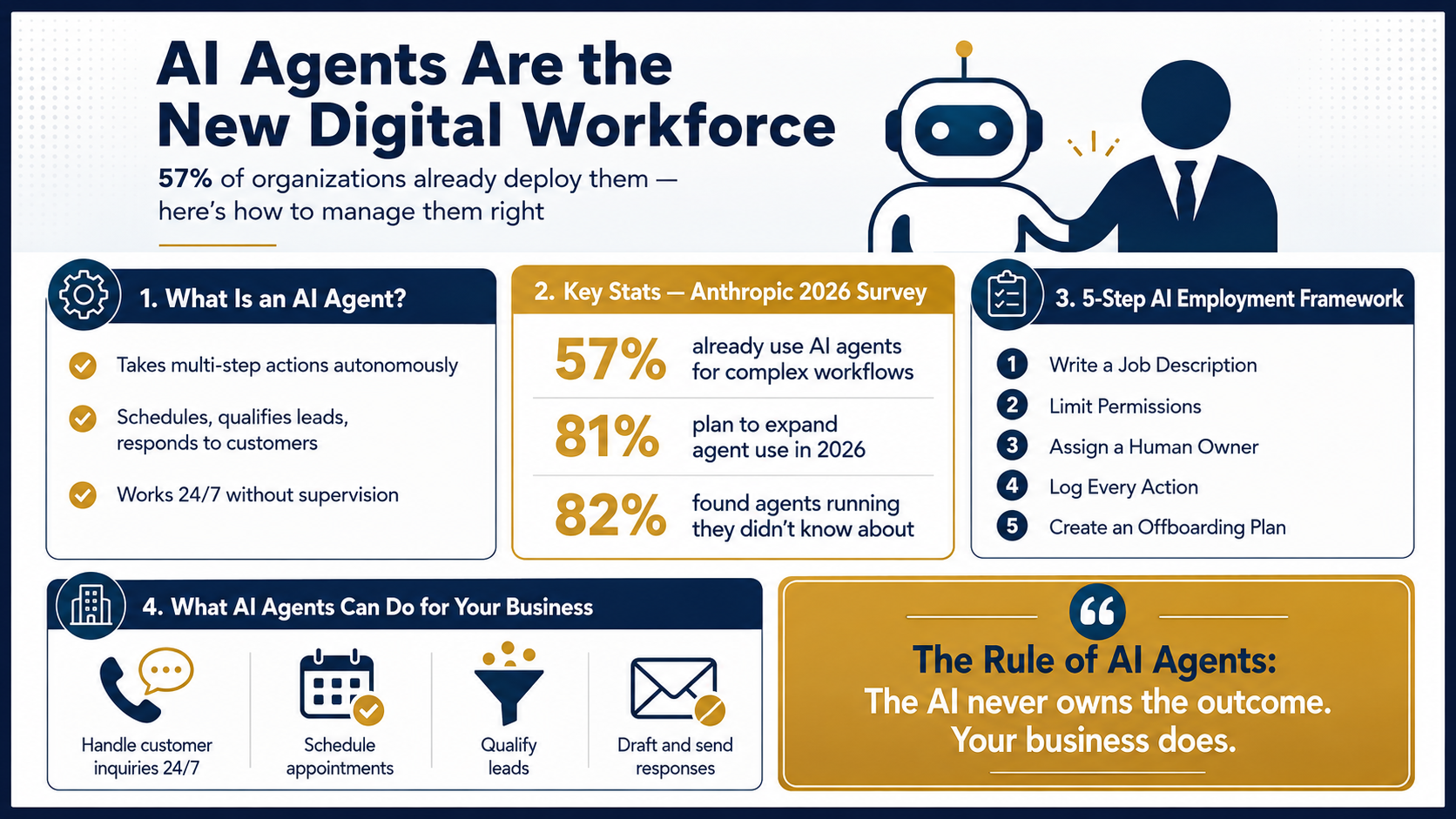
Your First AI Employee: What Small Business Owners Need to Know About AI Agents
AI agents are the next step once your workflows and data are connected — they can act autonomously across systems.
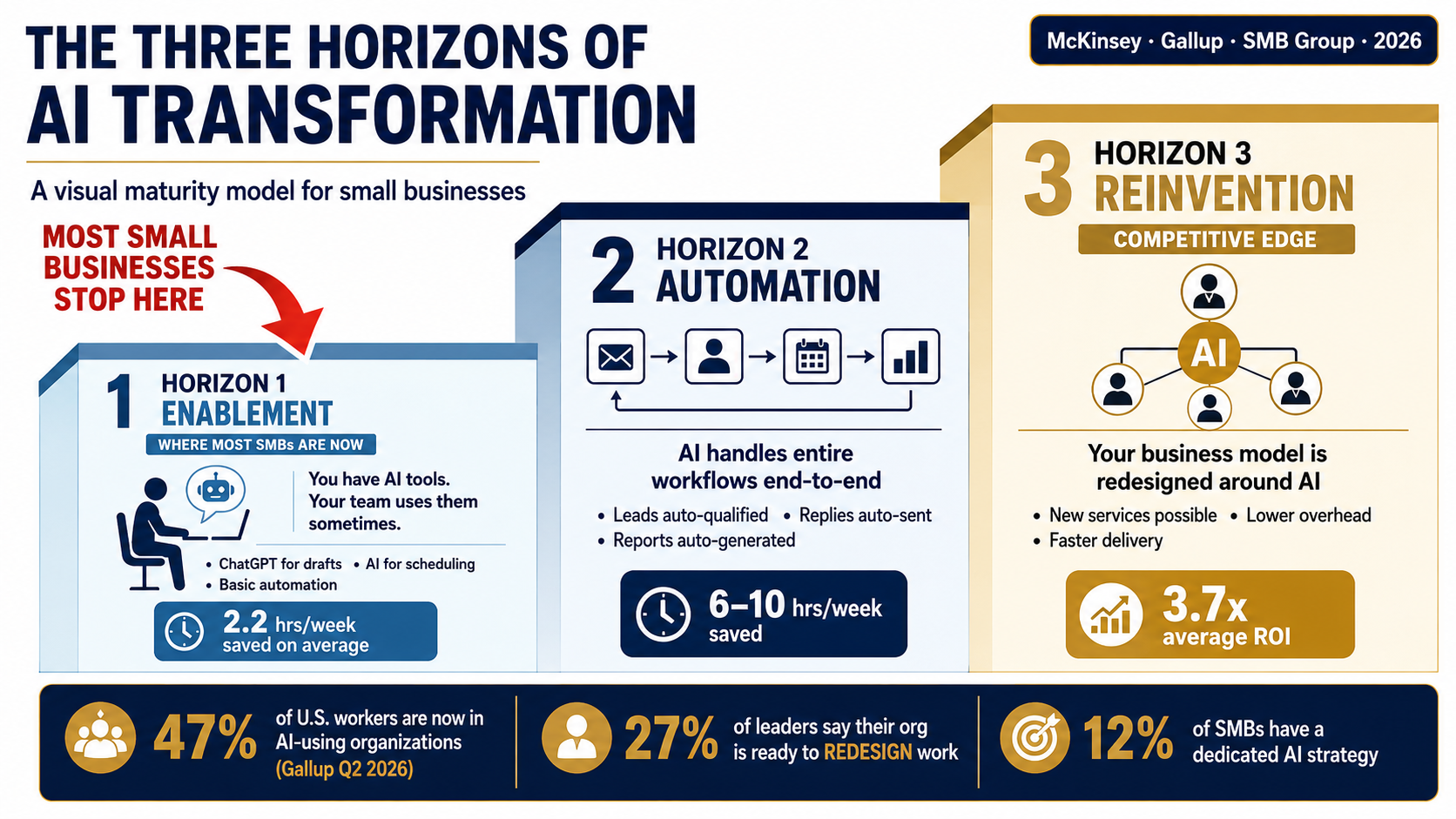
The AI Maturity Gap: Why Most Small Businesses Are Stuck at Horizon 1
McKinsey's horizon model maps the same journey — from basic usage to genuine workflow transformation.
Want to identify exactly where the workflow and data gaps are in your business — and what connected AI would look like in practice?