
Why 95% of AI Projects Fail — And What the Successful 5% Do Differently
New research shows that despite $30–40 billion invested in AI, only 5% of projects produce a measurable return. The problem is not the technology. Here is what small businesses keep getting wrong — and the clear pattern behind every implementation that actually works.
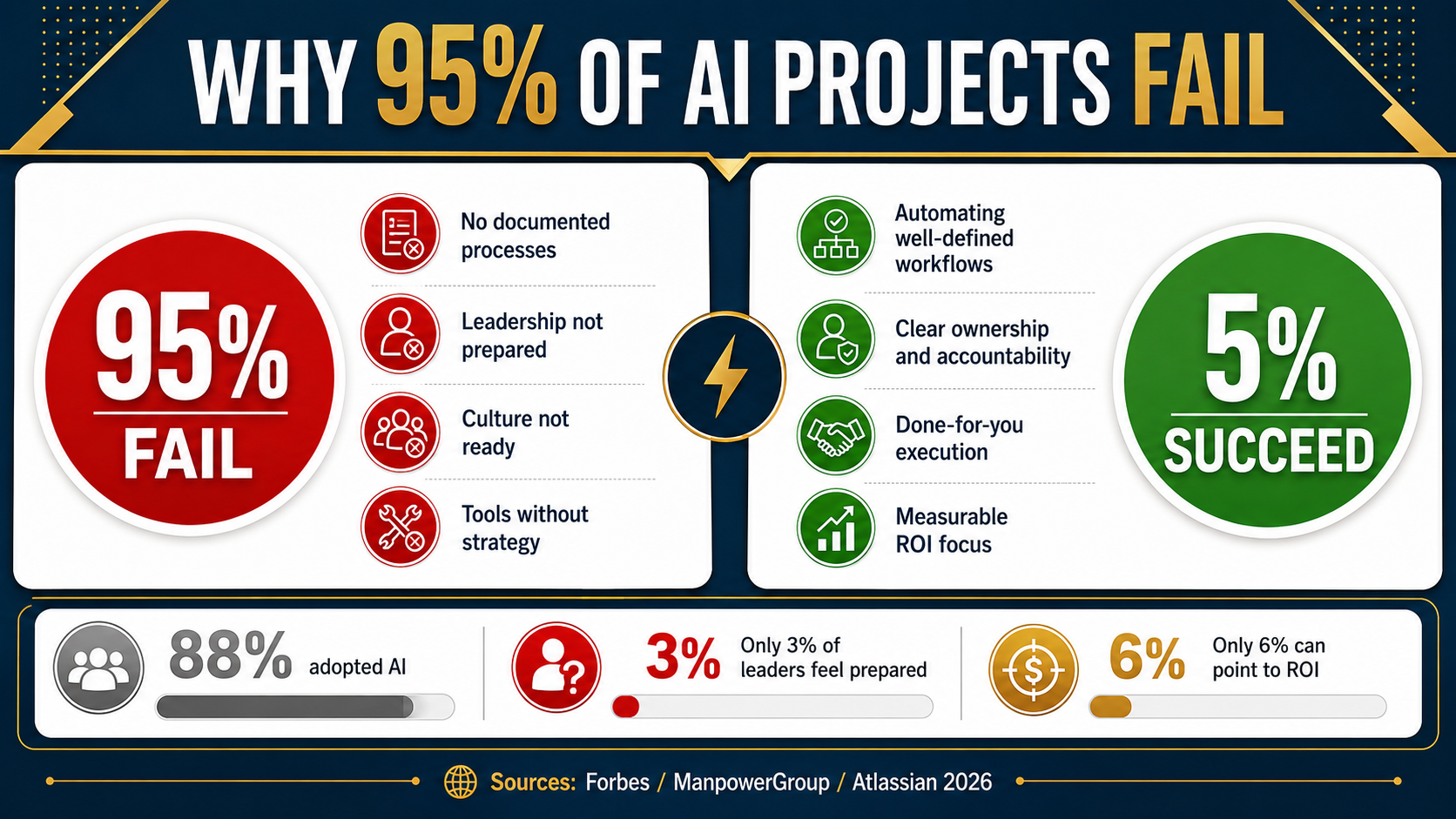
A striking new finding landed on July 28th, 2026. A Forbes analysis drawing on research from ManpowerGroup Talent Solutions, the Everest Group, and McKinsey reached a conclusion that is equal parts alarming and clarifying: despite $30–40 billion invested in generative AI, only 5% of AI projects produce a measurable return on investment. The other 95% are, in the words of the researchers, "invisible from a profit perspective."
For small and medium-sized businesses evaluating whether and how to adopt AI, this is exactly the kind of number that deserves a closer look — because understanding why the 95% fail is the clearest possible guide to joining the 5% that succeed.
The AI Productivity Paradox Is Real
The Forbes data is consistent with what practitioners have been observing in real organizations. Atlassian's State of Teams 2026 report found that 89% of executives say AI has increased the speed of work — but only 6% feel confident they can point to specific, organization-wide ROI. The Silicon Valley Product Group, one of the most respected voices in product strategy, named this the AI Productivity Paradox: adoption is accelerating, investment is growing, but sustained impact on performance remains elusive.
Speed without direction is just noise. And for small businesses — where every dollar and every hour of attention counts — noise is expensive.
95%
of AI projects produce no measurable ROI
3%
of leaders feel prepared to lead an AI-enabled team
70%
of AI transformations fail due to culture, not technology
It Is Not a Technology Problem
The ManpowerGroup study, developed by the Everest Group and drawn from 80 C-suite and senior talent leaders, found that only 3% of current leaders feel fully prepared to lead an AI-enabled team. McKinsey's 2025 State of AI Survey found an even starker number: only 1% of organizations have achieved full maturity in their AI strategy.
The research is unambiguous on the root cause: 70% of AI transformations fail because of organizational culture — not the tools themselves. Businesses buy software, subscribe to platforms, and run workshops — then wonder why nothing changed. The gap is not in the AI. It is in the readiness of the organization receiving it.
"AI amplifies operational maturity. It does not create it."
— Forbes / ManpowerGroup Research, July 2026
The Founder Dependency Trap
For small businesses specifically, the research points to a problem with a name: "founder dependency." In most small businesses, the critical decisions, processes, and workflows live inside the founder's head — undocumented, undelegated, and invisible to any system trying to automate them. AI cannot automate a process it cannot see.
This is why the researchers are consistent on one practical recommendation: document your existing processes before adopting AI. Not after. Not in parallel. Before. Because AI will amplify what is already there — and if what is already there is chaotic, the chaos just moves faster.
What the Successful 5% Actually Do
The pattern among businesses that do achieve ROI from AI is consistent and repeatable. The successful 5% share three characteristics:
- 1. They automate repetitive, well-documented processes first. Not creative work. Not strategic judgment. The things that happen the same way every time — customer follow-up, appointment reminders, lead qualification responses — are where AI delivers fast, measurable results.
- 2. They measure a specific outcome, not just activity. Not "we're using AI more." But: response time dropped by 40%, follow-up rate increased, cost per lead decreased. If you cannot measure the before, you cannot prove the after.
- 3. They keep a human in the loop for anything judgment-dependent. The most effective AI implementations in 2026 are hybrid: AI handles the volume, humans handle the exceptions. This is not a compromise — it is the optimal design.
The Done-for-You Shortcut
Here is the practical implication of all this research for a business owner who does not have the time or the internal resources to become an AI strategist: the fastest path to the successful 5% is working with a partner who has already solved the process documentation, tool selection, and execution problem for you.
This is the core design principle behind how GoHuman AI approaches every client engagement. Rather than handing over a set of tools and expecting the business to figure out how to deploy them, GoHuman AI builds and runs the systems — applying AI to well-defined, high-ROI workflows like lead follow-up, customer communication, content production, and sales outreach.
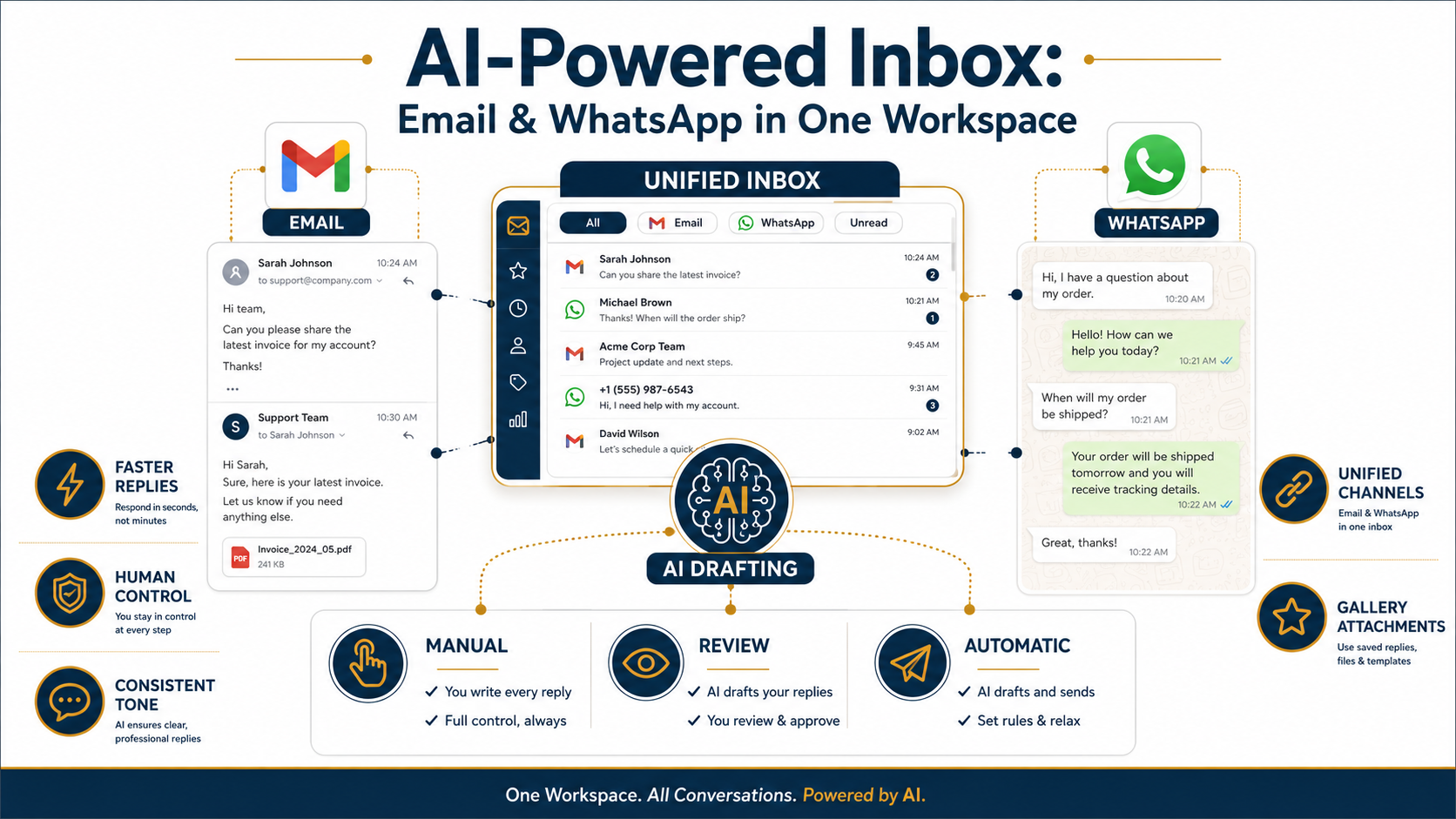
A practical example is the kind of AI-powered inbox automation we covered recently — where email and WhatsApp conversations are brought into one AI-assisted workspace, with configurable response modes that keep a human in the loop wherever judgment is needed. It works not because it is clever technology, but because it applies AI to a repetitive, well-defined process — exactly what the research says the successful 5% do.
What to Do Right Now
If you are a small business owner evaluating your AI strategy — or wondering why the AI tools you have already invested in are not delivering — the research points to three immediate actions:
- ✓ Map your repetitive processes. Write down the five things your team does the same way every week. These are your AI targets.
- ✓ Pick one and measure it. Baseline it now — response time, cost, volume — so you can prove the impact of automation.
- ✓ Decide on your execution model. Build and manage it internally, or work with a partner who runs it for you. The research suggests that for most small businesses, the latter is significantly more likely to reach measurable ROI.
The headline number — 95% failure — is not a reason to avoid AI. It is a roadmap. The businesses that succeed are not smarter or better resourced than the ones that fail. They are simply more deliberate about where they start, what they measure, and how they execute.
Want to talk about where AI can deliver real ROI in your business?