
The AI Maturity Gap: Why Most Small Businesses Are Stuck at Horizon 1
Gallup just recorded the sharpest quarterly jump in AI adoption ever. McKinsey's new research explains why that headline hides a problem — and why the businesses seeing real ROI aren't the ones using AI most, but the ones using it differently.
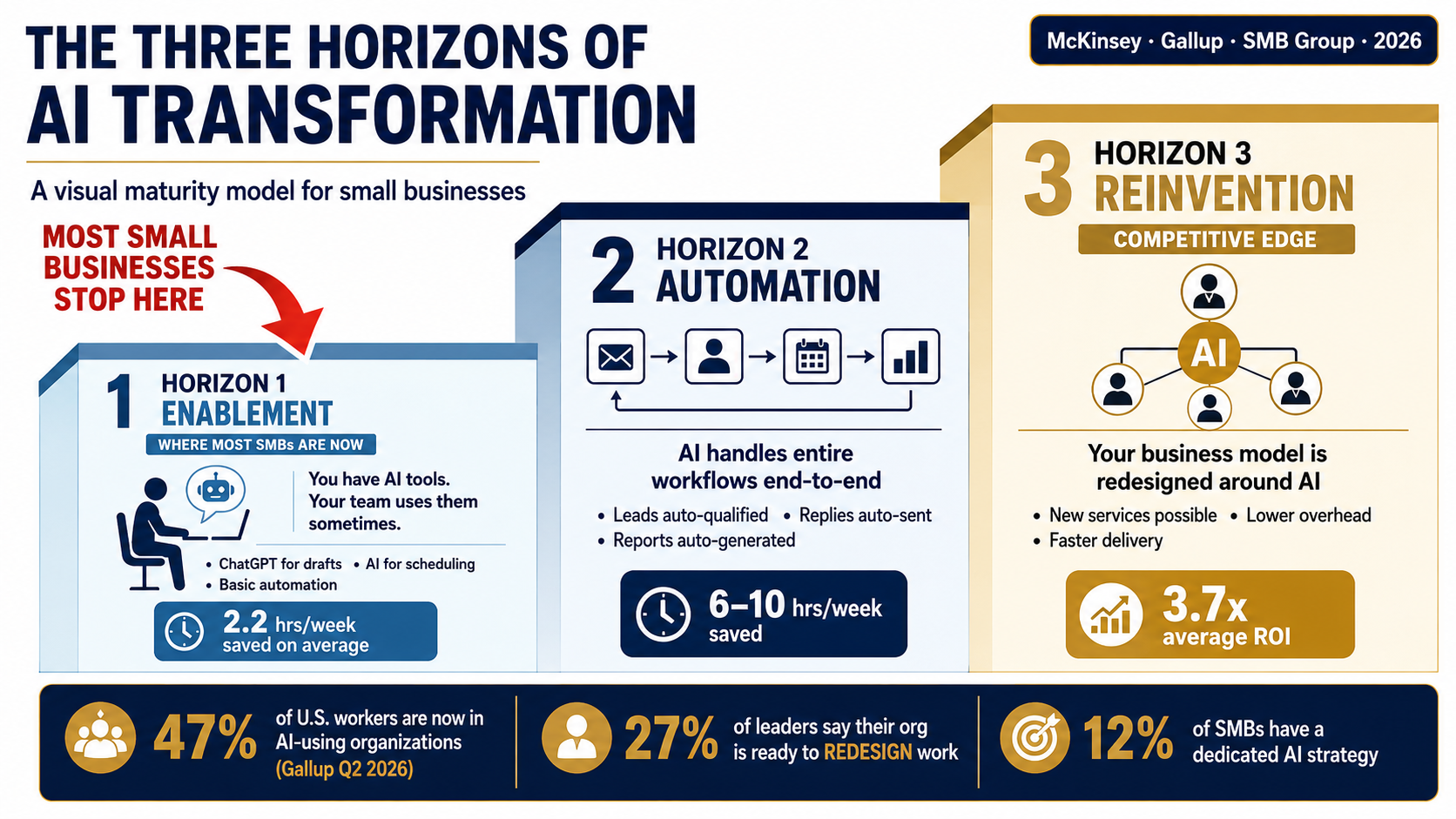
Gallup's Q2 2026 data landed with a headline that spread fast: 47% of U.S. employees are now in organizations that have integrated AI tools — the steepest quarterly increase Gallup has ever recorded. On the surface, it reads like a transformation is underway. Then McKinsey published its own research on the same day, and it told a quieter, less flattering story.
The McKinsey report, From Adoption to Impact: Three Horizons of AI Transformation, surveyed 750 employees and leaders across industries between February and April 2026. Its finding: 70% of workers feel ready to use AI. Only 27% of leaders believe their organization is ready for the changes to how work is actually organized — the changes that turn AI usage into AI value. In other words, nearly everyone has the tools. Almost no one has redesigned the work around them.
For small business owners, that gap is not just a corporate problem. It is exactly why so many businesses spend money on AI subscriptions every month and still feel like nothing has fundamentally changed.
The Three Horizons: A Map of Where AI Value Actually Lives
McKinsey's framework maps AI maturity across three distinct stages. Understanding where your business sits — and what it takes to move up — is the most useful thing you can do with this research.
Horizon 1 — Enablement
Where most SMBs are right now
Employees receive general-purpose AI tools to help with existing tasks. Someone uses ChatGPT to draft emails faster. Another person uses an AI scheduler. A third uses a chatbot for customer questions. The tools are there. The work is the same. Average time saved: about 2.2 hours per week.
Horizon 2 — Automation
Where the hours start adding up
AI improves entire workflows across the business — not one task at a time, but end-to-end. A new lead comes in, gets qualified automatically, receives a follow-up, and lands in your CRM with notes — without anyone touching it. Research shows businesses at this level typically save 6 to 10 hours per week per team member.
Horizon 3 — Reinvention
Where the competitive edge lives
Roles, workflows, and the operating model are fundamentally redesigned around AI. The business can take on more clients, deliver faster, or offer new services — with the same headcount. Small businesses achieving this report an average 3.7× return on AI investment.
47%
of U.S. employees now in AI-using organizations — Gallup's steepest quarterly jump ever (Q2 2026)
27%
of leaders believe their org is ready to redesign work around AI — the step that unlocks value
12%
of SMBs have a dedicated AI strategy — the rest are experimenting without a plan
Why Horizon 1 Feels Productive but Delivers So Little
The trap at Horizon 1 is that it genuinely feels like progress. Your team is using AI. Meetings involve AI. You are saving 30 minutes here, 45 minutes there. But the underlying business workflows have not changed. AI is a layer on top of the old process — not a replacement for it. You are still running the same race; you just have slightly better shoes.
This explains a paradox that has puzzled researchers all year: 89% of small businesses report using AI in some capacity, while the vast majority see no measurable bottom-line impact. The adoption numbers are real. The ROI is not — because adoption at Horizon 1 was never going to produce it.
"Adoption is the easy horizon — where tools get handed out and a counter climbs. The return arrives only once the underlying work is redesigned, which almost no one has done."
— Analysis of McKinsey's Three Horizons research, July 2026
What Moving to Horizon 2 Actually Looks Like
Horizon 2 is not about adopting more tools — it is about redesigning one workflow at a time so that AI handles the whole sequence, not just isolated steps within it. Here is what that looks like for three common small business scenarios:
-
Service business (plumber, HVAC, cleaner): A new inquiry arrives via web form. AI qualifies the lead against your service area and calendar, sends a quote within minutes, books the appointment, and adds a reminder sequence — without anyone on your team touching it until the job date. Time from inquiry to booked job: minutes instead of a day.
-
Retail or e-commerce: A customer asks about a product. An AI-powered inbox handles the reply, checks stock, and suggests alternatives if needed — with your tone, your policies, your product knowledge. Escalation to a human only when the query goes outside normal parameters.
-
Professional services (accountant, consultant, recruiter): Monthly reports are drafted automatically from your data. Client check-in emails go out on schedule without anyone writing them. New project intake is handled end-to-end before a human reviews the scope.
Notice the pattern: in every case, AI is not helping someone do a task — it is handling an entire handoff chain that previously required multiple people or manual steps. That is the difference between Horizon 1 and Horizon 2. And it is why AI agents are the natural next step for businesses that have laid the groundwork.
The Three Moves That Get You to Horizon 2
McKinsey's research identifies a consistent pattern among businesses that actually reach Horizon 2: they are not the ones buying the most tools. They are the ones doing three specific things differently.
-
1
Audit one workflow end-to-end before adding AI. Map every step a task goes through — from trigger to completion. Only then does it become clear where AI can take over a handoff, not just assist within a single step.
-
2
Measure a specific outcome, not general usage. "We use AI for customer replies" is Horizon 1 thinking. "AI-handled inquiries: average response time dropped from 18 hours to 4 minutes; lead-to-booking rate up 22%" is Horizon 2 thinking. You cannot improve what you do not measure.
-
3
Assign one human owner to each automated workflow. Horizon 2 automation works because a person is accountable for the outcome — reviewing logs, catching edge cases, and deciding when a workflow needs to expand or change. Without a named owner, automated systems drift.
The good news: the cost barrier that once made this level of automation enterprise-only has essentially disappeared. Horizon 2 is within reach of any small business with a clear workflow, a measurable goal, and someone accountable for the result. The constraint is no longer budget — it is strategy.
What This Means for Your Business This Quarter
The McKinsey research does not argue that every small business needs to reach Horizon 3 this year. It argues that the gap between Horizon 1 and Horizon 2 is where most of the practical value lives, and that gap is surprisingly small to close — once you stop treating AI as a layer on top of old work and start treating it as a reason to redesign one workflow at a time.
The question worth asking yourself this week is not "Are we using AI?" Nearly 90% of businesses already are. The useful question is: "Which of our workflows has AI taken fully off our plate — and can we measure the difference?" If the answer is none, you are at Horizon 1. And the research is clear on what that means for your ROI.
At GoHuman AI, the work we do with every client starts with that audit: mapping the workflows that eat the most time, identifying where AI can own an entire handoff chain rather than assist within a step, and then building and managing the automation with human oversight at the points that matter. The goal is always the same — getting you from Horizon 1 to Horizon 2 with a specific, measurable outcome attached.
The one question that separates Horizon 1 from Horizon 2:
"Is AI completing a workflow for us — or just helping someone complete it faster?" If the answer is the latter, you haven't redesigned the work yet. You've just given it better tools.
Related Reading
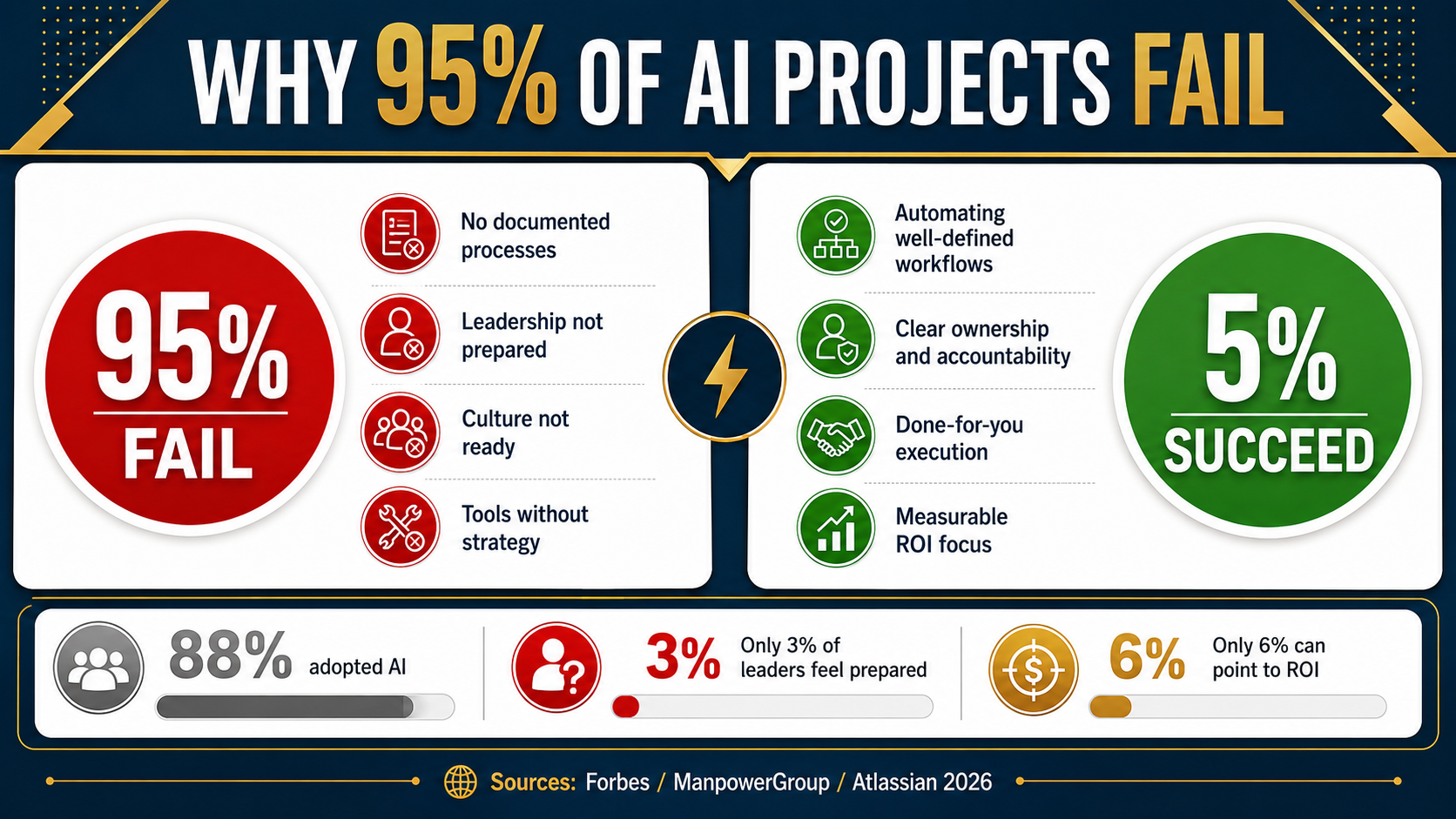
Why 95% of AI Projects Fail — And What the Successful 5% Do Differently
Most AI spending produces no ROI. This post explains the pattern behind every implementation that actually works.
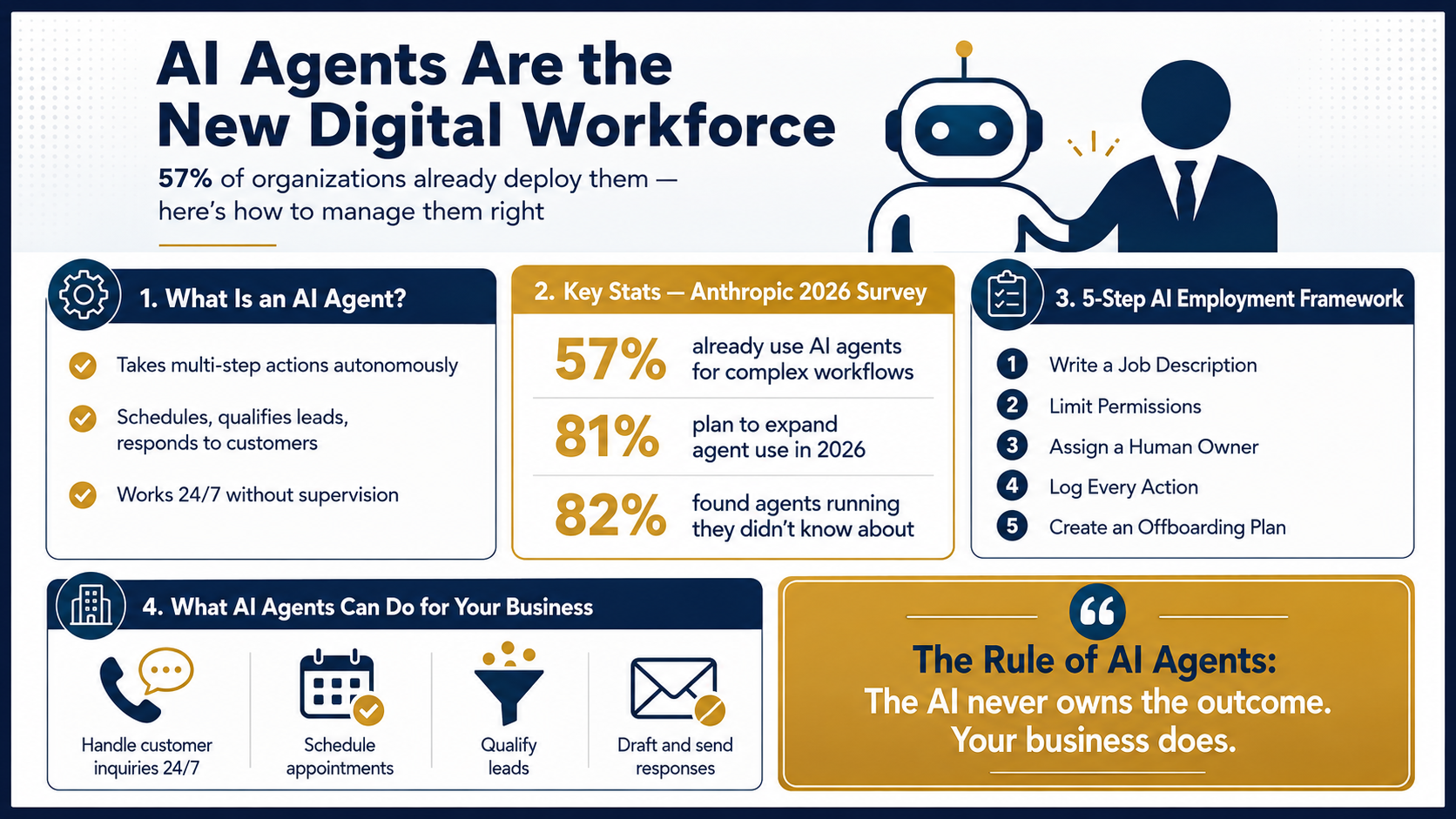
Your First AI Employee: What Small Business Owners Need to Know About AI Agents
Once your workflows are ready, AI agents are the natural next step — here is the framework for deploying them safely.
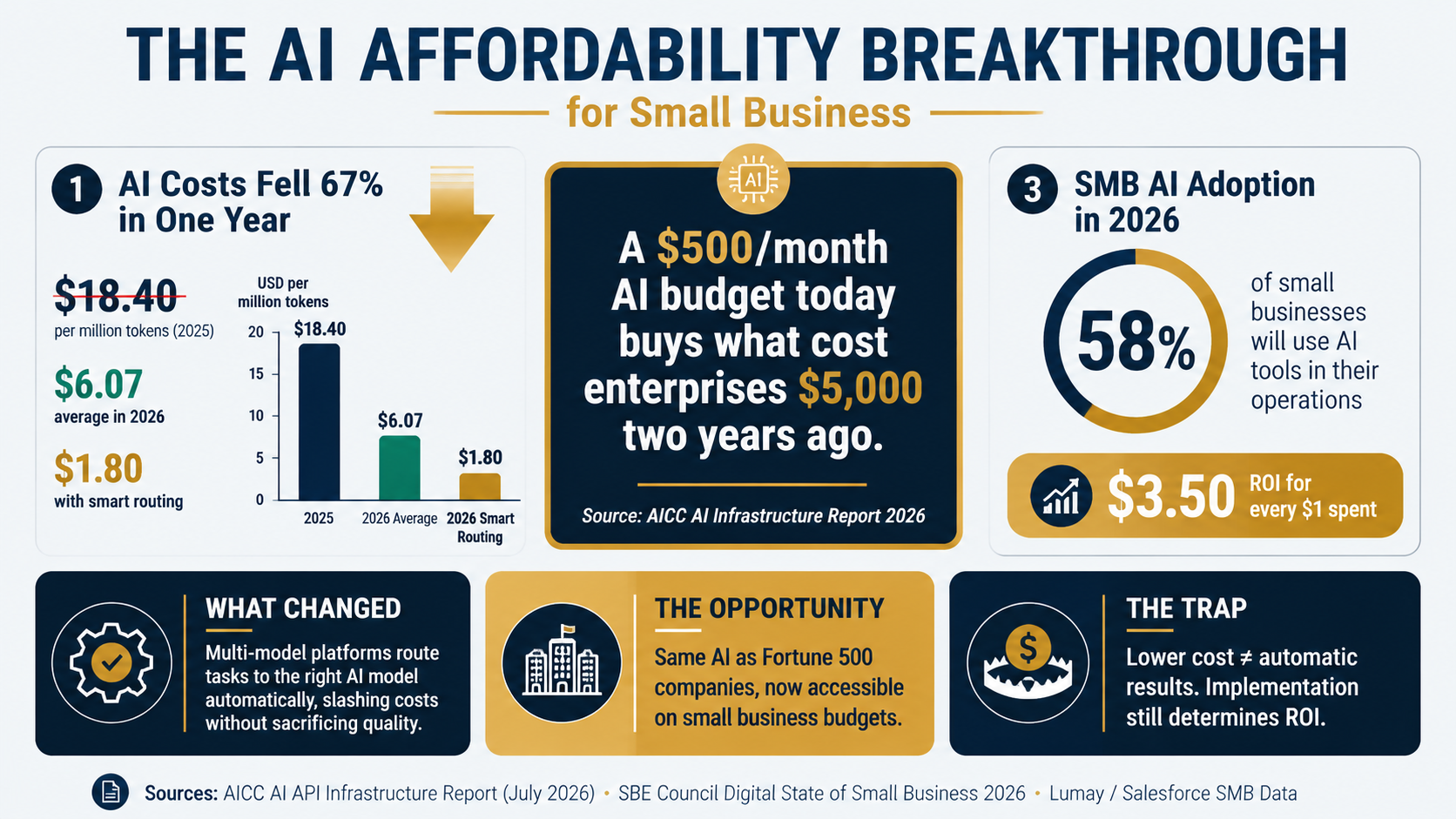
The Great AI Equalizer: Enterprise-Grade AI Is Now Affordable for Small Business
The cost barrier is gone — Horizon 2 automation is within any small business budget.
Ready to move your business from Horizon 1 to Horizon 2?