
The Great AI Equalizer: Enterprise-Grade AI Is Now Affordable for Small Business
A new industry report shows AI costs dropped 67% in a single year. The models Fortune 500 companies paid $5,000 a month to access are now available for $500. The price barrier that kept small businesses on the sidelines is gone — here is what that means, and how to take advantage of it.
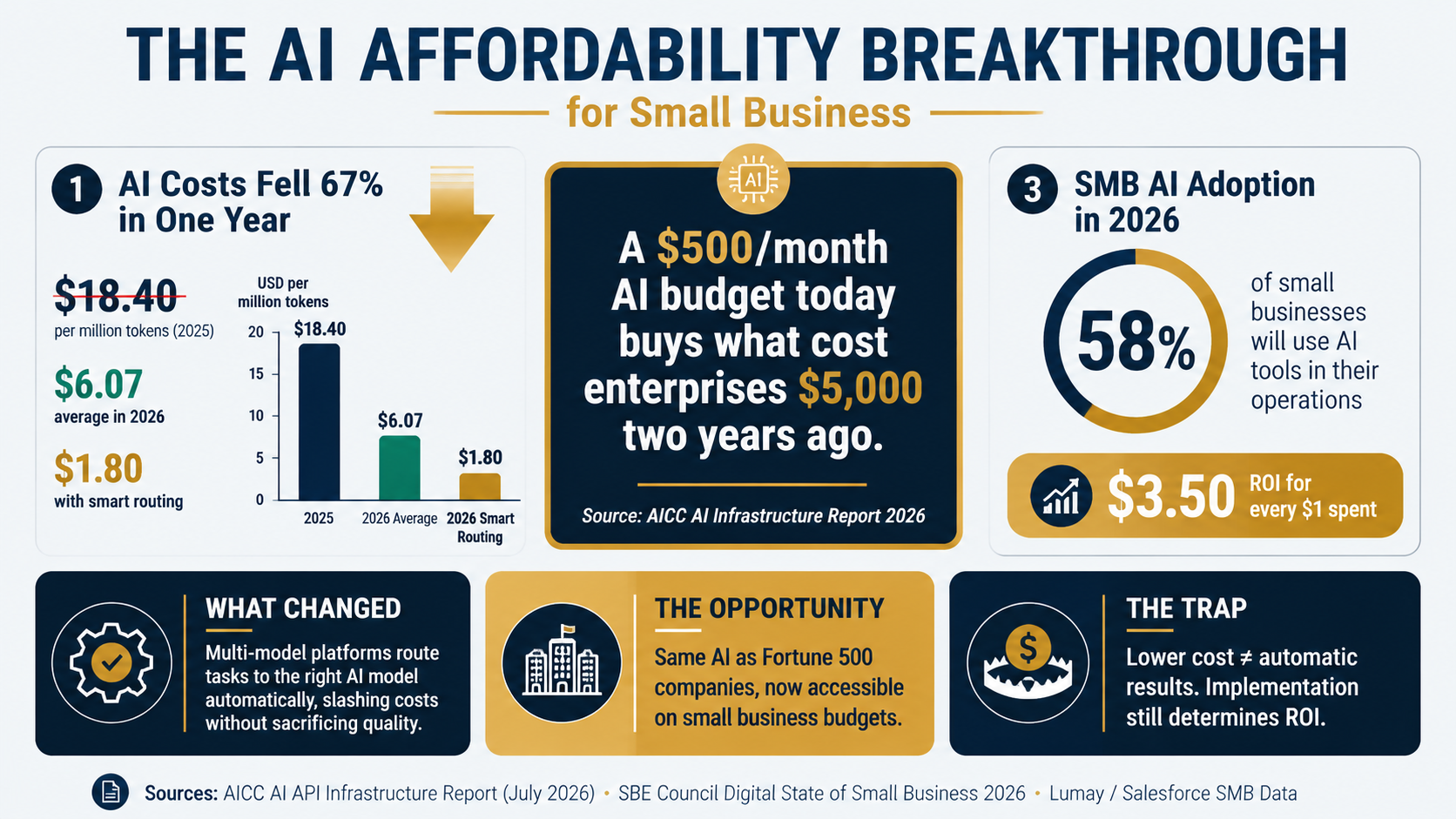
For years, the most powerful AI tools carried a price tag that put them firmly out of reach for most small and medium-sized businesses. The large language models driving Fortune 500 boardroom conversations, the same systems processing millions of customer interactions for global brands, cost thousands of dollars a month to run at any meaningful scale. For a business owner managing a lean team and a tight budget, that was a non-starter.
That calculus changed dramatically in 2026. A new report from AICC, a unified AI API platform processing more than 90 million daily requests, analyzed 2.4 billion API calls and reached a conclusion that should get every small business owner's attention: enterprise AI token costs fell 67% year-over-year. The blended cost per million tokens dropped from $18.40 to $6.07. On multi-model routing platforms — systems that automatically send each task to the most cost-efficient AI model capable of handling it — the effective rate fell as low as $1.80 per million tokens.
In plain English: "A startup with a $500 monthly AI budget can now run the same models that cost enterprises $5,000 monthly just two years ago," according to the AICC research team. "The economics of AI have shifted from a barrier to an equalizer."
The Numbers Behind the Shift
The AICC report is the clearest data point yet on a structural change that has been building for the past 18 months. What drove the collapse in costs? Three things happening simultaneously:
- 1. Model competition intensified. The number of capable AI models available via API grew from a handful to hundreds. When dozens of models can handle the same task competently, pricing cannot stay where it was.
- 2. Multi-model platforms emerged. Rather than locking into a single provider, unified API platforms now route each request to the best model for that specific task — automatically trading off quality, speed, and cost based on what the task actually requires. A simple classification task does not need to run on the most expensive frontier model; it can run on a cheaper specialist model and deliver the same result for a fraction of the price.
- 3. Inference hardware got cheaper and faster. The underlying compute cost of running AI has been falling steadily, and those savings are now passing through to end users.
67%
drop in enterprise AI token costs, year-over-year
58%
of small businesses now actively using AI tools (2026)
$3.50
average ROI returned for every $1 invested in AI automation
Small Business Adoption Is Accelerating — With Results
The affordability shift is already showing up in adoption data. The SBE Council's Digital State of Small Business 2026 survey — drawing on the same U.S. Chamber of Commerce and Salesforce SMB dataset benchmarks — found that small business AI adoption reached 58% in 2026, with an average return of $3.50 for every $1 invested in AI automation. Business owners are using AI to conduct research, improve customer service, strengthen marketing, analyze data, and — increasingly — automate the repetitive operational work that used to consume hours every week.
Karen Kerrigan, President and CEO of the Small Business & Entrepreneurship Council, described AI as potentially "one of the greatest equalizers in the history of small business" — dramatically lowering the cost and complexity associated with starting and scaling a business that can compete with firms many times its size.
"AI has the potential to become one of the greatest equalizers in the history of small business. It is dramatically lowering the cost — and decreasing the complexity — associated with starting and scaling a business."
— Karen Kerrigan, President & CEO, Small Business & Entrepreneurship Council (July 2026)
The Opportunity Is Real — But So Is the Trap
Here is where the story gets nuanced — and where the framing of "AI is now affordable" can lead business owners into a familiar mistake. Cheaper access to powerful AI is genuinely good news. But access is not the same as results.
This is the pattern we have covered in detail before: the overwhelming majority of AI projects — 95% by some estimates — still fail to produce measurable ROI, not because the tools are poor, but because the implementation is. A business that could not afford frontier AI last year can now afford it — but if they drop it into an undocumented workflow with no clear measurement baseline, they will just join the 95% at a lower price point.
The businesses capturing that $3.50 ROI return are not just buying subscriptions. They are applying AI to specific, well-defined, repetitive processes — and measuring the outcome before and after. The tool cost is now a minor variable. The strategy is still everything.
Where the Returns Are Coming From
Based on both the SBE Council data and what we see in practice with the businesses we work with, the clearest ROI from affordable AI in 2026 is concentrating in a few specific areas:
- ✓ Customer communication and response. AI-assisted inbox tools that handle email and WhatsApp in one unified workspace — like the AI-powered inbox approach we covered recently — are delivering real-time speed improvements without adding headcount. When every slow reply costs you a lead or a renewal, faster response times have a direct revenue value that is easy to measure.
- ✓ Lead qualification and follow-up. AI agents that monitor inbound leads, send follow-up messages, and route qualified prospects to a human salesperson — eliminating the 48-hour gap between initial inquiry and first contact that kills conversion rates in most small businesses.
- ✓ Content and marketing production. Blog articles, social posts, email newsletters, and ad copy that previously took hours of a founder's time now take minutes — with AI drafting and a human editor refining. The cost-per-piece of content has dropped dramatically.
- ✓ Operational and administrative tasks. Scheduling, data entry, report generation, and internal summaries — the unglamorous backbone of every business — are ideal AI targets. No creativity required; just consistency and speed.
How to Move from Access to Actual Results
The price drop means the barrier to starting is now genuinely low. Here is a practical framework for turning that access into results, rather than letting affordable AI become the latest underused subscription:
- 1. Start with one process, not the whole business. Pick the single most repetitive, high-volume task your team handles every week. Customer follow-up. Appointment reminders. Quote responses. One well-chosen target, implemented well, will produce results you can prove — and that proof is what builds internal confidence to expand.
- 2. Baseline before you automate. How long does the process take today? What is your current response time, cost per task, or error rate? You cannot demonstrate ROI without a before number. This takes 10 minutes and is worth more than any tool configuration.
- 3. Keep a human in the loop for judgment calls. The multi-model routing that made AI affordable also made AI smarter — but it still makes mistakes, misreads context, and produces outputs that need a human eye on anything customer-facing. Design your workflow so AI handles the volume and a human checks the exceptions. That hybrid model is consistently where the best results land.
- 4. Measure after 30 days and decide. If the baseline improved — response time, cost, throughput — expand. If not, adjust the process first before assuming the tool is wrong. The tool is cheap now. The limiting factor is almost always the process it is attached to.
The Window Is Open — But It Will Not Stay Wide Forever
At 58% adoption, nearly four in ten small businesses are still not meaningfully using AI. For now, that means real competitive differentiation is available to those who move deliberately. But adoption curves in technology tend to accelerate: the businesses currently in the 58% are getting faster, more responsive, and more efficient every month. The gap between AI-enabled and AI-free businesses is widening.
The price of access is no longer the obstacle. The time to move is now — and the path that works is the same one the successful 5% have always taken: clear process, specific measurement, and a human-in-the-loop design that keeps quality where customers see it.
GoHuman AI helps small and medium-sized businesses close the gap between affordable AI access and actual measurable ROI. Rather than leaving you to configure tools and figure out implementation alone, we build and run the systems — applying AI to the specific workflows where it will move your numbers. If you want to find out where that is in your business, the conversation starts with a free strategy call.
Related Reading
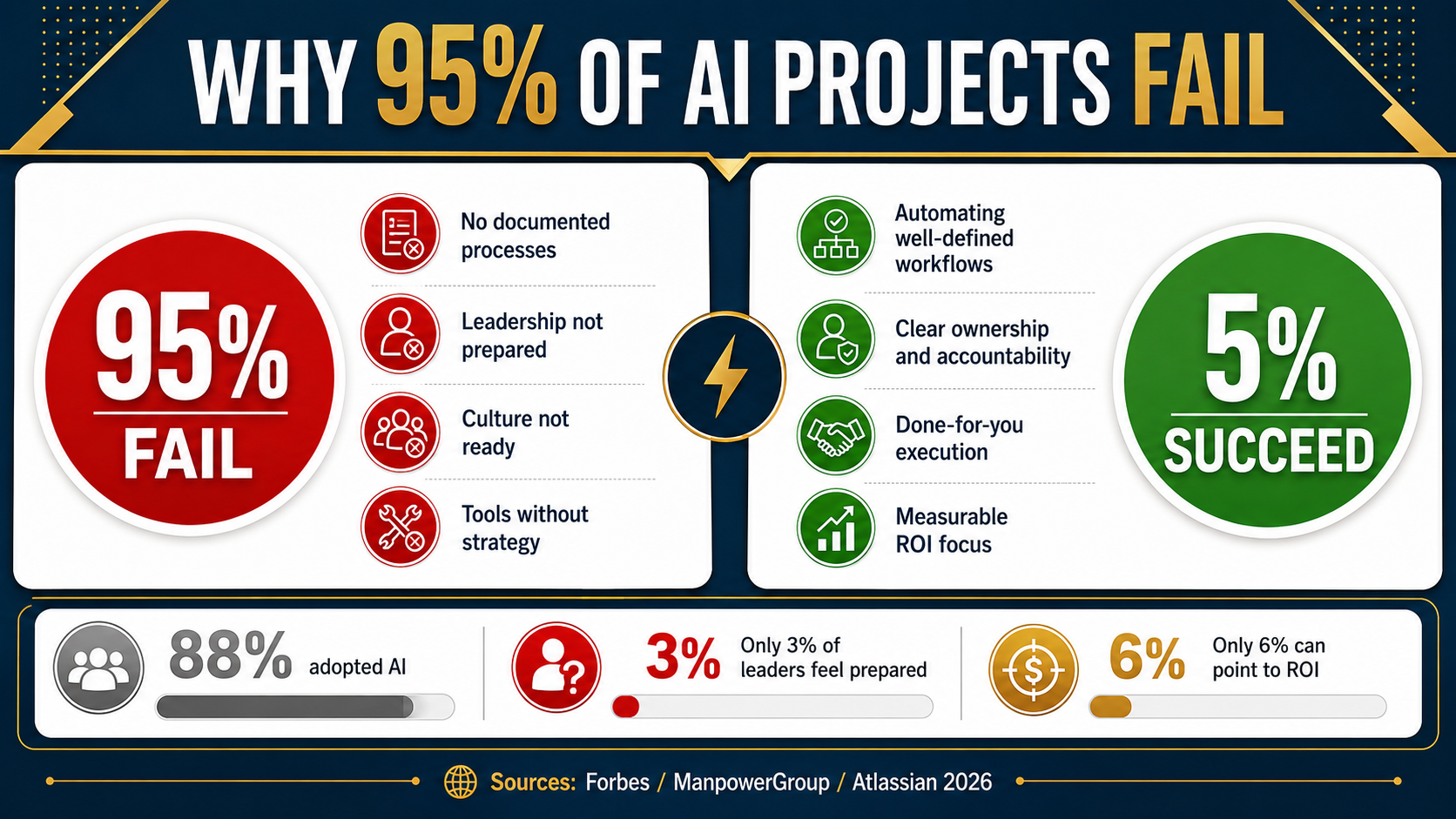
Why 95% of AI Projects Fail — And What the Successful 5% Do Differently
Lower costs do not fix poor implementation. Here is what the successful 5% do that the rest do not.
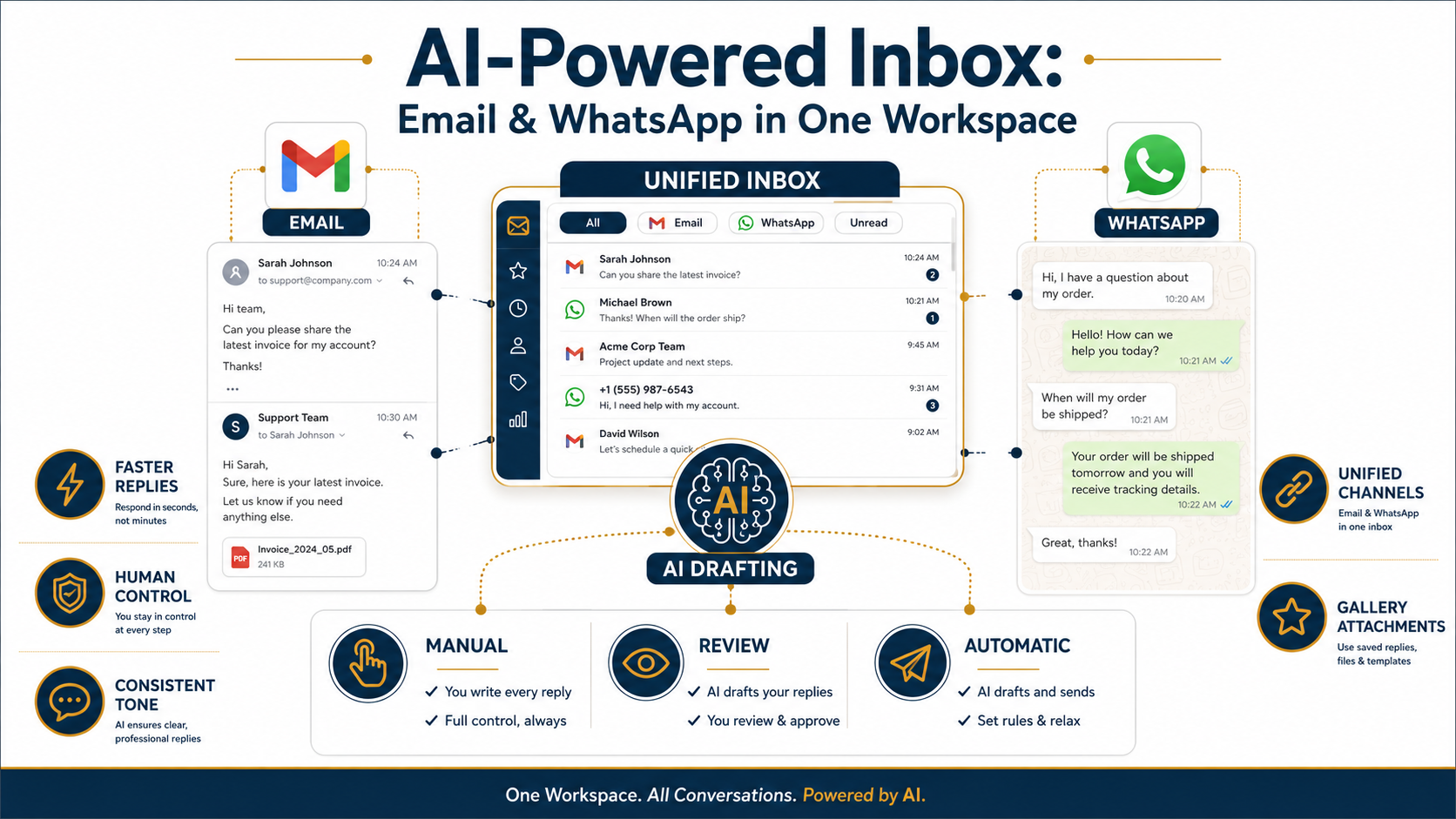
From Scattered to Streamlined: How AI-Powered Inbox Is Changing Business Communication
A practical example of affordable AI applied to a high-ROI business process — customer response time.
Ready to find out where AI can deliver real ROI in your business?