
Your First AI Employee: What Small Business Owners Need to Know About AI Agents
A new Anthropic survey shows 57% of organizations already deploy AI agents for complex workflows — scheduling, lead qualification, customer replies — and 81% plan to add more in 2026. But 82% of enterprises have discovered AI agents running inside their business they did not know existed. Here is the practical framework every small business needs before deploying their first one.
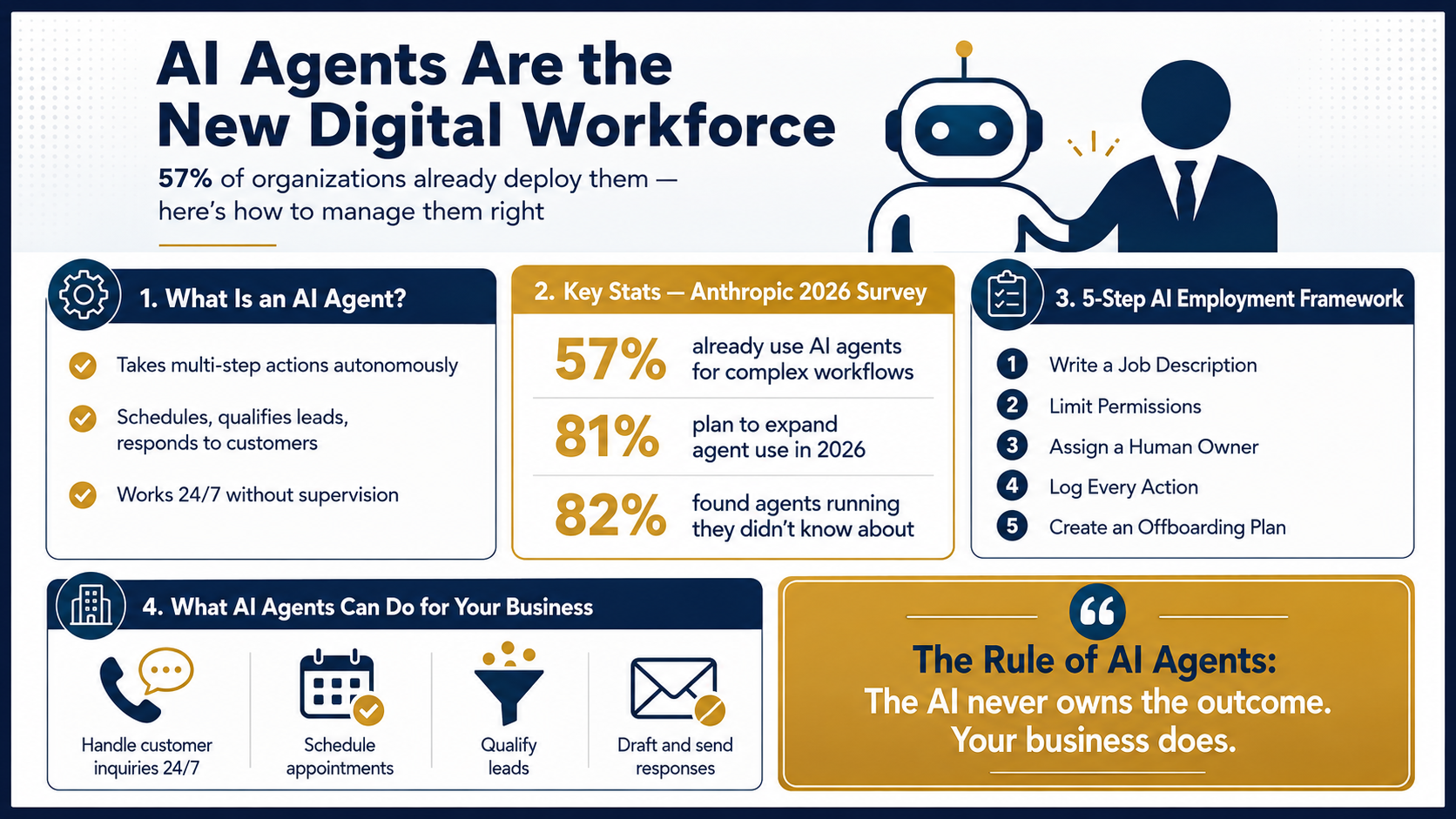
A report published today by Forbes draws on a striking new data set: AI agents are no longer just tools — they are acting like employees. According to the Anthropic State of AI Agents Report 2026, 57% of organizations now deploy AI agents for multi-step workflows, and 81% plan to expand their use before the year is out. Agents are scheduling appointments, qualifying sales leads, answering customer queries, and updating business records — work that was previously assigned to people.
For small and medium-sized business owners, this is not a distant enterprise trend. It is already here, and it is arriving faster than most governance frameworks can keep up with. The same report found that 82% of enterprises have discovered at least one AI agent or autonomous workflow running inside their organization that they did not know existed. That number should give any business owner pause — and a clear agenda.
What Is an AI Agent, Exactly?
Most business owners are familiar with AI tools that respond to prompts — you ask a question, you get an answer. An AI agent is different. It takes multi-step actions autonomously. You give it a goal ("qualify new leads from our contact form and schedule a call if they meet our criteria") and the agent plans and executes the steps required to complete it — without you approving each action individually.
Nextiva, the business communications platform, markets its XBert product as an "AI employee" for exactly this reason. It answers calls, schedules appointments, qualifies leads, and routes requests across connected systems. The terminology is deliberate: calling software an employee signals that it can represent your company, exercise limited authority, and complete work on your behalf. The company deploying it remains responsible for everything it says and does.
57%
of organizations already deploy AI agents for multistage workflows
81%
plan to use AI agents for more complex tasks by end of 2026
82%
of enterprises discovered agents running that they didn't know about
The Management Gap Is the Real Risk
The 82% "surprise agent" finding is not just a corporate IT problem. It reflects a broader issue: most organizations are deploying AI agents faster than they are building systems to manage them. Research from Okta found that only 47% of senior executives could identify all the agents running in their environment, 46% could control what those agents accessed, and 45% could authorize their individual actions. The Cloud Security Alliance reports that 65% of enterprises have already experienced incidents like unintended data exposure linked to AI agent activity.
The parallel to human employment is clarifying. When you hire someone, you give them a job description, limit their access to what they need, assign them a manager, and — if things do not work out — you offboard them and revoke their access. AI agents need exactly the same treatment. The difference is that nobody hands you an HR checklist when you plug in an AI agent. You have to build that structure yourself.
"If an agent is going to work like an employee, give it an employment file: a manager of record, a scoped job description, a badge that expires, a written deferral threshold, and an offboarding process."
— Anupam Satyasheel, CEO of Occams Advisory, via Forbes (July 30, 2026)
The 5-Step AI Employment Framework for Small Business
The good news is that the framework for managing AI agents responsibly is not complicated. It mirrors what good businesses already do with human staff. Here is the practical checklist:
-
1
Write a job description. Define exactly what the agent is supposed to do — and what it is not supposed to do. "Handle inbound customer inquiries during business hours and escalate anything involving refunds to a human" is a job description. "Help with customer stuff" is not.
-
2
Limit permissions to what the job requires. If the agent answers customer questions, it does not need access to your financial records. Every additional system the agent can reach is a potential risk if it behaves unexpectedly.
-
3
Assign a named human owner. Every agent should have one person who is accountable for its behavior — who reviews its logs, catches errors, and decides when it needs adjustment. "The AI" is never responsible for the outcome. Your business is.
-
4
Log every action. A good AI agent platform maintains a record of what the agent did, when, and what triggered each action. This is not optional — it is your audit trail if anything goes wrong, and it is how you prove the agent is working as intended.
-
5
Have an offboarding plan. As Okta's security research points out, human employee badges are deactivated on their last day. Most AI agent credentials have no expiry. Know how to switch an agent off — and revoke its access — before you switch it on.
Start Small, Measure Everything
The same principle that separates the 5% of AI implementations that succeed from the 95% that fail applies directly to AI agents: start with one well-documented, repetitive process, assign a specific human owner, and measure a specific outcome. An agent that handles appointment scheduling for your service business is a good first agent. An agent that "manages your customer relationships" is not a good first agent — it is too broad to govern and too vague to measure.
The cost barrier that once kept AI agents in the enterprise domain has largely disappeared — AI costs dropped 67% in a single year, putting the same tools that Fortune 500 companies pay for within reach of any small business budget. The new question is not whether you can afford an AI agent. It is whether you have the management structure in place to run one well.
What This Means Practically for Your Business
The shift to AI agents is not something that will happen to your industry in five years. It is happening now, and many of your competitors are already running them. But the businesses that will get lasting value from AI agents are not the ones who deploy first — they are the ones who deploy correctly, with clear scope, human oversight built in, and the discipline to review performance and adjust.
That discipline — defining the process, setting up the right governance, monitoring the results — is exactly what most small business owners do not have the bandwidth to build from scratch. It is also the core of what GoHuman AI does for every client: not just recommending tools, but designing, deploying, and managing the AI systems that handle your repetitive work, with human oversight at every decision point that matters.
Think of it as having a partner who has already done the hard work of writing the job description, setting the permissions, and building the audit trail — so your first AI agent starts working on day one, inside a framework you can trust.
The one rule to remember about AI agents:
"The AI never owns the outcome. The business does. If your agent makes a promise, that's your promise." — Yaniv Masjedi, CMO, Nextiva
Related Reading
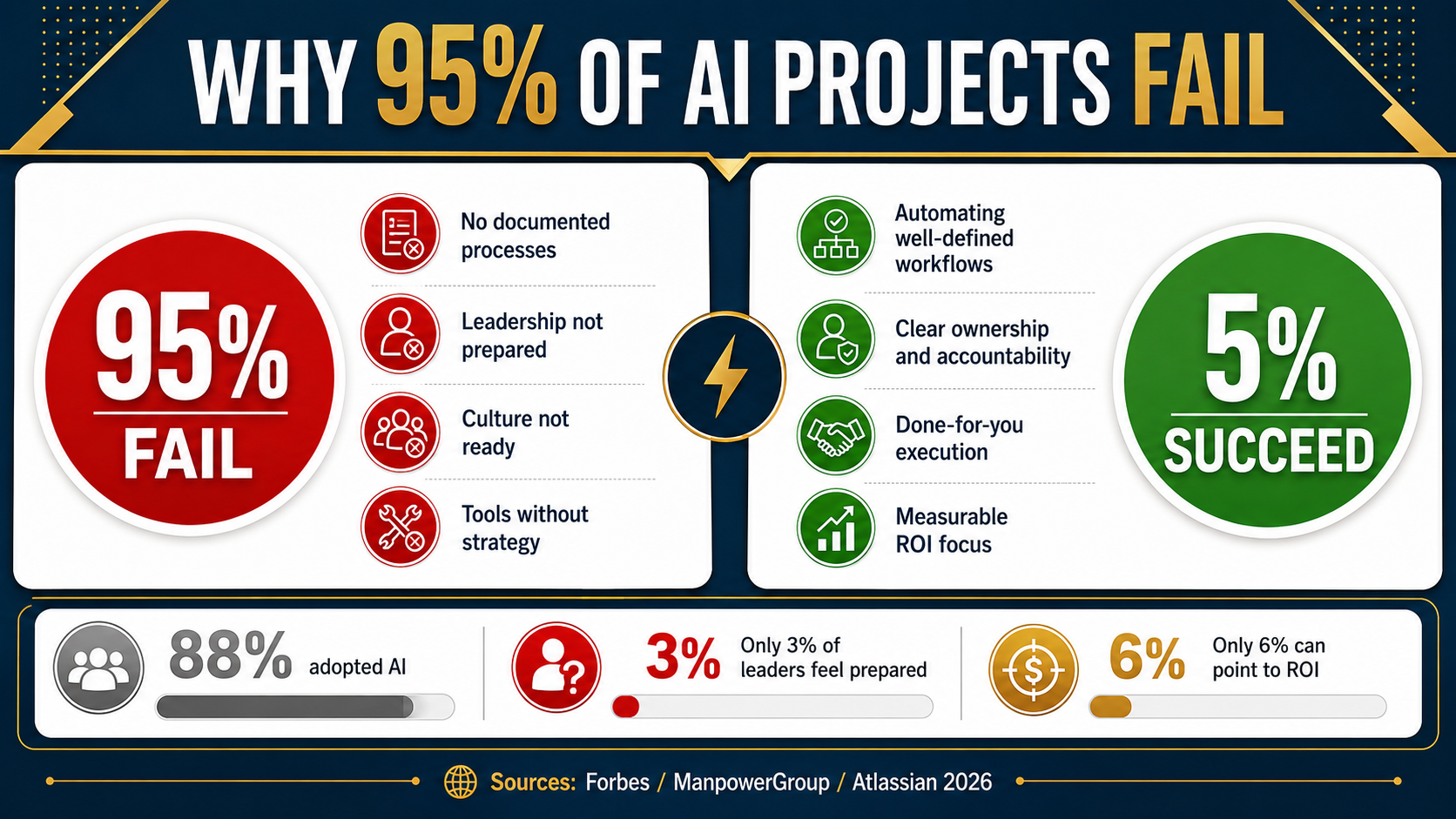
Why 95% of AI Projects Fail — And What the Successful 5% Do Differently
The research behind why most AI implementations never produce ROI — and the pattern that predicts success.
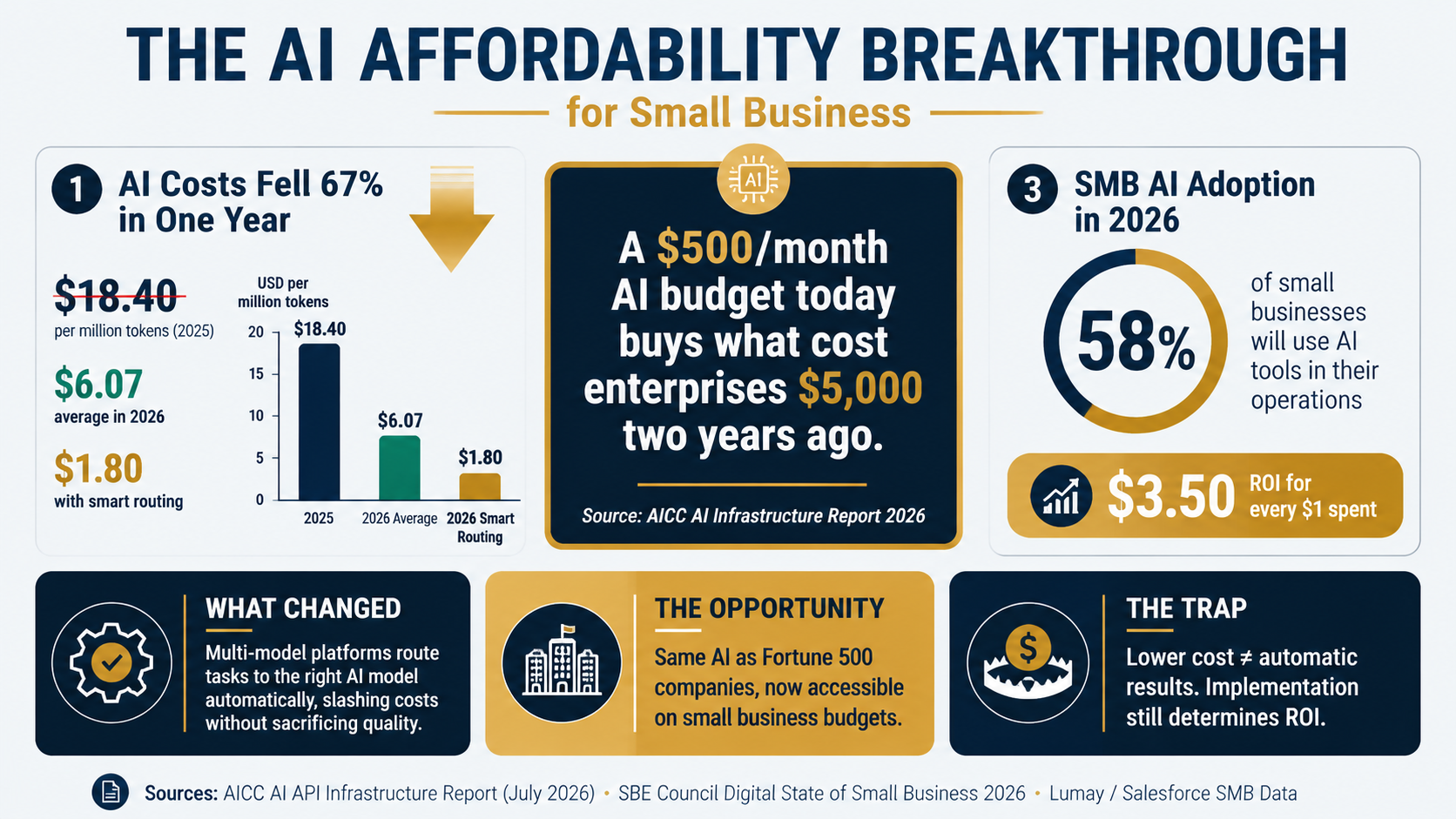
The Great AI Equalizer: Enterprise-Grade AI Is Now Affordable for Small Business
AI costs dropped 67% in a year — the access barrier is gone. Here is how to take advantage of it.
Ready to deploy your first AI agent the right way?