
The SaaS Stack Tax: How Small Businesses Are Cutting $50,000–$200,000 a Year by Replacing Legacy Software With AI
A 55-person real estate firm in Atlanta canceled its Salesforce contract, laid off a full-time administrator who only existed to manage it, and replaced the entire system with an AI-built alternative. Another business built a fully functional CRM in under an hour with no monthly cost. A third replaced a $100,000 annual software stack with 12 AI prompts. This is not a trend on the horizon — it is already happening.
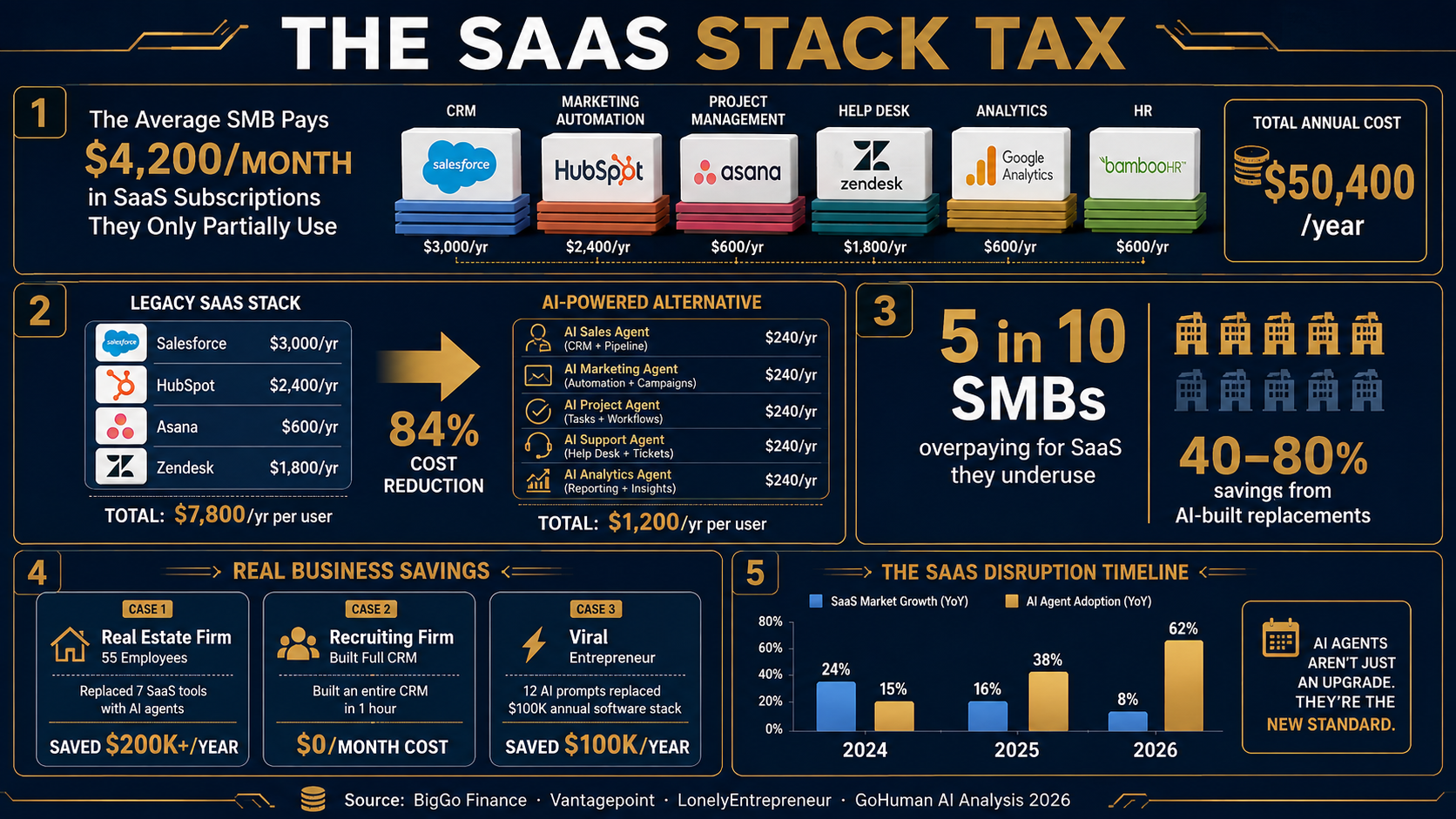
Every month, the average small business quietly pays a SaaS tax. It shows up as a line item for the CRM nobody fully uses. Another for the project management tool that has been half-configured since launch. Another for the help desk platform that only two people know how to navigate. Stack them up and the typical SMB is spending $3,000 to $5,000 per month — $36,000 to $60,000 per year — on software subscriptions that collectively deliver about 30% of their advertised value.
In 2026, a growing number of small business owners are doing something about it. They are canceling legacy software contracts and building AI-powered alternatives that do the same job — often better — for a fraction of the cost. The savings range from $40,000 to $200,000 per year. And unlike the promise of AI productivity gains, these savings are immediate: they show up in the first month's bank statement.
This is not a niche experiment by tech-savvy founders. According to reporting by BigGo Finance, at least five companies with 20 to 70 employees have already terminated contracts with Salesforce or HubSpot and replaced them entirely with AI-built tools. The businesses doing this look like your competitors — not your Silicon Valley outliers.
The Numbers Behind the Cancellation Wave
The math on SaaS stack costs has always been unfavorable for small businesses. Enterprise platforms like Salesforce were built for the needs of thousand-person organizations. SMBs get the complexity and the price tag without the features that justify them. The average Salesforce contract for a small business runs $1,200 to $3,600 per user per year — and that does not include the IT staff, consultants, or administrators often required to keep it running.
40–80%
Cost Reduction
AI-built vs. legacy SaaS
3.2×
ROI in 12 Months
From SaaS consolidation
$100K+
Saved Annually
Multiple documented cases
Greenleaf Management, an Atlanta-based real estate investment firm with roughly 55 employees, is one of the most documented examples. The company previously paid Salesforce subscription fees, employed a full-time staff member solely to manage the system, and retained an external consultant for ongoing customization. When they migrated to an AI-built alternative, they eliminated all three cost lines simultaneously. The total savings crossed $200,000 per year.
A separate case that went viral on X involved a business owner who described replacing their entire HubSpot and Salesforce setup with "12 AI prompts" — a dramatic shorthand for the growing ability to build custom AI workflows that replicate what enterprise CRMs do, but without the licensing fees, the training overhead, or the bloated feature list. The claimed savings: over $100,000 in annual stack cost. Another practitioner reported building a fully functional CRM for a recruiting firm in under an hour using Google Sheets and AI tooling, with zero ongoing monthly cost.
These are not outliers anymore. Vantagepoint's 2026 platform consolidation research shows companies that have reduced their SaaS stack and replaced key functions with AI see 20–35% cost reductions and a 3.2× ROI within twelve months. At the more aggressive end, where businesses replace core platforms entirely, cost reductions of 40–80% are documented across multiple case studies.
Why This Is Happening Now
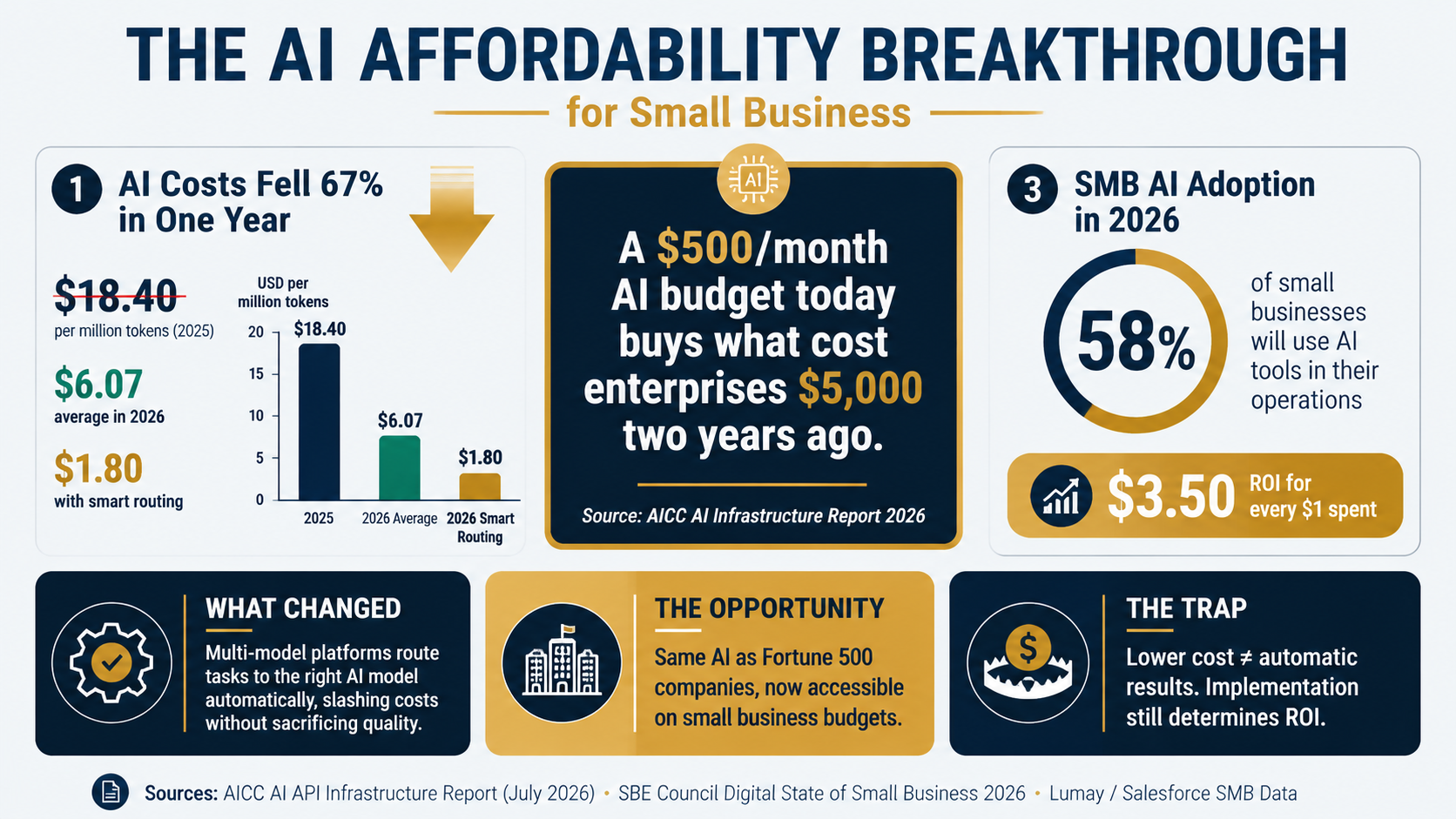
The SaaS cancellation wave is not primarily about dissatisfaction with the tools themselves. It is about a fundamental shift in what is possible. AI model costs fell 67% in a single year — meaning the building blocks for custom AI-powered alternatives to legacy software are now cheap enough that any small business can afford them. The same AI capabilities that once cost $5,000 per month are now accessible for $500 per month or less.
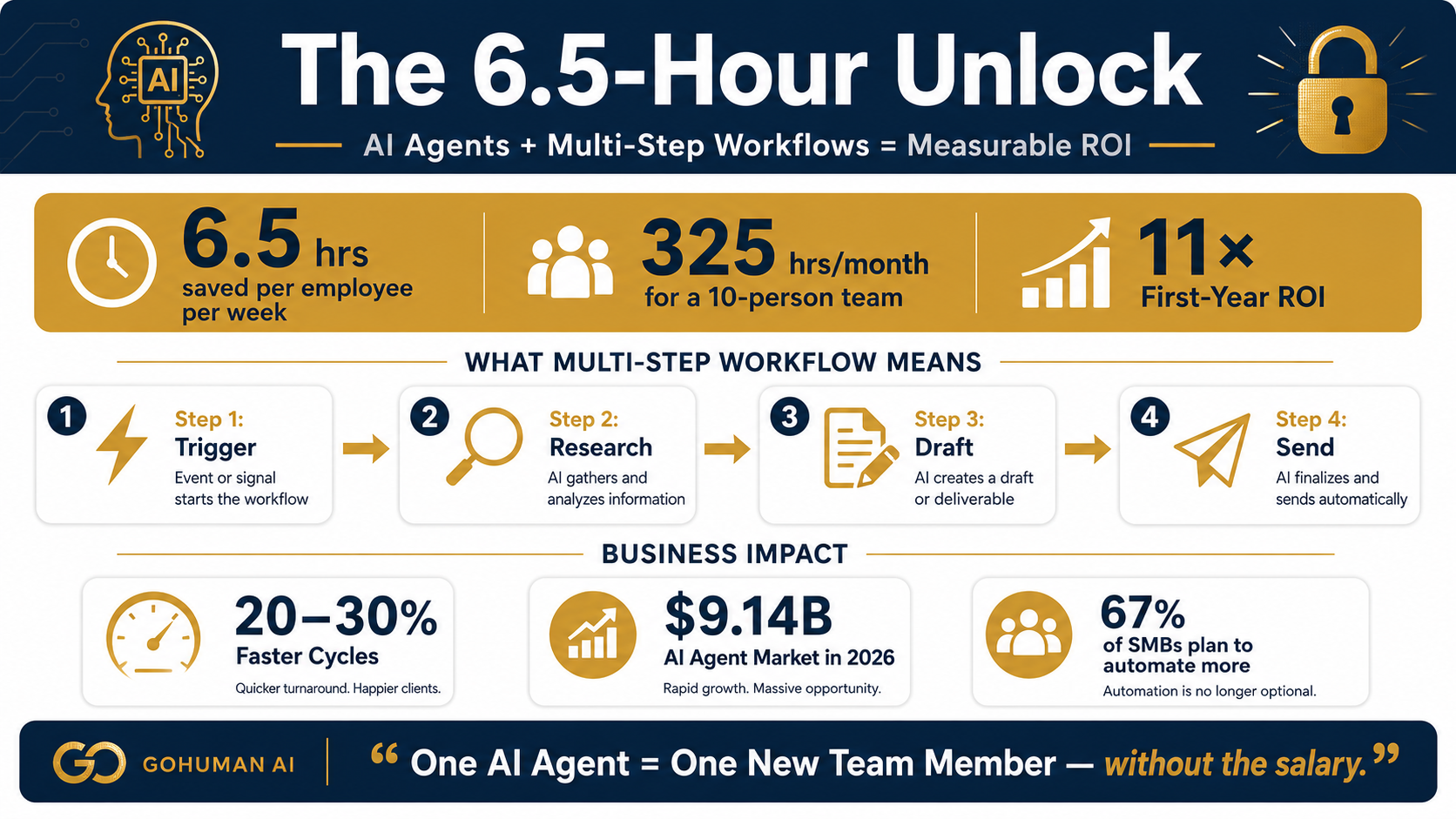
At the same time, no-code and low-code AI platforms have dramatically lowered the technical barrier. You no longer need a developer to build a functional AI-powered CRM or workflow automation. Tools that connect to your existing data — your email, your spreadsheets, your customer records — can be configured by a business owner in a weekend. The full power of AI agents that reason, plan, and execute multi-step workflows is now available without a six-figure software contract.
The core shift:
Enterprise SaaS was built to solve problems that humans could not solve at scale. AI agents are built to solve the same problems — but they adapt to your business, not the other way around. The price difference is not incremental. It is structural.
Which Tools Are Being Replaced — And What Takes Their Place
Not every SaaS platform is equally at risk. The ones that are being replaced most aggressively share a common profile: they are workflow tools — platforms that exist primarily to manage, route, and track information and tasks. CRMs, help desks, project management platforms, marketing automation suites, and lead tracking tools are all in this category. These are exactly the functions that AI agents handle natively.
CRMs: Salesforce and HubSpot are the most-cited cancellations. AI-powered replacements use a combination of large language models, your existing customer data, and integrations with tools you already use (email, calendar, phone) to build a fully functional relationship management system. The AI doesn't just store contacts — it reads your email threads, surfaces follow-up priorities, drafts outreach, and flags at-risk accounts. It does what a good Salesforce admin would do, minus the $80,000 annual salary.
Marketing automation: Tools like Marketo and ActiveCampaign are being replaced by AI agents that write, schedule, personalize, and optimize campaigns autonomously. The AI monitors which messages convert, adjusts targeting in real time, and drafts follow-up sequences without human intervention. The monthly cost is a fraction of the enterprise platform — and the output quality, because it is personalized at scale, typically outperforms the rule-based automation of legacy systems.
Help desk and support: Platforms like Zendesk and Intercom are being replaced or substantially reduced by AI agents that handle first-line support, triage tickets, pull relevant account history, and draft responses for human review. The 55-point productivity gap research found that businesses connecting AI to their core data systems get dramatically better outcomes — and support is one of the highest-leverage starting points.
Project management: Asana, Monday, and similar tools are being supplemented or replaced by AI agents that update task status based on email and meeting notes, flag blockers before they become delays, and generate status reports automatically. The AI does the administrative overhead that makes project management tools valuable — without requiring every team member to remember to update their tasks manually.
Where to Be Careful
The SaaS replacement wave is real, but it is not frictionless. The businesses getting the best outcomes are not ripping and replacing their entire stack overnight. They are being strategic about which tools to replace first, which to supplement, and which to leave alone.
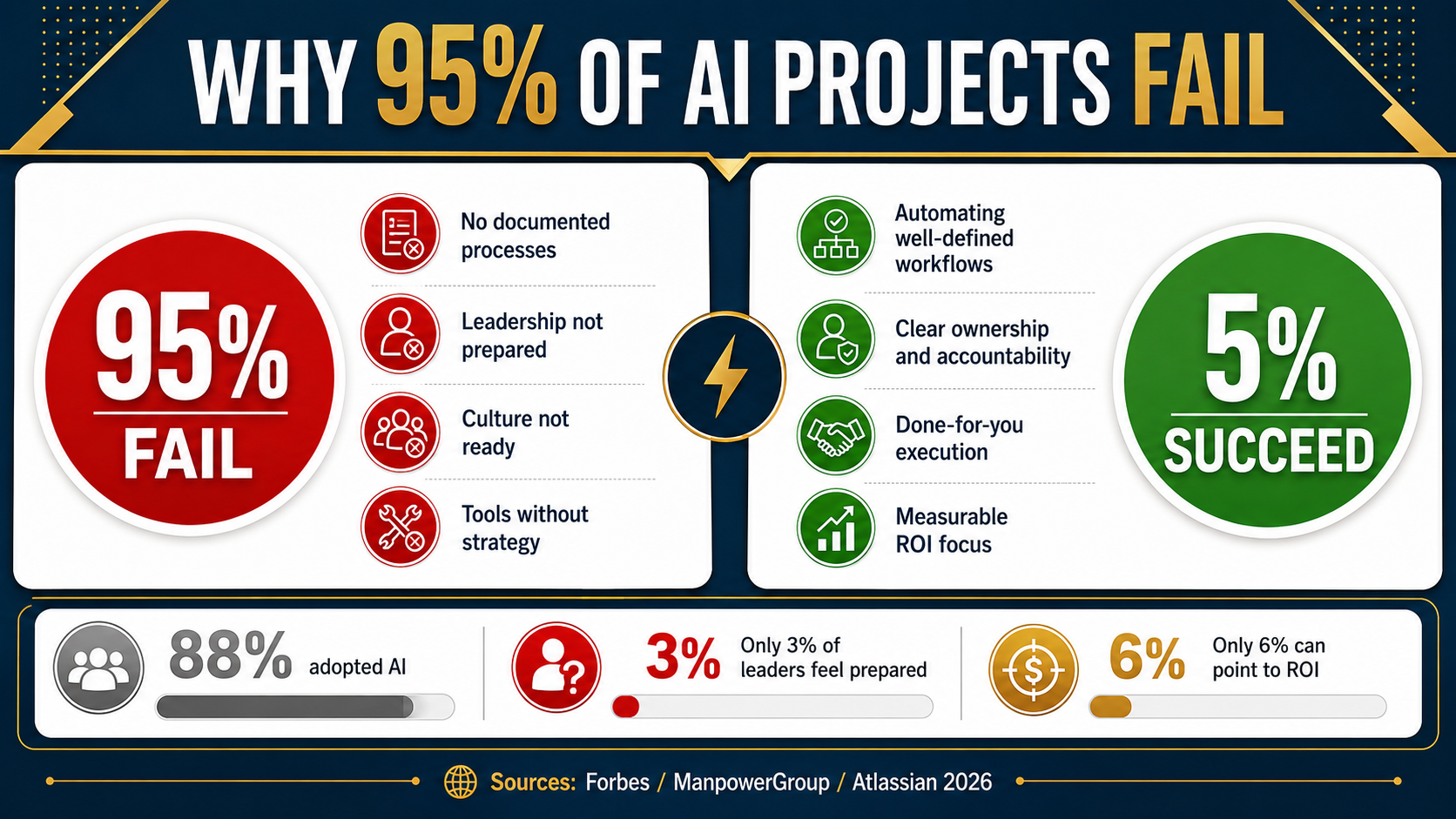
Migration complexity is real. If you have five years of customer data in Salesforce, a structured export and data-cleaning process is required before any AI alternative can be useful. Businesses that skip this step end up with AI agents running on incomplete or inconsistent data — the same root cause behind most AI implementation failures. Clean data first. Build the alternative second.
Some tools should stay. Accounting platforms (QuickBooks, Xero), payroll systems, and compliance-sensitive tools are not prime replacement candidates. The liability exposure from an AI making errors in financial reporting or payroll calculations is not worth the subscription savings. Stick with purpose-built tools in regulated domains.
Start with one, not all. The businesses generating the best ROI are starting with their single most expensive, least-used platform and building an AI-powered alternative to prove the concept. Once that is running successfully, they move to the next. The same staged approach that drives multi-step workflow ROI applies here: one agent, optimize it, then scale.
The SaaS Replacement Checklist
- 1Identify your highest-cost, lowest-utilization platforms (pull your SaaS spend report now)
- 2Audit what data lives in those platforms and whether it is exportable
- 3Define the 3–5 core jobs that platform actually does for your team
- 4Build or configure an AI agent that handles those specific jobs — not the whole platform
- 5Run parallel for 30 days before canceling — let the numbers speak
The Bigger Picture: What This Means for Your Business
The SaaS model thrived because software was hard to build and hard to customize. A small business in 2015 had two choices: buy an off-the-shelf platform or hire an expensive development team. Neither was good. Enterprise platforms were the least bad option.
In 2026, there is a third option: build a custom AI-powered system that does exactly what you need, costs a fraction of the enterprise alternative, and improves as your business data grows. This is not a hypothetical future capability. It is what the businesses in the case studies above are doing today, at 20-person scale, in industries as traditional as real estate and recruiting.
The competitive implication is significant. If your competitor cancels a $60,000 per year SaaS contract and redirects that budget into growth, hiring, or marketing, they have just gained a structural cost advantage. That advantage compounds. Every year they are not paying the SaaS tax, they are investing that capital elsewhere.
At GoHuman AI, we help businesses audit their SaaS stack, identify the highest-value replacement opportunities, and build or configure AI-powered alternatives with human oversight built in. If you are spending more than $2,000 per month on software subscriptions and are not sure you are getting full value, that conversation is exactly where we start. The savings often pay for our entire engagement in the first 90 days.
Related Reading
The Great AI Equalizer: Enterprise-Grade AI Is Now Affordable for Small Business
How a 67% price drop in AI models changed the competitive landscape for SMBs.
The 6.5-Hour Unlock: How Small Businesses Are Using AI Agents for Multi-Step Workflows
Where to start once you've freed up budget from legacy software.
Why 95% of AI Projects Fail — And What the Successful 5% Do Differently
The data-quality mistakes to avoid before you cancel your first SaaS contract.
Spending more than $2,000/month on software subscriptions you underuse? Let us show you what an AI-powered alternative would cost — and save.