
The AI Hiring Paradox: New Data From 34,000 Businesses Shows AI Creates Jobs, Not Cuts Them
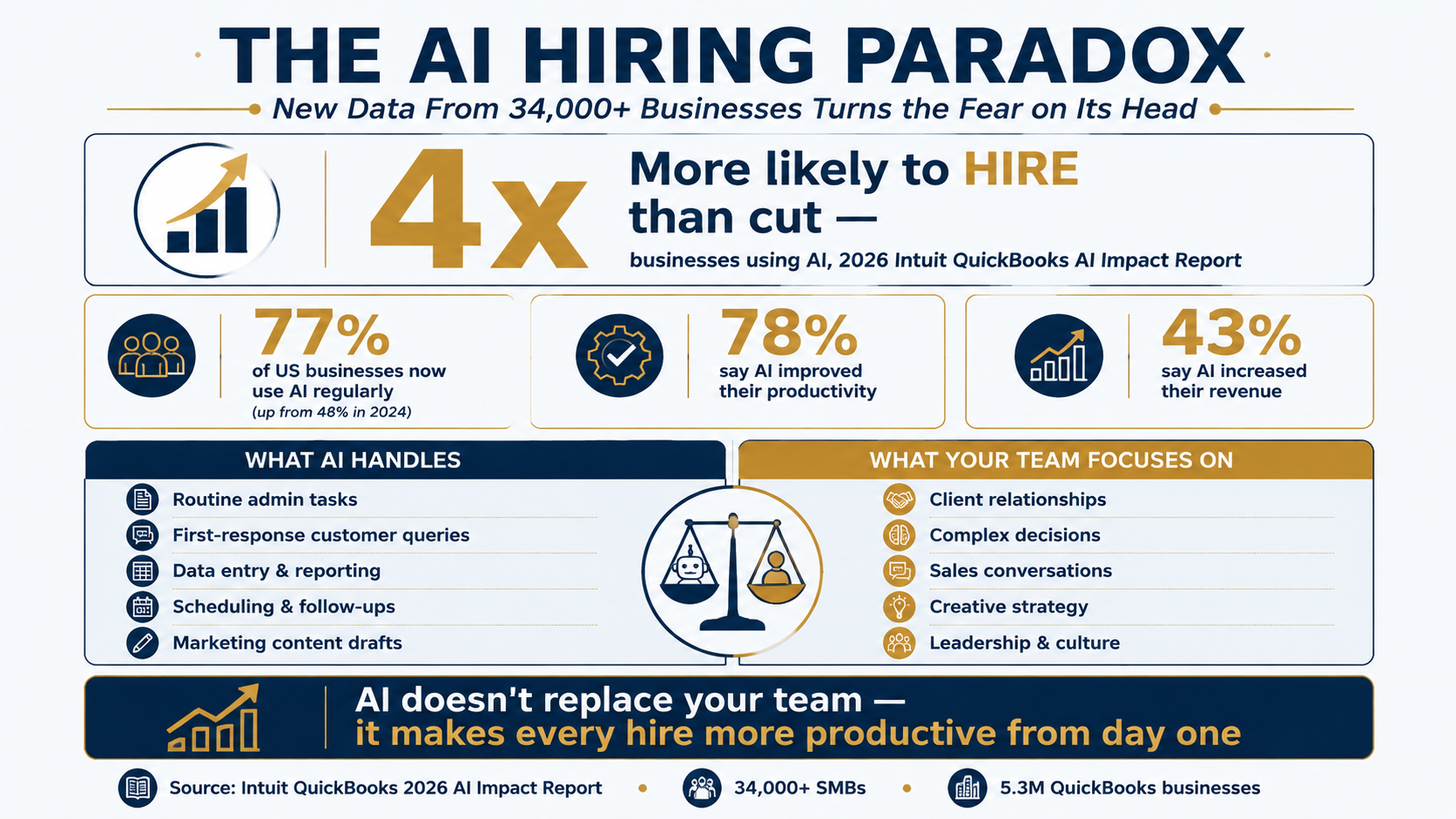
For years the warning has been the same: AI is coming for jobs. But the largest study of small and mid-sized businesses to date tells a completely different story. Businesses that use AI are four times more likely to report growth in headcount than reductions — and the reason why should reframe how every small business owner thinks about their next hire.
Ask most small business owners what they worry about when it comes to AI, and the answer is usually some version of the same fear: that it will replace the people they depend on, make roles redundant, or hollow out their team. It is a fear that has been reinforced by years of headlines predicting mass automation and widespread job displacement.
The data from the largest study ever conducted on AI adoption in small business tells a completely different story — and it is one that should change how every owner thinks about AI, hiring, and growth at the same time.
The 2026 AI Impact Report from Intuit QuickBooks drew on surveys of more than 34,000 small and mid-sized businesses conducted from July 2024 through January 2026, combined with anonymized behavioral data from more than 5.3 million QuickBooks businesses. Its headline finding on employment is unambiguous: businesses using AI are four times more likely to say it helped them hire than to say it led to cuts. Not slightly more likely. Not marginally more likely. Four times.
Why the Fear Is So Persistent — and So Wrong
The AI-kills-jobs narrative is intuitive. If a tool can do work that a person used to do, the economic logic seems to say that the person becomes unnecessary. And in narrow contexts — individual tasks, specific roles at large enterprises — there are real examples of automation reducing the need for certain kinds of work.
But for small businesses, this logic misses something fundamental about how growth actually works. Small businesses do not have surplus capacity to eliminate. They have the opposite problem: not enough hours in the day, too much routine work absorbing time that should go to customers and strategy, and a hiring decision that always feels riskier than it should because each new salary is a meaningful percentage of the total cost base.
AI does not change that picture by reducing headcount. It changes it by making every person — including the owner — dramatically more productive. And that productivity gain is precisely what generates the revenue growth that makes the next hire possible.
4×
more likely to hire than cut — businesses actively using AI, 2026 Intuit AI Impact Report
78%
of businesses say AI has improved their productivity — across 34,000+ SMBs surveyed
43%
report AI has directly increased their revenue — creating the conditions for team growth
The Leap That Separates a Side Hustle From a Growth Business
Of the nearly 474,000 business applications filed in August 2025 alone, only around 28,700 are projected to become employer businesses within twelve months. Hiring is the leap that separates a solo operation from a company with genuine growth potential — and it is a leap that many small business owners delay or avoid because the risk feels too high relative to the reward they can currently see.
What AI changes is not whether you need people. It changes what each person can do once they are on the team — and what the business can sustain as a result. A hire that would have been marginal in a business running everything manually becomes clearly worth it in a business where AI is handling the scheduling, first-response communications, reporting, and routine follow-ups that would otherwise consume that person's first three months. The business is not less reliant on people. It is more capable of giving people meaningful, high-leverage work from day one.
"Hiring is the leap that separates a side hustle from a growth business — and the businesses that grow in 2026 will be the ones that use AI to make that leap with confidence."
— Intuit QuickBooks 2026 AI Impact Report
What AI Actually Replaces — and What It Deliberately Does Not
The Intuit report does not paint AI as a universal replacement for human work. Quite the opposite: across every country tracked in the study, employee management, complex negotiations, and legal decisions consistently ranked at the bottom of AI use cases. Businesses are deliberately drawing a line — keeping judgment-heavy, relationship-driven work firmly in human hands, while letting AI handle the routine layer around it.
That distinction matters because it tells you exactly what kind of business you are building when you add AI to the mix. You are not building a business that needs fewer people to function. You are building one where every person spends more of their time on the work that actually generates value — the conversations, decisions, creative output, and relationships that cannot be templated or automated away.
This is what AI agents are increasingly designed to do: take the repeatable, multi-step operational tasks off the plate of the humans on your team so those humans can focus entirely on the things that require judgment and care. The agent handles the admin. The person handles the relationship.
The Confidence Gap That Holds Small Businesses Back
The research also points to something subtler than just the tools themselves: confidence. A separate 2026 survey from Bluehost found that 87% of small businesses are already using at least one AI tool, with more than half using AI every day. But usage alone does not generate the 4x hiring outcome. The businesses getting the strongest growth results are the ones that have moved from tentative experimentation to genuine operational confidence — using AI not occasionally for one-off tasks, but as a consistent layer woven into how the business actually runs.
That confidence gap mirrors what the 55-point productivity gap research from MYOB Acumatica showed earlier this year: businesses that embed AI in core workflows see dramatically different outcomes from those that bolt it on as an afterthought. The tool is not the variable. The depth of integration is. And the practical effect of that integration is not job loss — it is the financial headroom and operational capacity to hire the people you have been hesitating to bring on.
The Practical Implication for Your Next 90 Days
If you have been sitting on a hiring decision — a role you know the business needs but that you have been holding off because the timing feels uncertain or the margin feels thin — the question worth asking is whether AI could change that calculation. Not by making the role redundant, but by making it sustainable. By ensuring the person you hire spends their time on work that generates a return, rather than on administrative overhead that AI can handle for a fraction of the cost.
Concretely, this looks like auditing the work your next hire would actually be doing in their first six months. How much of it is genuinely irreplaceable — complex, relationship-driven, judgment-intensive? And how much is routine overhead that arrived bundled with the role by default? The portion that is routine is the portion AI can absorb, making the remaining human work more valuable and the hire more economically viable from the start.
This is also why the data on AI and revenue per employee is so significant: the 24% higher sales per employee that AI-using businesses generate is not a reason to avoid hiring — it is evidence that each hire in an AI-enabled business carries more revenue potential than in one operating without it. The businesses growing fastest are not choosing between AI and people. They are using AI to make each person they add meaningfully more effective.
A reframe worth sitting with:
"What if AI is not the reason you delay your next hire — but the reason you finally feel confident making it?" The businesses that answered yes to that question in 2024 are the ones showing up in the 2026 data as four times more likely to have grown their teams.
The fear that AI destroys jobs at small businesses is understandable. It is also, according to the most comprehensive data available, wrong. The reality is more nuanced and more useful: AI creates the conditions — productivity, revenue growth, operational capacity — under which small business owners feel confident enough to hire. It does not replace the team. It builds the foundation that makes a team possible.
The businesses that will look back at 2026 as a turning point are the ones that understood this early — and used AI not as a substitute for people, but as the scaffolding that let them bring in the right people faster, with more support around them and clearer paths to impact from day one. If you want to understand what that looks like in practice for your specific business, that is exactly the conversation we have with small business owners every day at GoHuman AI.
Related Reading
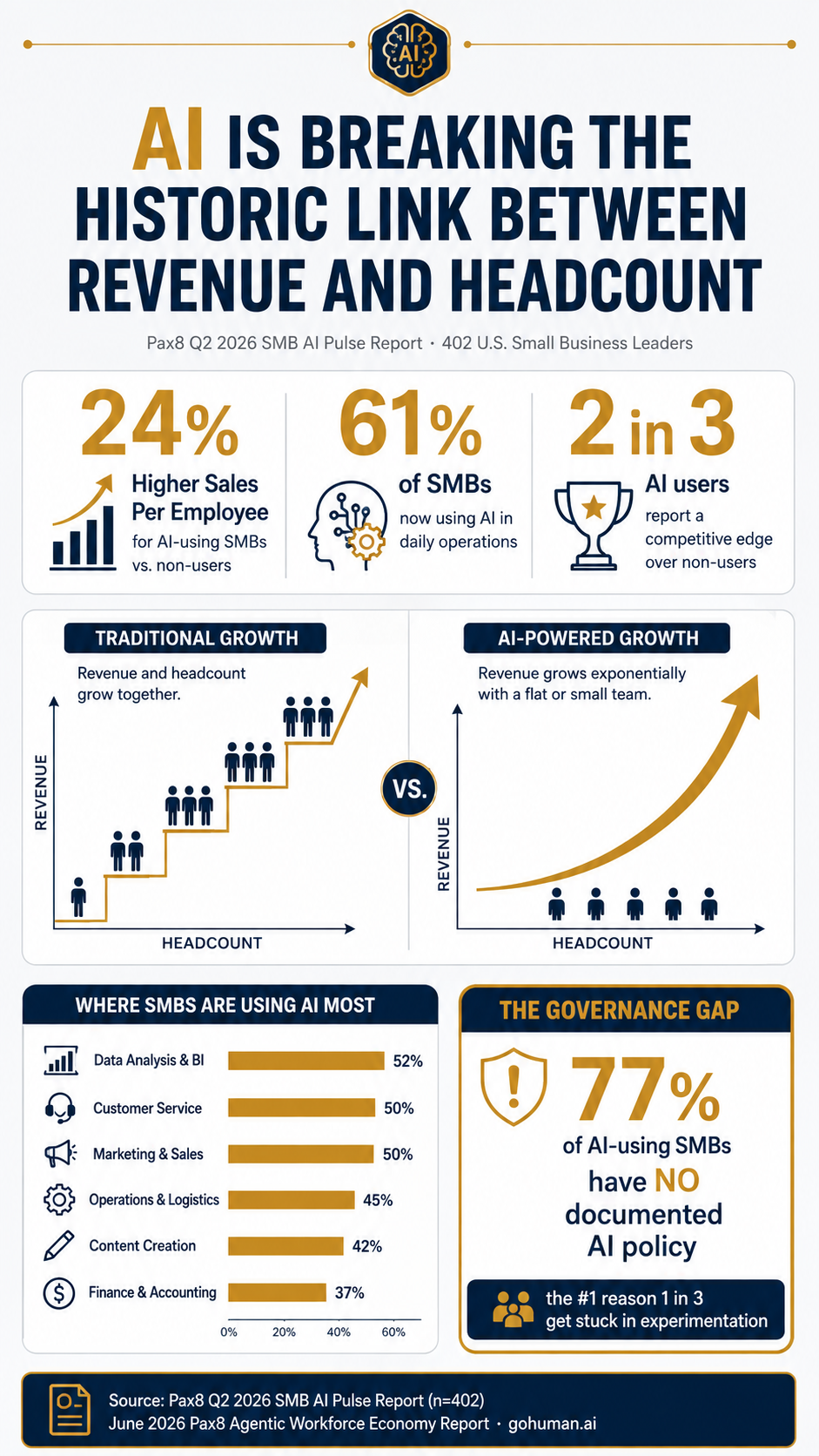
The End of Hire-to-Grow: AI-Using SMBs Generate 24% More Revenue Per Employee
More revenue per person — which is what makes each hire more affordable and less risky.
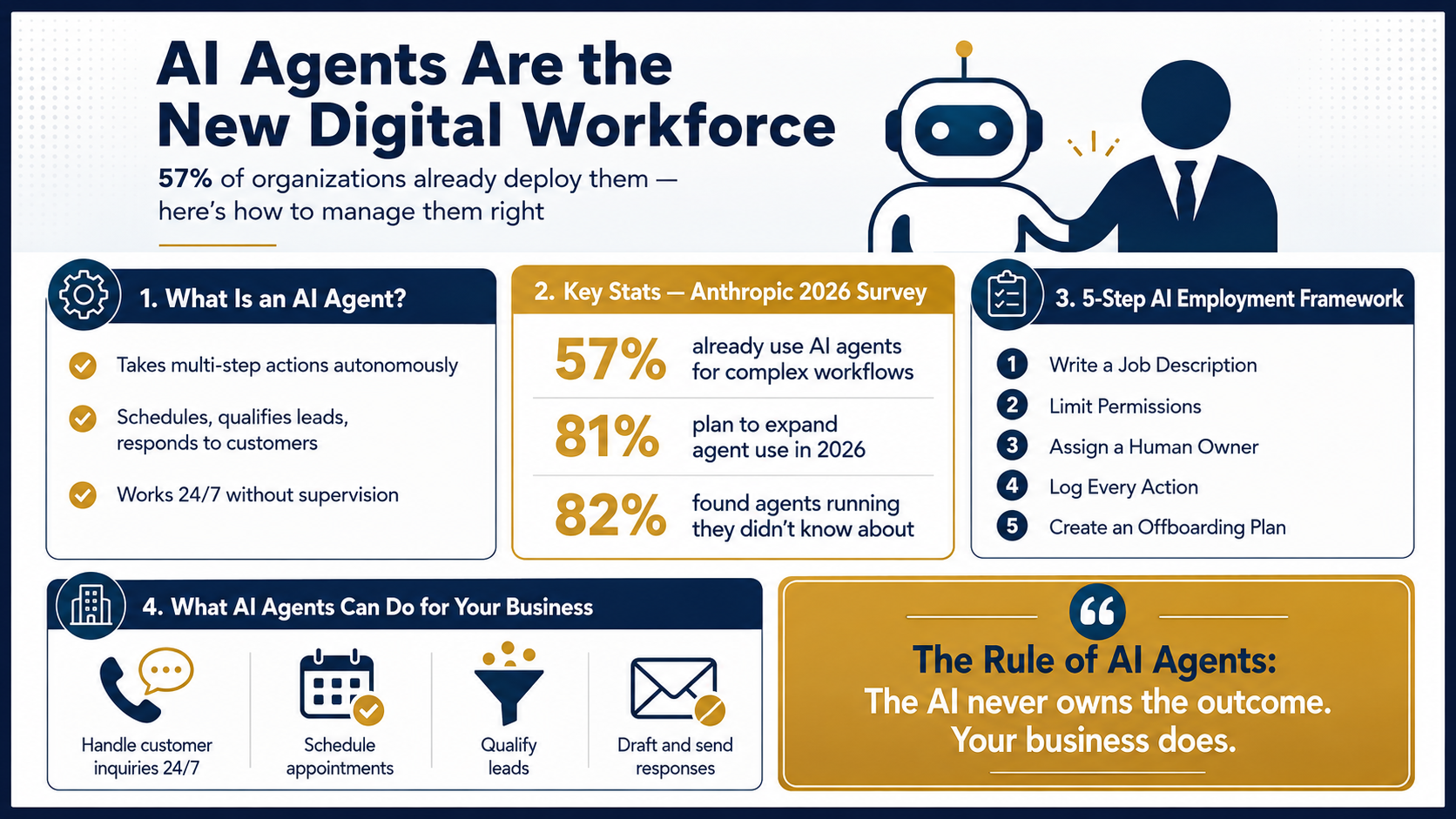
Your First AI Employee: What Small Business Owners Need to Know About AI Agents
How AI agents take on the routine work that otherwise consumes your team's time.
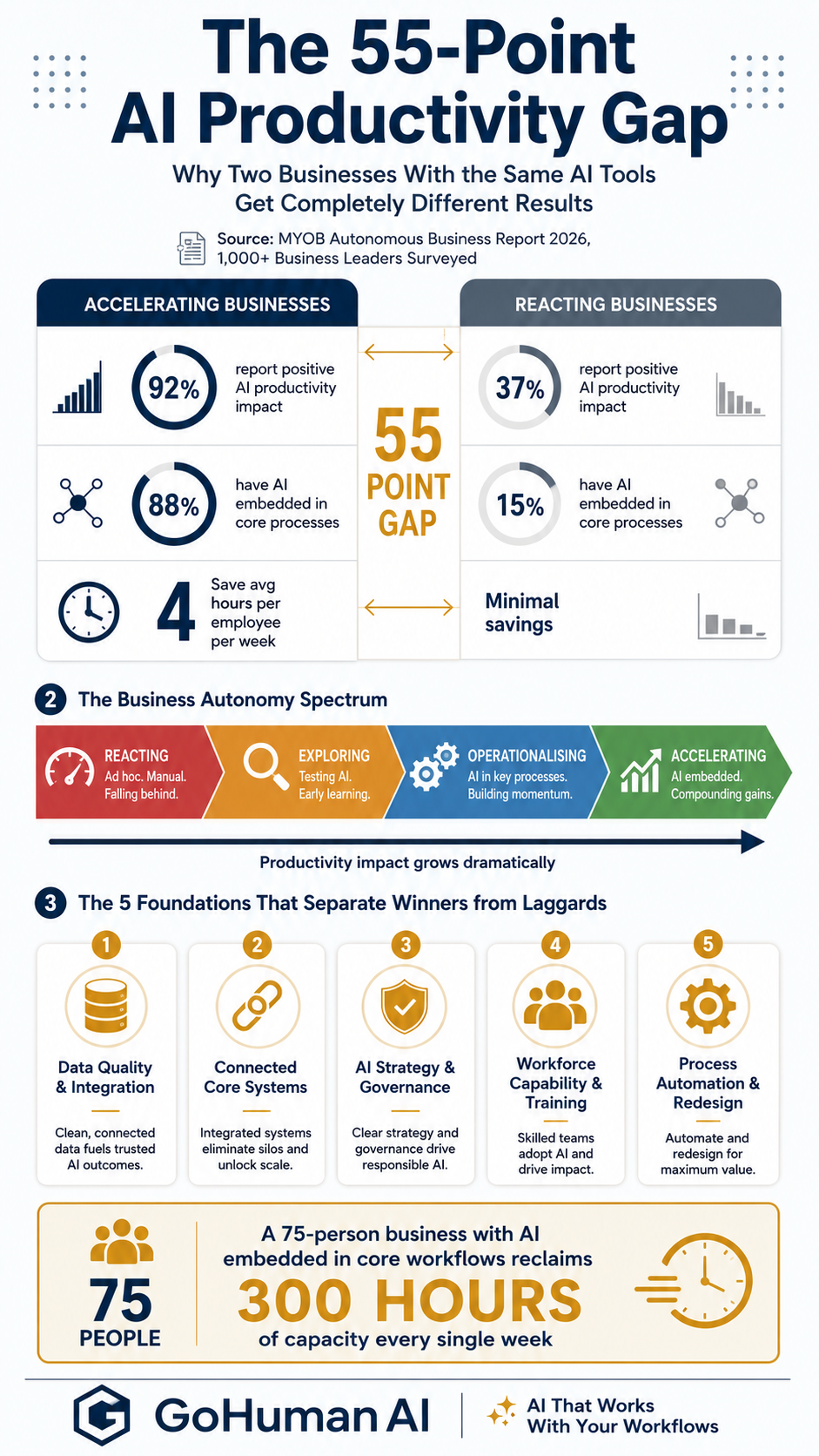
The 55-Point Productivity Gap: Why Two Businesses With the Same Tools Get Different Results
Integration depth — not tool choice — is what separates the businesses growing fastest.
Want to understand how AI could make your next hire more confident, more productive, and more commercially viable from day one?