
The Manager Multiplier: New Data Shows AI Saves Business Owners 2× More Hours Per Week Than Their Staff
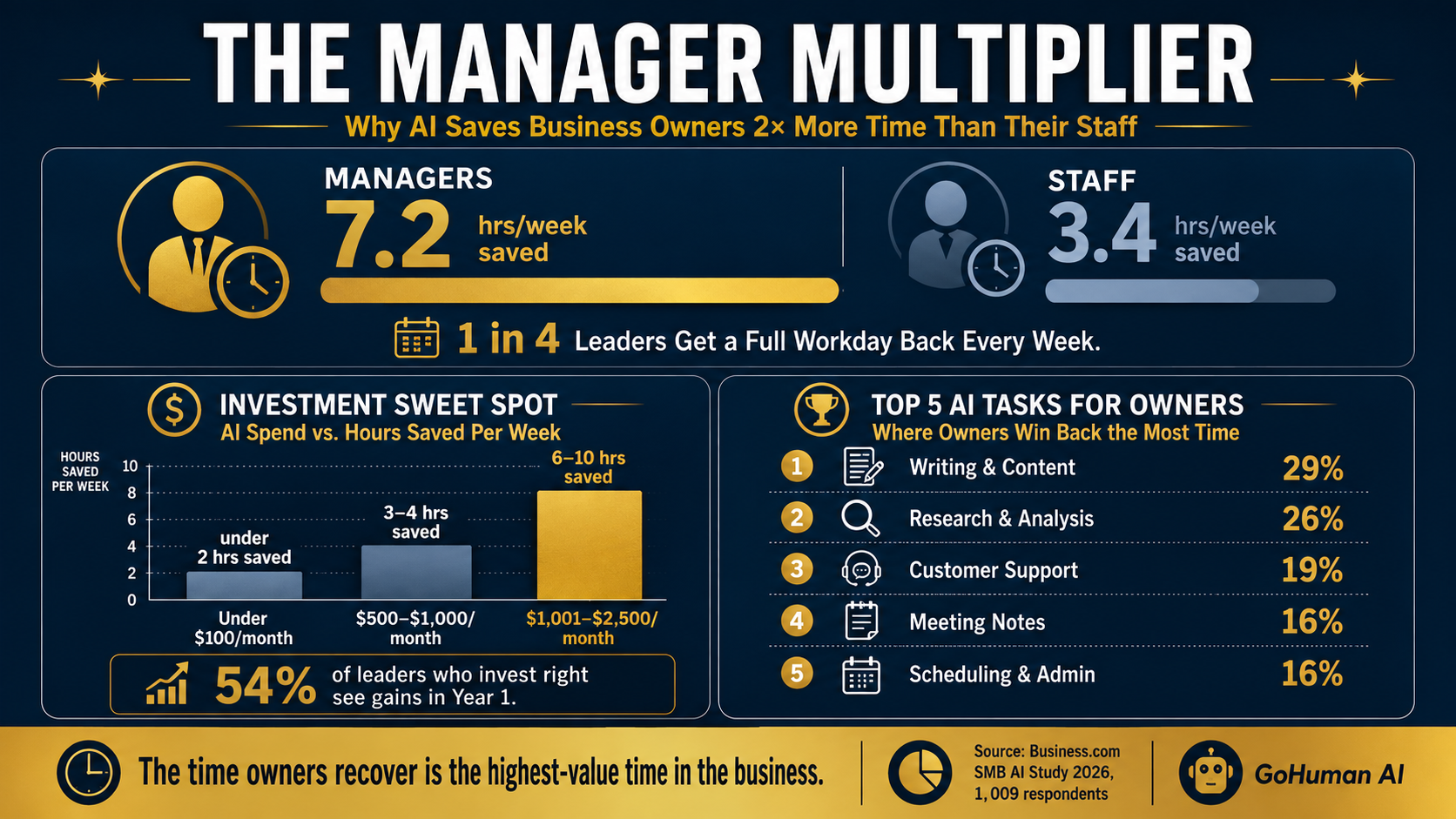
A survey of 1,009 small businesses found something the productivity headlines keep burying: the owners and managers — not the frontline staff — are the biggest beneficiaries of AI. Managers save 7.2 hours per week. Their employees save 3.4. One in four business leaders now gets a full workday back every week. The question is why, and what the top performers are doing that the rest are not.
Every conversation about AI and small business eventually lands on the same talking point: your employees will save time. Hours per week. Hours that add up. Hours that compound into ROI. And that is true — the data supports it. But the conversation almost always stops there, and in doing so it misses the most important finding buried inside the same research.
According to Business.com's 2026 Small Business AI Outlook Study — a survey of 1,009 respondents at companies with 2 to 250 employees — the owners and managers using AI are saving more than twice as many hours per week as their frontline staff. Individual contributors save an average of 3.4 hours per week. Managers save 7.2 hours. That gap is not a rounding error. It is the most consequential AI productivity finding for small businesses in 2026, and almost no one is talking about it.
This matters because your hours — as the owner — are not equal to an employee's hours. The time you spend on administrative overhead, routine research, drafting communications, and scheduling is time you are not spending on strategy, relationships, and the decisions only you can make. When AI gives you 7.2 hours back each week, it is not giving you extra time to do more of the same tasks. It is giving you capacity to run a different kind of business.
The Numbers Behind the Manager Gap
The Business.com study drew on a sample of over 1,000 respondents across businesses in the 2–250 employee range — exactly the segment most people call "small business." The time savings data is striking not just for the average, but for the top cohort. Twenty-two percent of small and medium business leaders — roughly one in four — report that AI saves them between 6 and 10 hours per week. That is a full workday. Every week.
7.2 hrs
Saved Per Week
Average for managers using AI
1 in 4
Leaders Save 6–10 hrs/wk
A full workday back, every week
54%
Report Productivity Gains
After AI implementation
For context: if a business owner recovers 7.2 hours per week, that is roughly 374 hours per year. At a conservative internal value of $150 per hour for owner time, that is $56,100 in recovered productive capacity annually — before counting any employee-level gains. The math compounds fast. This is why businesses that generate 24% more revenue per employee with AI are often driven by owners who changed how they personally work, not just what tools their staff use.
Why Managers Benefit More Than Staff
The manager gap is not random. It reflects a structural reality about what owners and managers actually do versus what frontline employees do.
Individual contributors tend to do specialized, repeatable, process-bound work. A customer service rep follows a script. An accountant works within a defined workflow. A salesperson runs the same sequence of outreach steps. AI can assist here — and does — but the assistance is often incremental. A faster email draft. A summarized report. A suggested response. Each saves minutes, not hours.
Owners and managers, by contrast, do a very different kind of work. They context-switch constantly. A typical morning might involve reviewing financial reports, responding to a prospect email, researching a competitor, preparing a vendor proposal, scheduling a team meeting, and drafting a response to a customer complaint — all before lunch. Each of those tasks is knowledge-intensive, communication-heavy, and structurally ideal for AI delegation. When an AI agent handles the research, drafts the email, summarizes the financial data, and prepares the talking points for the meeting, the time savings are not additive — they are multiplicative.
The core insight:
Management work is high-variety, high-context, communication-dense — exactly what large language models were built for. The more variety in your daily workload, the more an AI can compress it.
What the Top 22% Are Actually Doing
The leaders saving 6 to 10 hours per week are not using fundamentally different AI tools than everyone else. They are using the same tools differently — with more intentionality, more consistency, and in more of the right task categories. The study data identifies five areas where owner-level AI adoption drives the highest time recovery.
1. Writing and communications (29% of respondents). The single most common high-value use. This includes drafting and editing client emails, vendor proposals, marketing copy, job descriptions, policy documents, and internal memos. An AI-assisted owner can draft a 500-word client proposal in four minutes instead of 45. Multiply that across a week of communication volume and the savings become immediately visible.
2. Research and competitive analysis (26%). Before a sales call, a pricing decision, a vendor negotiation, or a new market entry, owners typically spend hours pulling together background information. AI compresses this to minutes — summarizing industry reports, profiling competitors, surfacing relevant data, and organizing findings into a usable briefing. This is one of the clearest cases where multi-step AI workflow automation pays off immediately at the leadership level.
3. Customer support triage (19%). Four in five business leaders who handed first-line customer support to AI reported measurable productivity improvements. For owners who still handle complex escalations directly, AI handling the first layer of inquiry — answering FAQs, routing issues, drafting acknowledgments — removes a constant interruption pattern and reclaims focus time.
4. Meeting notes and follow-up (16%). Owners sit in more meetings than anyone on their team. AI transcription and summarization tools convert a 45-minute call into a one-page brief with action items in under two minutes. Multiply across a week of meetings and you recover a meaningful block of follow-up time that typically consumed evenings and weekends.
5. Scheduling and calendar management (16%). Low-value by the task, but high-volume in aggregate. Owners who automate scheduling workflows — proposals, reminders, confirmations, rescheduling — often cite it as the change that most visibly reduced their inbox noise, even if the hourly savings look modest.
The Investment Threshold That Changes Everything
One of the study's most actionable findings is the relationship between AI investment level and hours saved per week. It is not linear — there is a clear threshold effect.
AI Spend vs. Hours Saved Per Week (Owner/Manager)
Source: Business.com 2026 SMB AI Outlook Study · ✦ Sweet spot for maximum owner time recovery
The leaders saving under 2 hours per week are typically using one or two consumer-grade AI tools with no structured workflow around them. They open ChatGPT when they think of it. They use it for a quick draft, then revert to old habits. The time savings are real but accidental.
The leaders saving 6 to 10 hours are doing something categorically different. They have built AI into specific recurring workflows. They have systems that run without them having to remember to use AI. The investment reflects tools, setup, and configuration — not just subscription fees. This mirrors the finding from research on the 55-point productivity gap: the difference is not which tools you buy, it is whether your data and processes are connected to them.
This also explains why businesses that see no ROI from AI keep blaming the technology. They are at the $100/month tier — using AI as a novelty rather than as infrastructure. The investment threshold is not arbitrary. It buys the configuration, the integrations, and the ongoing optimization that turns AI from a tool into a system.
What to Do With the Time You Get Back
Recovering 7 hours per week is not the goal. It is the enabling condition. The owners generating the highest returns from AI are not spending their recovered time on more administrative tasks. They are reinvesting it in the work that compounds.
That means more strategic client relationships — the ones that require a senior voice and generate high-value referrals. More time hiring and developing the right people. More time reviewing the financial picture with clarity instead of reaction. More time on the product decisions and positioning choices that determine trajectory twelve months from now.
The businesses that are generating 24% more revenue per employee are not doing so because they ran their existing business slightly faster. They changed what the owner was doing every day. AI handled the operational drag. Leadership focused on the highest-leverage work. That is what the 7.2-hour gap actually represents when it is used correctly.
The Owner's AI Audit: 5 Questions to Ask This Week
- 1What did you spend your last 3 hours of desk time on — and could AI have done any of it?
- 2How much of your week is writing, research, or meeting prep — the top three AI use cases?
- 3Are you at the $100/month tier (accidental AI) or the $1,000+ tier (systematic AI)?
- 4Do you have AI connected to your actual data — your email, your CRM, your documents — or are you starting from scratch every time?
- 5If you had 7 extra hours per week, what would you do with them that would actually move the business forward?
The Competitive Implication
The manager multiplier has a competitive dimension that is easy to underestimate. When your competitor's owner is spending 7.2 hours per week on administrative overhead that AI could handle — while yours has already automated it — you are not just saving time. You are buying strategic depth. You are the one who had time to read the industry report. To call the big client. To review the pricing model. To recruit the next hire. Your competitor was formatting spreadsheets.
The data shows that AI adoption among SMBs has grown from 36% in 2023 to 57% in 2026. But adoption is not the same as effectiveness. Only 23% of businesses have formal AI training in place. Most are at the casual-use tier. The owners who cross the threshold — who build systematic AI workflows into how they personally operate — are pulling away from the field in a way that compounds every quarter.
At GoHuman AI, the first thing we do with any new client is audit where the owner personally spends their time. Not the business — the owner. Because that is where the leverage is highest, and where AI delivers the most disproportionate return. If you are spending more than three hours per day on tasks that require your attention but not your judgment, that gap is worth closing. The 22% of leaders already doing it are not going back.
Related Reading
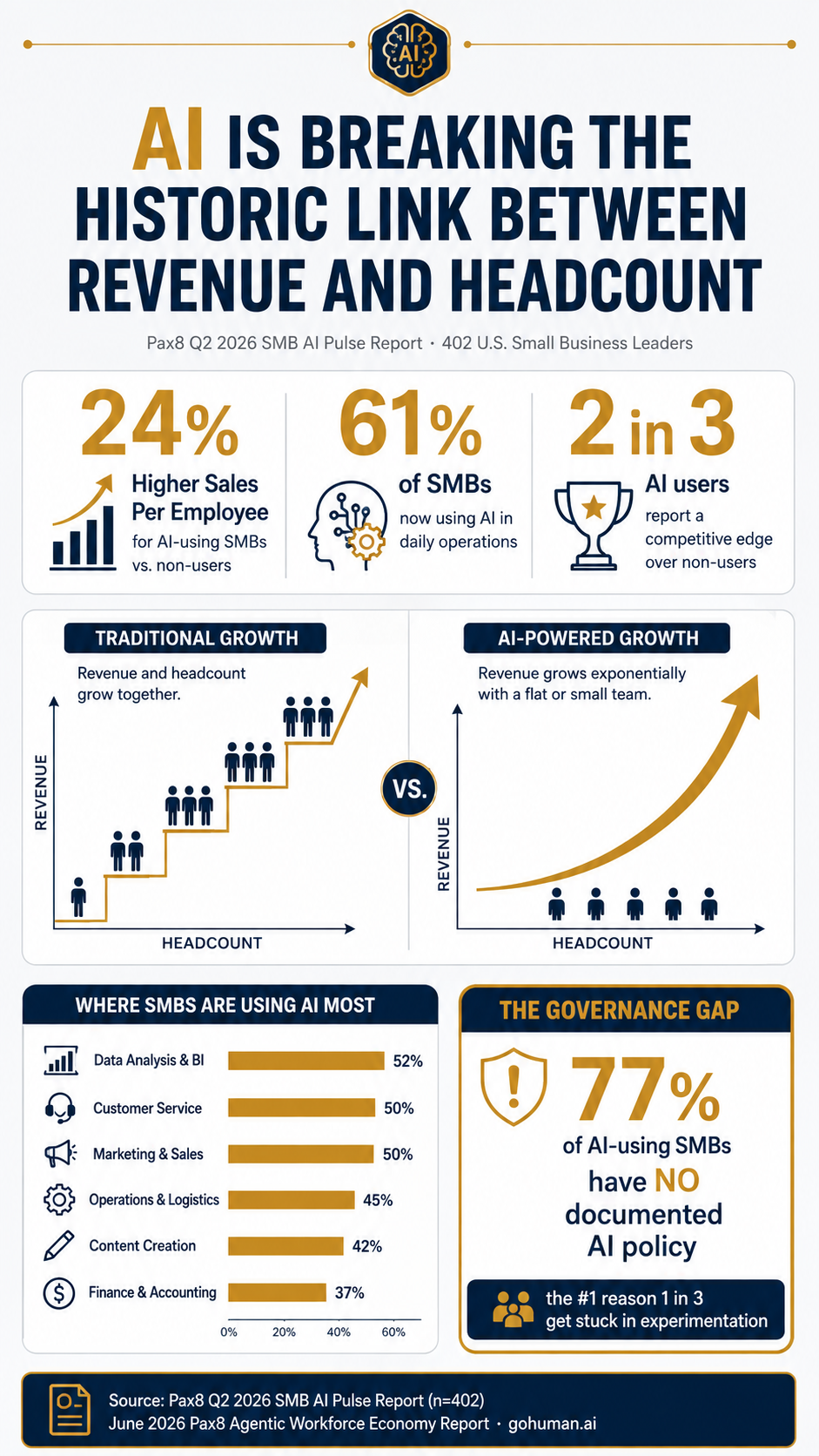
The End of Hire-to-Grow: How AI-Using SMBs Generate 24% More Revenue Per Employee
What owners are doing with recovered time that changes revenue trajectory.
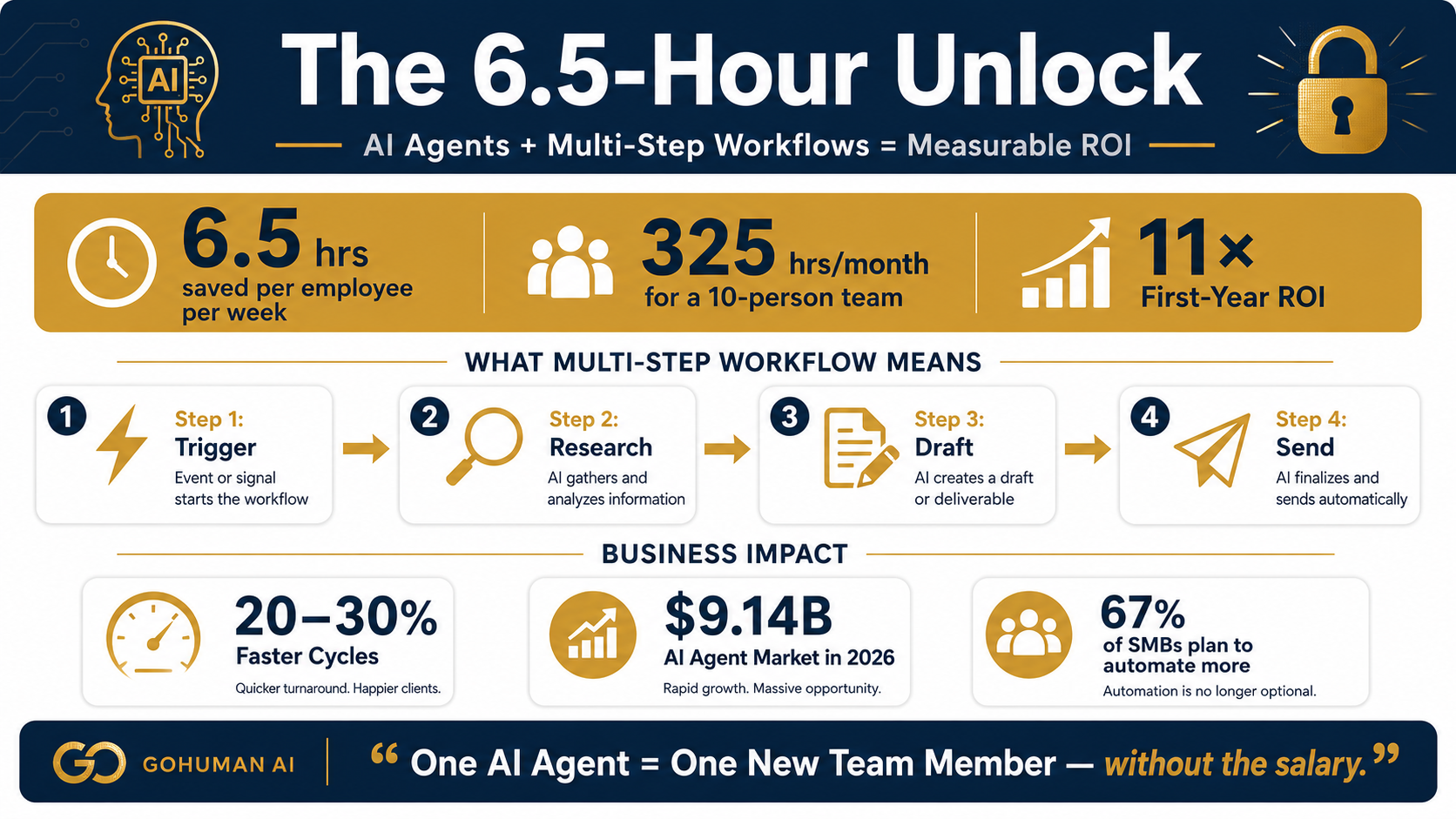
The 6.5-Hour Unlock: How Small Businesses Are Using AI Agents for Multi-Step Workflows
The workflow layer that turns one-off AI use into systematic time savings.
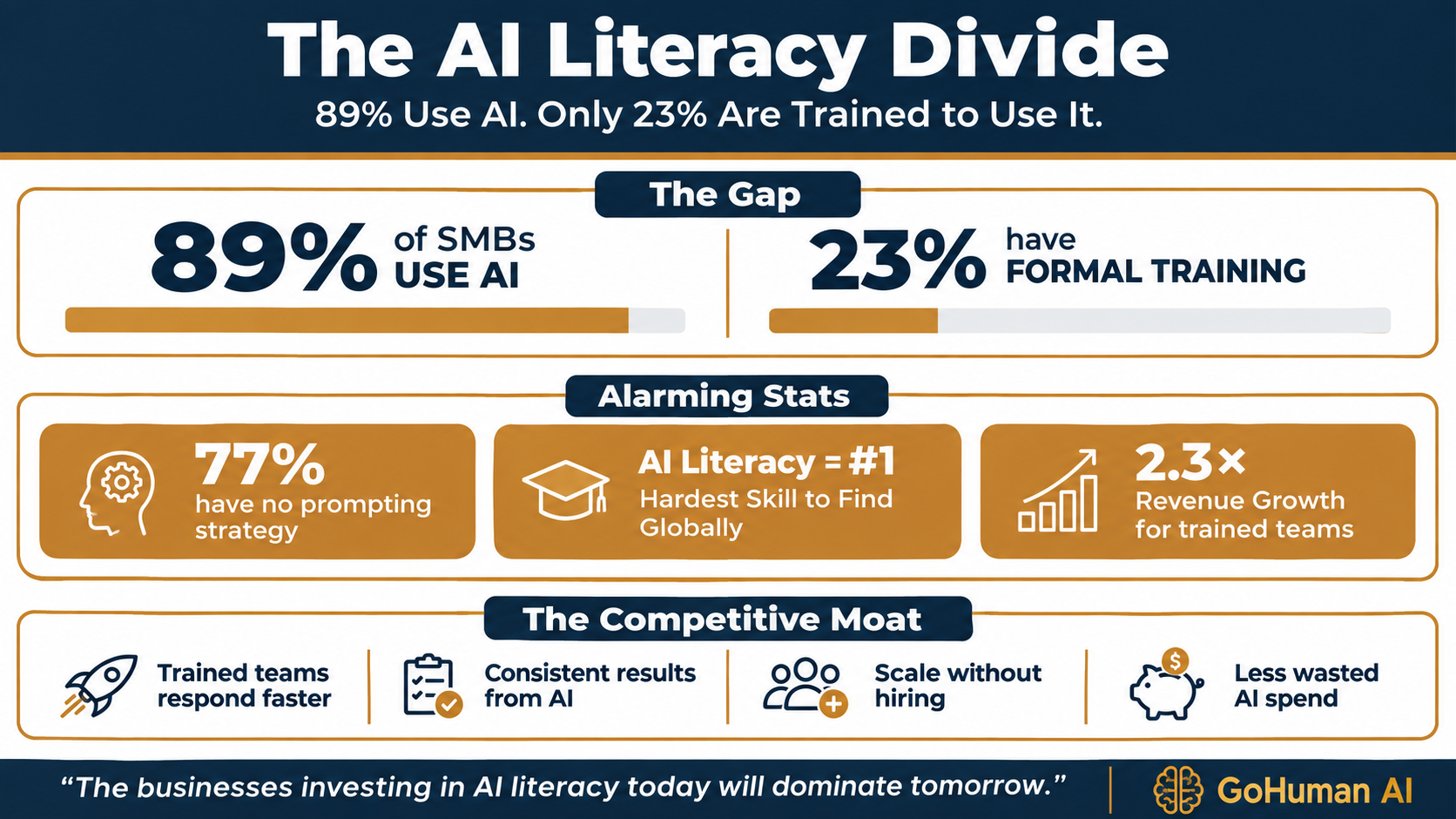
The AI Literacy Divide: 89% Use AI, But Only 23% Are Trained to Use It
Why casual use and systematic use produce completely different outcomes.
Spending more than 3 hours a day on tasks AI could handle? Let us audit where your time goes and show you what a systematic AI workflow would save you — starting this week.