
The AI Literacy Divide: 89% of Small Businesses Use AI, But Only 23% Are Actually Trained to Use It
The adoption numbers look impressive: nine out of ten small businesses now use AI. But beneath that surface sits a troubling reality. Most of those businesses are using AI without any formal training, strategy, or structure. Meanwhile, AI literacy has become the number-one hardest skill to find globally — and the businesses that are investing in it are pulling far ahead.
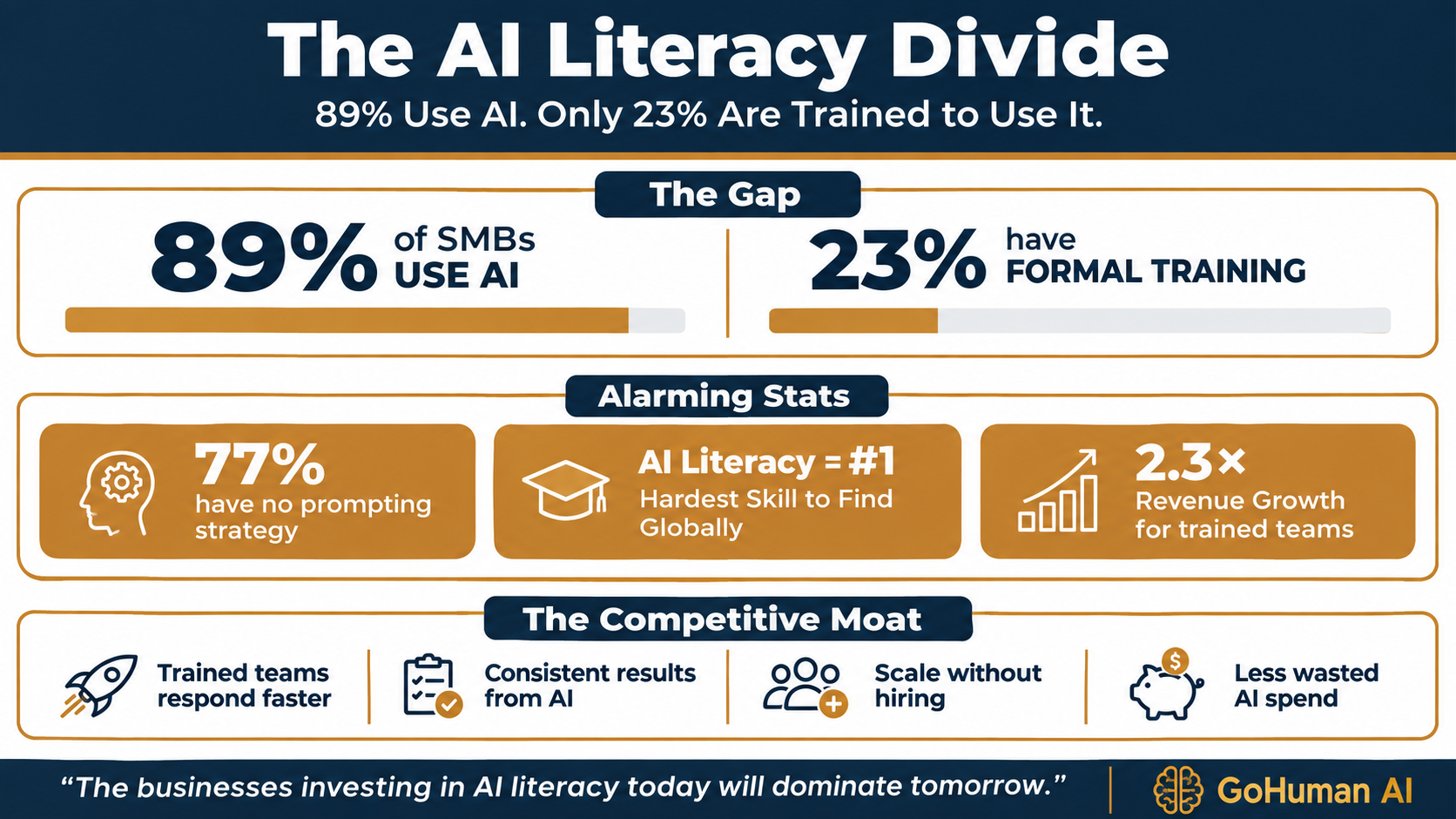
There is a quiet crisis unfolding in small business right now. It is not about whether to adopt AI — that decision has already been made. Eighty-nine percent of small businesses now report using AI in some form. The real crisis is that most of those businesses are using AI without the foundational literacy, training, or strategy to actually get measurable results from it.
The data is stark. According to DataCamp's 2026 State of Data and AI Literacy report, only 23% of small businesses using AI have received any formal training on AI tools. More striking still: 77% of SMBs currently using AI have no formal prompting strategy or system in place. They are clicking buttons, getting results, but they have no repeatable methodology for improving those results. They are optimistic amateurs, not trained operators.
Meanwhile, something else is happening. Businesses that pair AI investment with structured workforce upskilling are seeing dramatically different outcomes. According to Upwork's 2026 State of AI Within SMBs research, small businesses that have upskilled their teams report 2.3 times more revenue growth than those that have not. AI literacy is no longer a nice-to-have skill — it has become the number-one hardest-to-find competency globally, according to ManpowerGroup's 2026 Global Talent Shortage survey, even outpacing specialized technical skills.
This gap is not a bug. It is an opportunity. And it is closing fast.
The Adoption vs. Training Paradox
The numbers tell a surprising story about AI adoption in small business. When researchers ask "Do you use AI?" nine in ten say yes. When they ask "How many of your employees have received formal training on AI tools?" that number collapses to less than one in four. When they ask "Do you have a documented strategy for how your team uses AI?" it gets worse. More than three-quarters say no.
This is not negligence or ignorance. It is the natural result of how AI adoption happened in small business. Most SMBs did not plan their AI transition the way a Fortune 500 company would. They did not commission a consulting firm, map out a strategy, and train their teams first. Instead, they discovered AI organically — an employee found ChatGPT or Claude, started using it, saw a time savings, and suddenly the whole team was experimenting. The AI was there before the strategy was.
That kind of organic adoption gets you to 89%. But it does not get you to results. It gets you to random, ad-hoc usage — some people prompting effectively, some people prompting poorly, no consistency, no learning curve, no compounding improvement.
89%
Of SMBs Use AI
23%
Have Formal Training
77%
No Prompting Strategy
Why This Gap Is Creating a Competitive Moat
The opportunity embedded in this gap is real and it is widening. When AI literacy becomes the number-one hardest skill to find globally, it stops being a competitive advantage and starts being a competitive moat. The businesses that invested in upskilling their teams early are not just ahead — they are increasingly unreachable by competitors who are still figuring out the basics.
Here is what the data shows: businesses that pair AI investment with structured capability-building are nearly twice as likely to see strong returns on their AI investments, according to DataCamp research. That is not a marginal difference. That is a factor of two. It means that for every dollar you spend on AI tools, a structured training program can double your returns.
And here is the timing: according to Upwork, only 8% of small businesses have reached advanced AI adoption levels. Ninety-two percent are still in early or experimental stages, investing in one or two use cases without a broader strategy. That means the businesses that build a real AI literacy program now — today, not next year — are moving into a tier that most of their competitors will not reach for years.
The gap is closing because the competition is waking up. But there is still a window. And that window is shrinking.
The reframe that changes the outcome:
Stop thinking of AI as a tool your team figures out on the fly. Start thinking of AI literacy as a strategic capability — one that requires training, strategy, and ongoing discipline, just like sales, finance, or customer service. The businesses that treat it that way are the ones pulling ahead.
What "AI Literacy" Actually Means for a Small Business
You do not need your team to become AI researchers or machine learning engineers. That is not what AI literacy means in a small business context. It means:
Understanding what AI is actually good for. Most people know AI can write and summarize. Fewer know that the real productivity gains in small business come from using AI for decision support, information retrieval, workflow automation, and autonomous task execution. Knowing which tool to use for which job is the foundation of literacy.
Having a repeatable prompting method. The difference between a bad AI output and a good one is often just the prompt. A team with a structured approach to prompting — one that is documented and taught — gets consistently better results than a team where everyone is guessing. This is where 77% of SMBs still are: guessing.
Building oversight into workflows. AI agents and autonomous systems work best when there is a human in the loop — someone who understands the output well enough to catch mistakes before they become costly ones. That requires training.
Knowing where to invest your AI budget. Not every workflow needs AI. The businesses pulling ahead are strategic about which processes get AI treatment, measuring the impact, and scaling what works. That is a learned skill.
The Three Tiers of AI Maturity in Small Business
The research shows a clear pattern: small businesses fall into three distinct tiers when it comes to AI adoption.
Tier 1: The Explorers. These are businesses using AI but with no formal training or strategy. They are seeing some time savings but not transformational results. They represent most of the 89% — probably close to two-thirds of them. They are generating value, but inefficiently. They are also highly vulnerable: one bad AI output, one mistake that slips through, and their confidence erodes. They are one incident away from pulling back.
Tier 2: The Strategists. These are the 23% who have received formal training or who have built a documented approach. They are seeing larger gains, more consistent results, and they are confident enough to expand AI into new areas. They are the ones starting to see 20%+ revenue growth. They are ahead of Tier 1, but they are not yet at scale.
Tier 3: The Operators. These are the 8% who have reached advanced AI adoption — AI is woven into their core workflows, their team is trained, and they have built accountability structures. They are seeing 2.3x+ revenue growth compared to non-AI businesses. They are not just winning — they are in a different competitive league than everyone else.
The move from Tier 1 to Tier 2 does not require a big budget. It requires a plan. Training and structured methodology are cheap compared to the gains they unlock. The move from Tier 2 to Tier 3 requires discipline and time, but it compounds dramatically.
What This Means for Your Business Right Now
If you are already using AI in your business, you have a head start on the majority. But if you are doing it without formal training or strategy, you are leaving massive gains on the table. The data is clear: the same businesses, with the same tools, are getting radically different results based on whether they have structured their approach.
Here is the practical path forward:
Audit your current usage. Which workflows are you already using AI in? What are you getting from it? Where is it working, and where is it creating problems? That audit is the foundation.
Build a prompting standard. Document how your team should approach AI — what questions to ask, what context to provide, how to evaluate outputs, how to iterate. This is not complicated, but it is important. It is the difference between Tier 1 and Tier 2.
Train your team. Not just on the tools, but on the methodology. Show them what good prompting looks like. Show them the workflows where AI adds the most value. Build their confidence through structure, not just through access.
Measure and scale. Pick one area where you want to expand AI usage. Measure the impact. If it works, scale it. If it does not, learn why and iterate. This is how businesses move from Tier 2 to Tier 3.
The window for competitive advantage in AI literacy is still open. But it is closing. The businesses that move from 89% adoption to 23%-level training to 8%-level operations are the ones that will be unreachable by the time their competitors catch up.
At GoHuman AI, we help small business owners build this kind of structured, strategic approach to AI. We start with an audit of where you are, build a roadmap to where you need to be, and deploy AI agents and workflows with the training and oversight that actually closes the gap between adoption and results. If you want to move from Tier 1 to Tier 2, or from Tier 2 to competitive leadership, that conversation is exactly where we start.
Related Reading
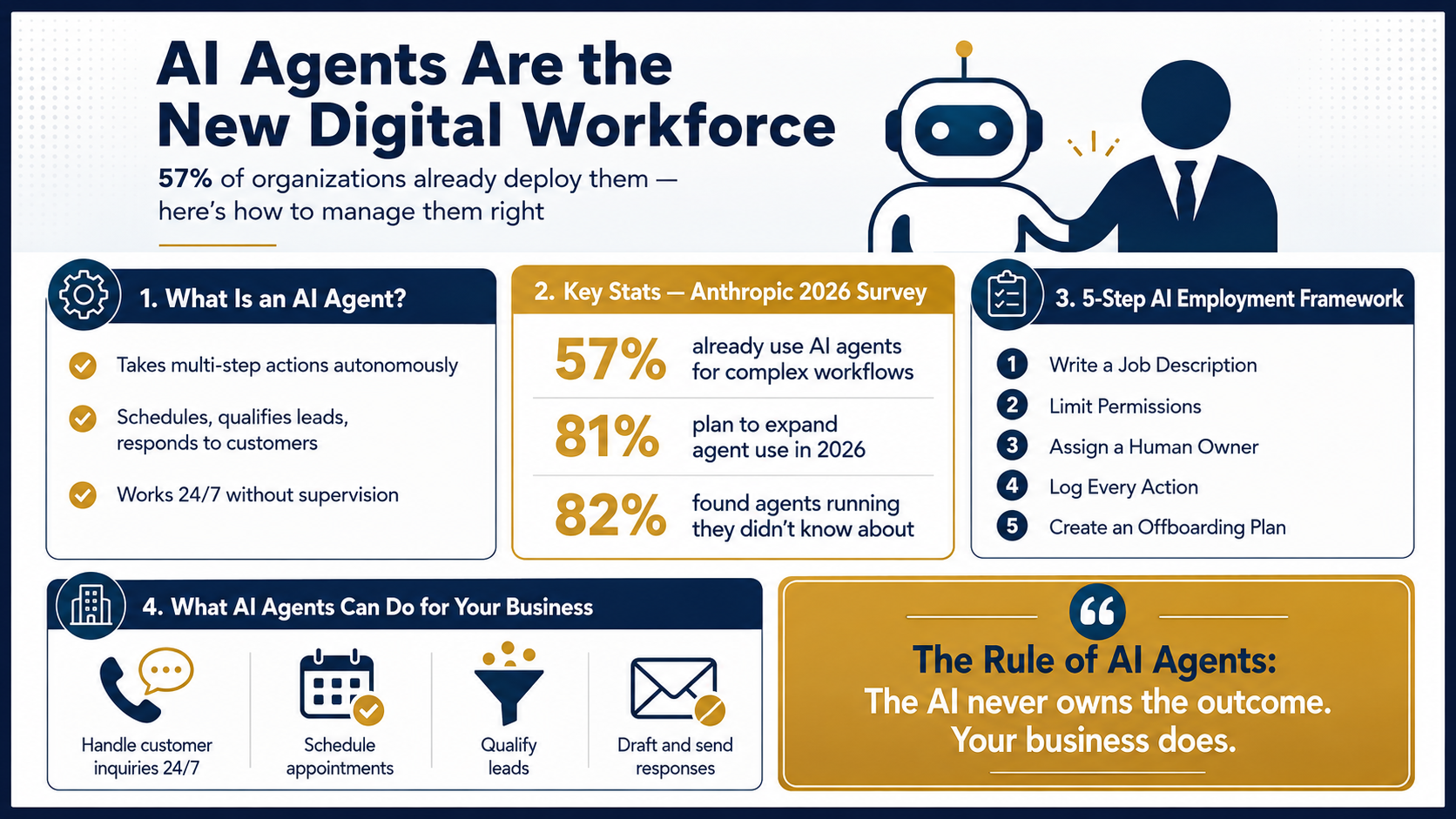
Why Every AI Agent Needs a Human in the Loop
How structured oversight ensures AI agents are safe, trustworthy, and accountable.
Your First AI Employee: What Small Business Owners Need to Know About AI Agents
The practical 5-step framework for deploying your first AI agent with structure from day one.
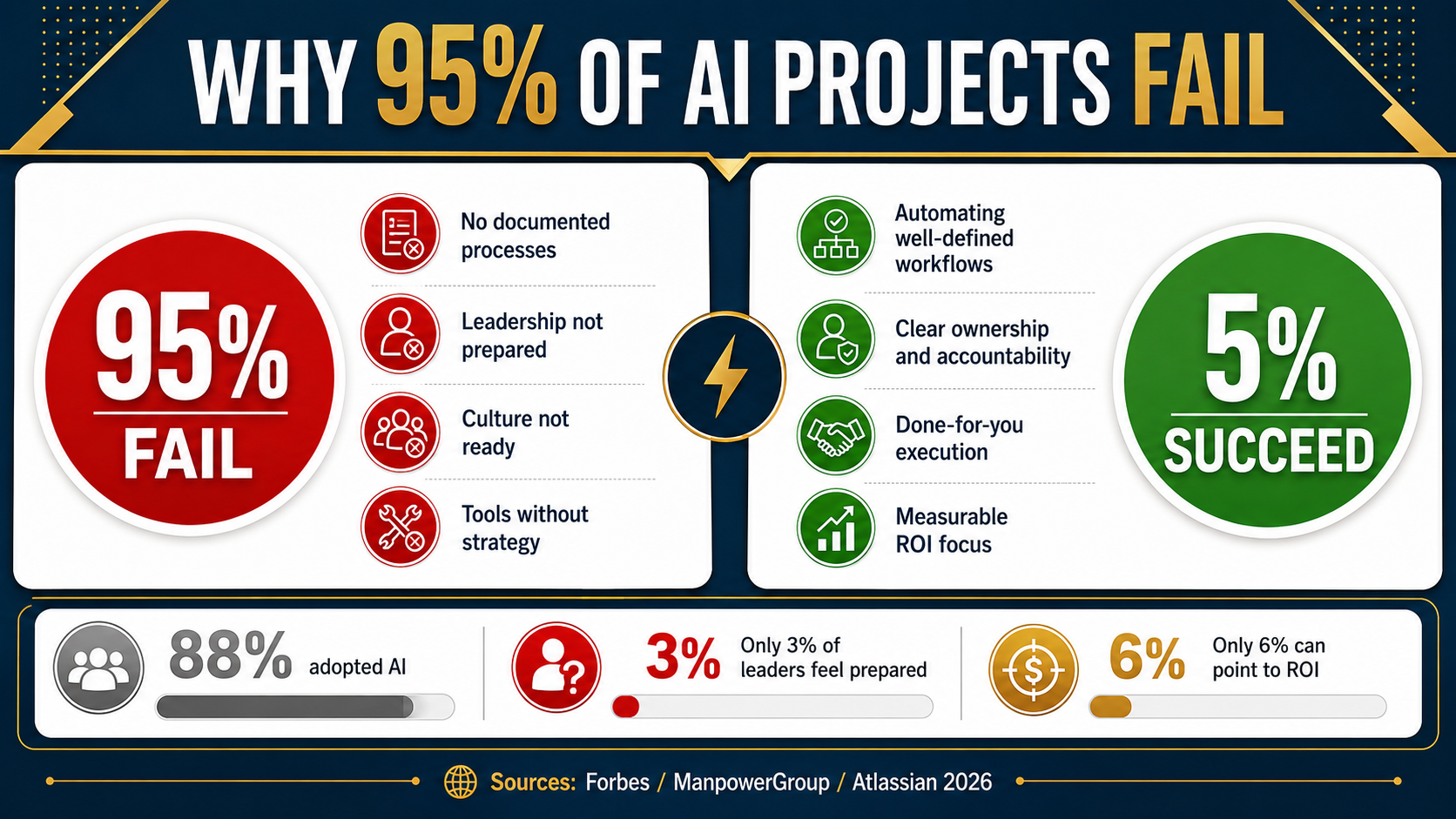
Why 95% of AI Projects Fail — And What the Successful 5% Do Differently
The pattern that separates AI implementations that compound from those that quietly disappoint.
Want to move from AI adoption to AI results? Let us build the strategy and training your team needs.