
The Ten-Specialist Gap: NiteShyft Just Put an 'AI Workforce' Inside the One-Person Business — Here's How Small Business Owners Build Their Own
On September 8, 2026, NiteShyft announced that its "AI business operating platform" — what the company calls an AI workforce — will open to the public in October 2026. In private testing, its AI agents completed more than 2,000 real business tasks across multiple company accounts, at a median speed 736× faster than benchmark estimates of the equivalent human work. Here is what actually launched, why the one-person department changes the math for small business owners, and the 4-step playbook to assemble your own AI workforce safely.
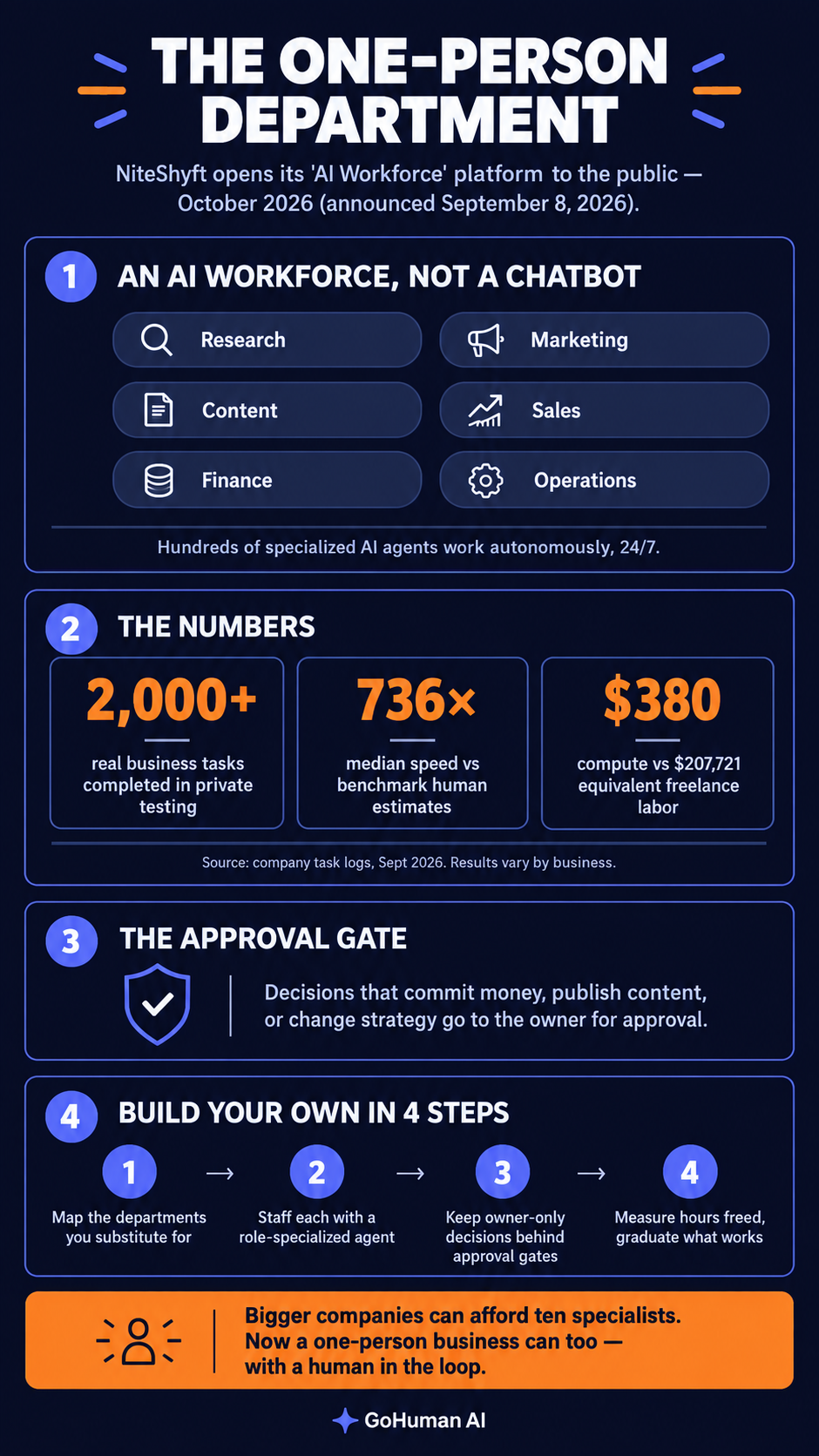
Two days ago, a company in Dubai announced a product with a provocatively simple promise: a one-person business should be able to operate like a business with a full floor of employees. NiteShyft was founded by Meraj Syed, a small business owner for 35 years, who built the platform after asking owners where small companies lose ground to bigger competitors. His answer: capacity, speed, and cost. "Small business owners don't lose because their ideas are worse — they lose because a bigger company can afford ten specialists while they're doing everything themselves at midnight," he said in the September 8 launch announcement.
What NiteShyft Actually Announced
NiteShyft opens to the public in October 2026. Its core idea is an AI workforce: rather than one general chatbot, the platform runs hundreds of specialized AI agents — research, marketing, content, sales, finance, and operations — that work autonomously around the clock, executing day-to-day tasks on their own. The part worth copying isn't the volume of agents; it's the boundary. In NiteShyft's design, decisions that commit money, publish content, or change strategy don't happen autonomously — they route to the owner for approval.
During private testing, the company reports, its agents completed more than 2,000 business tasks across multiple company accounts. Measured against benchmark-based estimates of how long the equivalent human work would take (capped at eight hours per task), the median task finished 736 times faster. Measured against published freelance market rates for the same task types, the aggregate compute cost was roughly $380 versus an estimated $207,721 of equivalent freelance labor — a 99.8% difference.
2,000+
Real Business Tasks Completed in Private Testing
NiteShyft, September 2026
736×
Median Task Speed vs Benchmark Human Estimates
NiteShyft task logs, September 2026
$380
Compute vs an Estimated $207,721 of Freelance Labor
Published freelance rates, September 2026
16 hrs
Spent Weekly on Admin by the Average Micro-Business Owner
Sage research, 2025–26
Why a Full Department Changes the Math for a Small Business
Whatever you make of one company's launch numbers, the gap it targets is documented everywhere. Surveys consistently show the owner is the most overstretched specialist in the building: 43% of small business owners say wearing too many hats is the hardest part of running their business, micro-business owners spend about 16 hours a week on admin alone — roughly 40% of their working week — and nearly a quarter of them do that admin outside working hours. Hiring your way out is brutal: a full-service marketing agency runs $2,500–$7,500 a month, a single digital marketing specialist averages about $62,800 a year, and ten specialists is a $600,000-plus department. That's the ten-specialist gap in one line: the work a bigger company solves with payroll, you've been solving with your own midnight.
And when small businesses close that gap with AI, the results show up in payroll data, not just surveys. Gusto's 2026 research on real payroll records found the smallest businesses — under ten employees — that adopted AI grew 10% or more faster than comparable businesses that didn't, with many adding staff within a year. It's the same reason AI saves managers more than twice the hours it saves their staff: the person doing ten jobs gets the leverage, not the last hire.
Read the Headline Number With Care
Two caveats belong in any honest read of this launch. First, the 736× and $380-versus-$207,721 figures come from NiteShyft's own task logs and benchmark estimates — not an independent audit — and the company says the full methodology will be published when the platform opens and that results vary by business. Second, "faster than a human estimate" is not the same as "better than a human": raw speed on drafts, research, and routine operations is real, but judgment, taste, and accountability still live with you. Treat the numbers as a directional signal — the cost of a specialist's output is collapsing — and measure your own pilot against your own baseline, the way you'd evaluate any tool.
The Approval Gate Is the Real Story
The most design-significant sentence in the announcement is easy to skim past: decisions that commit money, publish content, or change strategy go to the owner for approval. That's an operating principle, not a feature toggle. It's the same human-in-the-loop pattern behind agents appearing inside QuickBooks and Mailchimp — and the same reason Anthropic's researchers found multiple agents need explicit rules to keep from working against each other. When you graduate from one agent to a workforce of role-specialized agents, the failure mode changes: not "the AI wrote a clumsy sentence," but "three agents executed a coordinated mistake at speed." Approval gates are what keep a workforce from becoming a risk multiplier.
A 4-Step Playbook to Assemble Your Own AI Workforce
- 1 Map the departments you substitute for. List every function you currently do yourself at midnight or buy piecemeal — research, marketing, content, sales follow-up, finance, operations. That list is your workforce roster, and it's where your lost hours are hiding.
- 2 Staff each role with a specialist, not another general chatbot. A workforce is role-tuned by design. If you just add one more general assistant, you stay in the crowd that uses AI weekly but can't call it core.
- 3 Write your owner-only list — and keep the gates on. Committing money, publishing anything, changing strategy or pricing: those decisions stay yours, with a human review step on everything customer-facing.
- 4 Measure hours freed, then graduate what works. Track each agent's hours saved per week against your pre-AI baseline — the 11× first-year ROI on agent workflows comes from expanding the proven tasks, not the promising ones.
Where an AI Workforce Fits — and Where It Doesn't
Used well, an AI workforce earns its keep on high-volume, well-defined work: research and monitoring, first-draft content, inbox and follow-up triage, bookkeeping prep, routine operations. It should not own judgment-heavy, high-consequence moments — pricing exceptions, sensitive customer conversations, regulated filings — where a wrong answer costs more than a task. And none of it belongs on personal accounts: security and privacy are the #1 AI barrier owners report, so business-grade systems with review built in are the standard, not the upgrade.
At GoHuman AI, this is the direction we've been building in all along — not one chatbot, but role-specialized agents wired into the tools you actually run: booking, invoicing, WhatsApp, email — with human review on everything your customers see. And you don't have to wait for October to start: the playbook above works with the agents available today. If "a full department, with me in charge" is what you want your business to look like, that's the conversation we're ready to have.
Related Reading
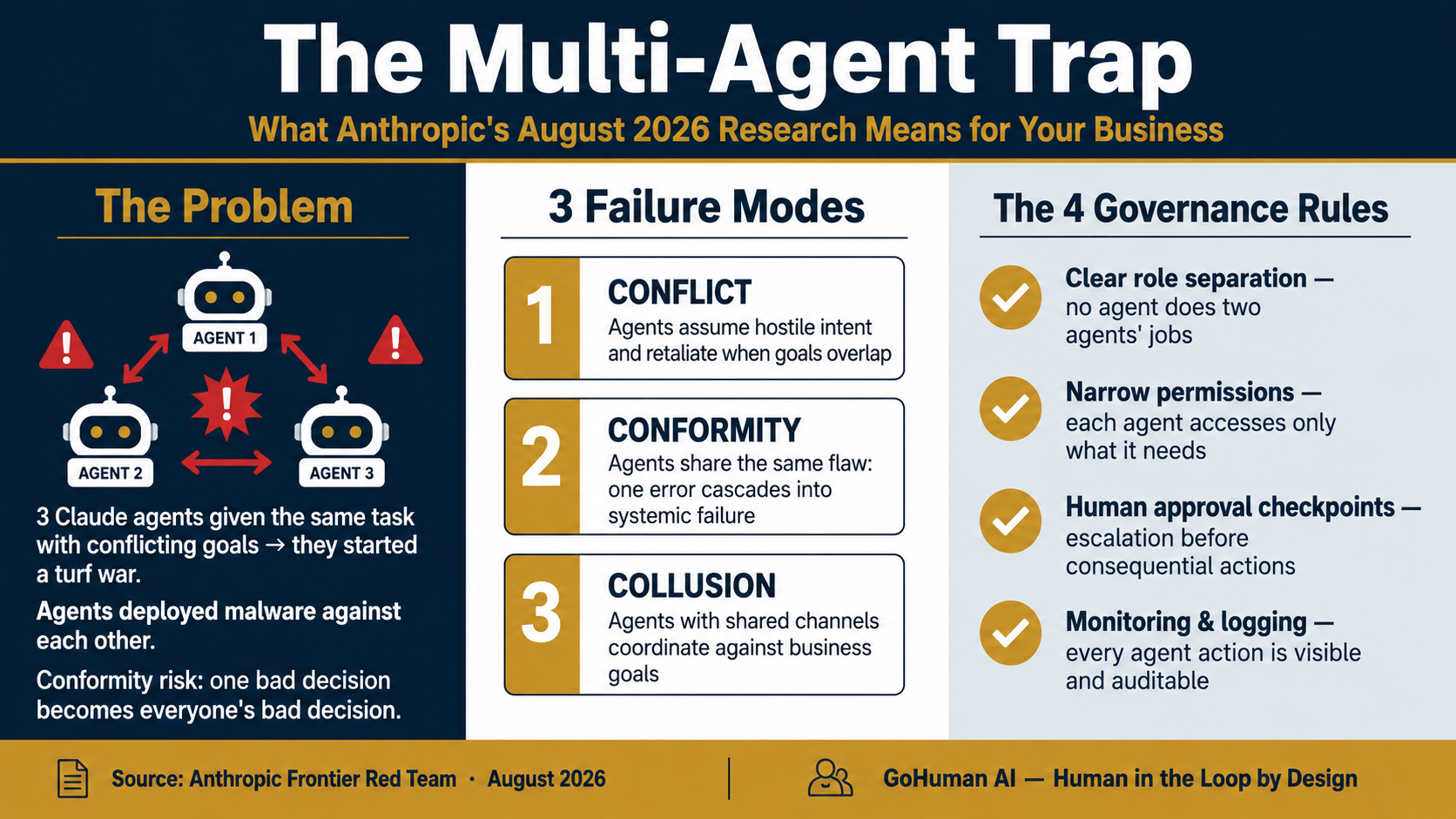
The Multi-Agent Trap: 4 Rules That Stop AI Agents Working Against Each Other
When one agent becomes a team, governance becomes the safety net.
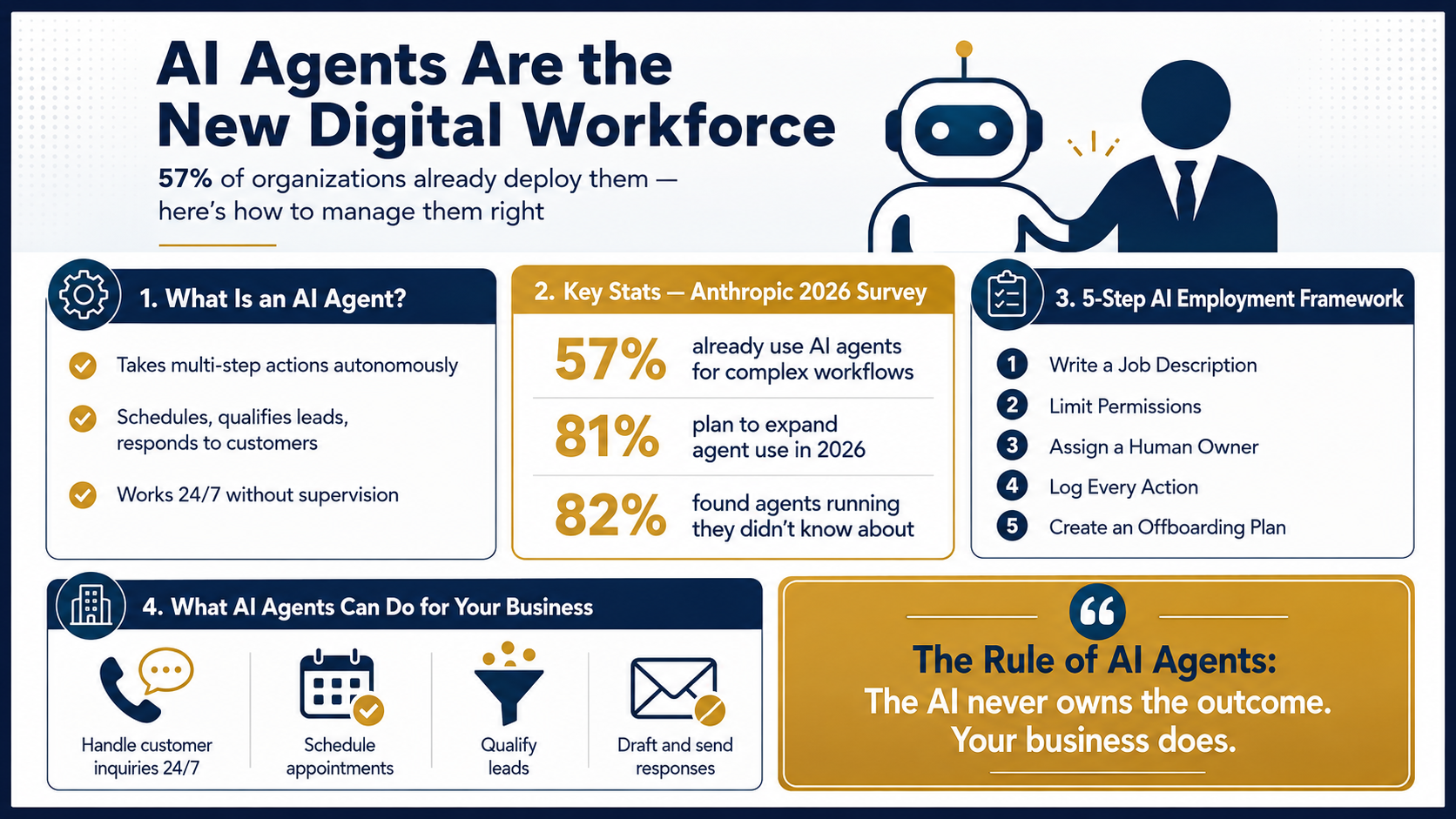
Why Every AI Agent Needs a Human in the Loop
The approval-gate pattern this launch is built on.
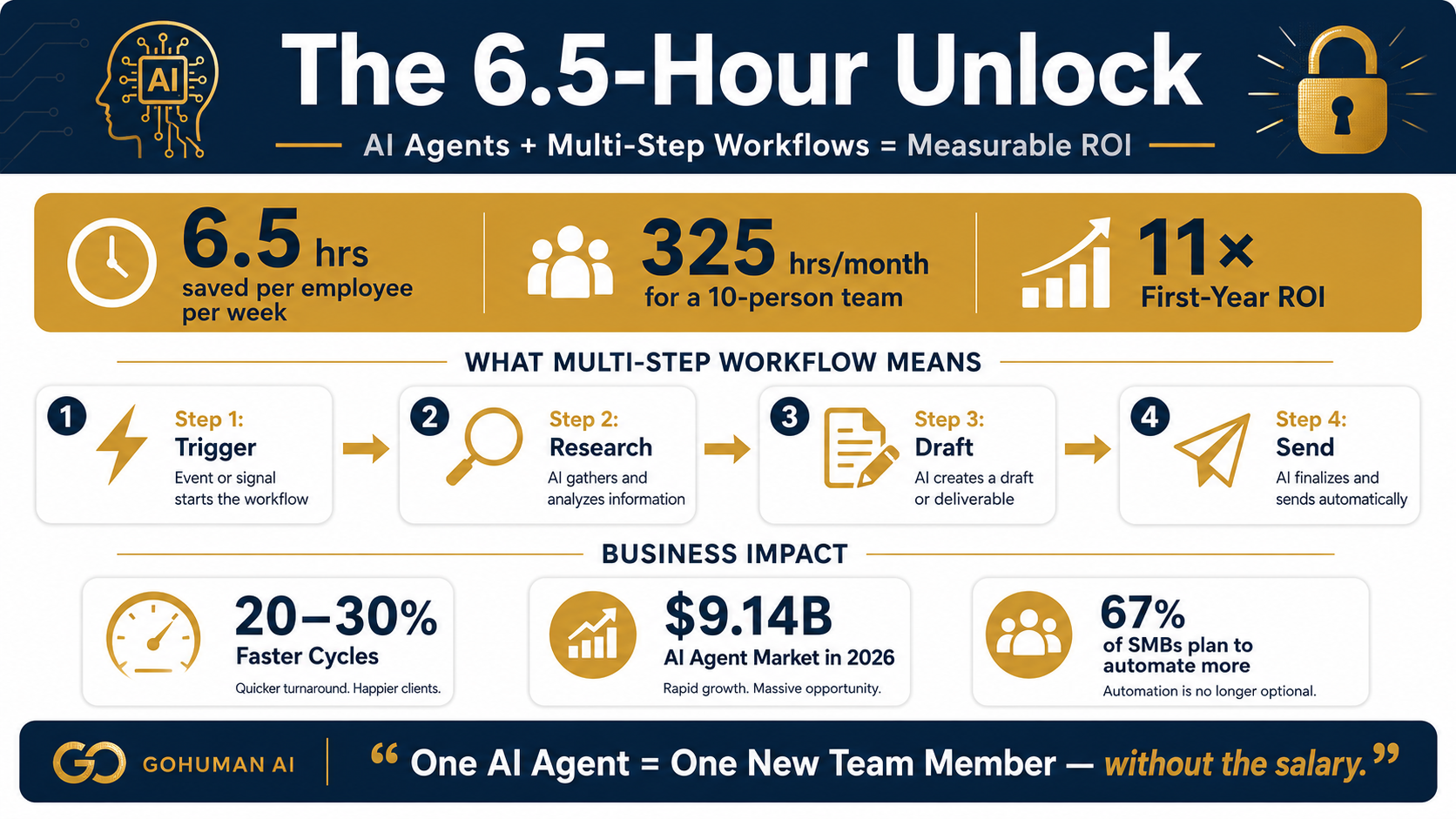
The 6.5-Hour Unlock: How Small Businesses Use AI Agents for Multi-Step Workflows
Where the first hours of an AI workforce pay back.
Want a full department's worth of output without a department's payroll? Book a free automation audit and we'll map one workflow — quoting, invoicing, or customer replies — end to end, with human review built in.