
The Confidence Gap: Small Business AI Adoption Doubled to 47% — But Only 19% Feel Very Confident Using It
On September 8, 2026, Simply Business published its 2026 SME Insights Report, and the headline number is striking: 47% of small business owners now use AI — more than double the 22% recorded in 2025. But adoption and capability are not the same thing. Only 19% describe themselves as very confident using AI day to day, a third use it just for routine admin, and the top barriers are security and privacy fears (44%), not seeing a clear use (39%), and accuracy worries (36%). Here is what the confidence gap means, and the 4-step checklist to close it safely.
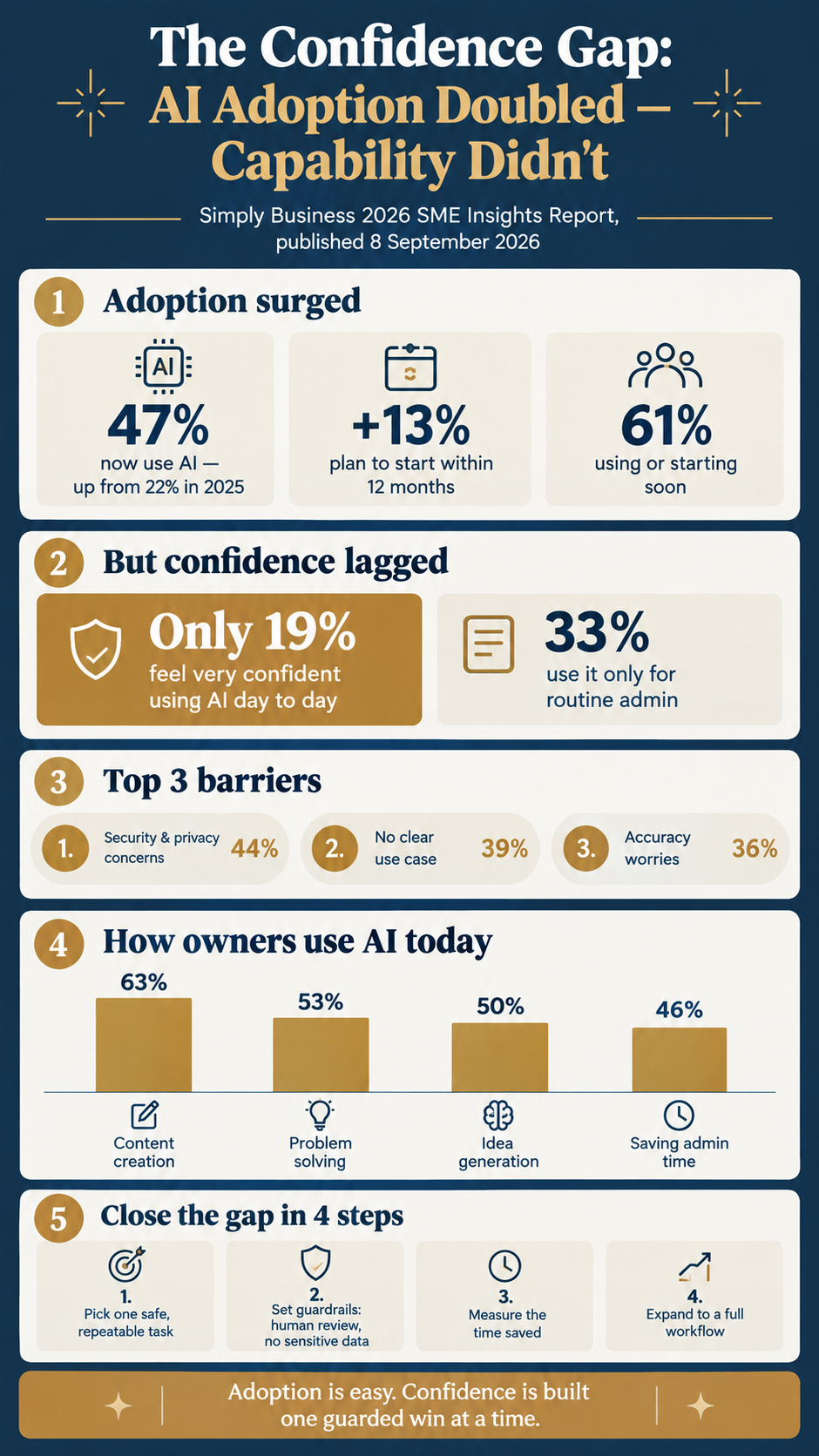
Every year, Simply Business — one of the UK's largest small business insurers — surveys thousands of small business owners for its SME Insights Report. The 2026 edition, published September 8, captures the fastest change the survey has ever recorded: AI adoption among small businesses more than doubled in a single year, from 22% to 47%. Another 13% plan to start within six to twelve months, meaning six in ten owners are either using AI now or about to. By any measure, the "wait and see" period is over.
But buried one paragraph below the headline is the number that actually matters: just 19% of owners describe themselves as very confident using AI day to day. Adoption doubled. Confidence didn't. And that gap — between owning the tool and knowing what to do with it — is where the next year of small business competition will be decided.
What the Report Found
The usage data tells you exactly how the average small business uses AI today: content creation (63%), problem solving (53%), and idea generation (50%). Nearly half (46%) say AI is saving them time on admin. Those are real, immediate wins — but notice what they have in common. They are all solo, low-stakes, single-step tasks. The report also found that a third of users (33%) limit AI to routine admin, which is precisely where its leverage is smallest.
47%
Now Use AI — Up From 22% in 2025
Simply Business, 2026
19%
Feel Very Confident Using It Daily
Simply Business, 2026
33%
Use It Only for Routine Admin
Simply Business, 2026
44%
Hold Back Over Security & Privacy
Simply Business, 2026
The Three Things Holding Owners Back
When Simply Business asked non-adopters and cautious users what was stopping them, three answers dominated. First, security and privacy concerns (44%) — the most cited barrier, and a reasonable one: owners are rightly wary of pasting customer data, financials, or contracts into tools they don't fully control. Second, not seeing a clear use case (39%) — the technology is everywhere, but nobody has shown these owners their specific workflow with AI inside it. Third, accuracy worries (36%) — the fear of confidently wrong answers reaching a customer.
Nearly a third of owners (31%) admit they simply don't understand how to use AI or are wary of integrating it into their work. Julie Fisher, Simply Business's CEO, framed the remedy well: small businesses need "tailored guidance on how AI can be used, accessible tools, and time to discover how it can work for them on their terms." The report's own conclusion is blunt: the obstacle is not access to the technology — it is clarity on its practical application.
This is worth pausing on, because it inverts the usual story. The common narrative is that small businesses are behind on AI adoption. This data says adoption is nearly half of the market and climbing fast — the real divide is the AI literacy gap, and it is widening. Two competitors can run the same AI tools; the one with confidence uses them to rebuild a workflow, and the research on that difference is stark: businesses that embed AI in connected workflows report a 55-point productivity advantage over those using the same tools as bolt-on helpers.
Confidence Isn't Taught — It's Built, One Guarded Win at a Time
Here is the practical takeaway from the report, and it applies well beyond the UK: confidence comes from completing one safe, bounded AI task end to end — not from reading about AI, and not from buying another tool. The 44% who fear for their data security don't need reassurance; they need a setup where the sensitive data never touches the AI in the first place. The 36% worried about accuracy don't need a better model; they need a human review step before anything reaches a customer. Both of those are human-in-the-loop design decisions, and they are exactly what turns wariness into trust.
The security barrier also has a concrete fix. Owners concerned about privacy should start with the same AI security fundamentals defenders use: keep customer and payment data out of general-purpose AI tools, use enterprise or business plans with data controls rather than free consumer accounts, and never let AI send anything externally without approval. Meanwhile, the "no clear use case" problem dissolves the moment you stop asking "what is AI good for?" and start asking "which of my repetitive tasks would I happily hand off?" For most owners that first task is something like drafting customer email replies, summarizing invoices, or turning a messy quote request into a clean quote — and it should grow from there into something bigger, like systematic marketing automation, where the ROI numbers (544% for the systematic users) dwarf the content-shortcut crowd.
A 4-Step Checklist to Build AI Confidence Safely
- 1 Pick one safe, repeatable task. Choose something low-stakes you do weekly — drafting replies, summarizing documents, cleaning up notes. Avoid anything involving payments, contracts, or customer data for now. Write down how long it takes you today.
- 2 Set guardrails before you start. Three rules are enough: no sensitive data goes in, everything gets human review before it reaches a customer, and you use a business plan with data-privacy controls — not a free consumer account. These directly neutralize the report's top three barriers.
- 3 Do it for two weeks and measure. Compare the time the task takes now versus your baseline. Confidence is a feedback loop: one measured win is worth more than a month of webinars, and it tells you whether the task was a good candidate at all.
- 4 Expand to a workflow, then to an agent. Once one task is trusted, chain it to the next — draft to review to send, or quote to follow-up to booking. That's the point where AI stops being a helper and starts being your first AI agent, and where the real ROI numbers (11× first-year returns on multi-step workflows) begin.
At GoHuman AI, we see the confidence gap every day — owners who use AI for emails but would never let it near their quoting or invoicing. Our approach is built for exactly that: start with one outcome, wire it end to end with human review on everything customer-facing, prove the time saved, then expand. Adoption doubled last year. The owners who close the confidence gap this year are the ones who stop treating AI as a curiosity and start treating it as a system — one guarded win at a time.
Related Reading
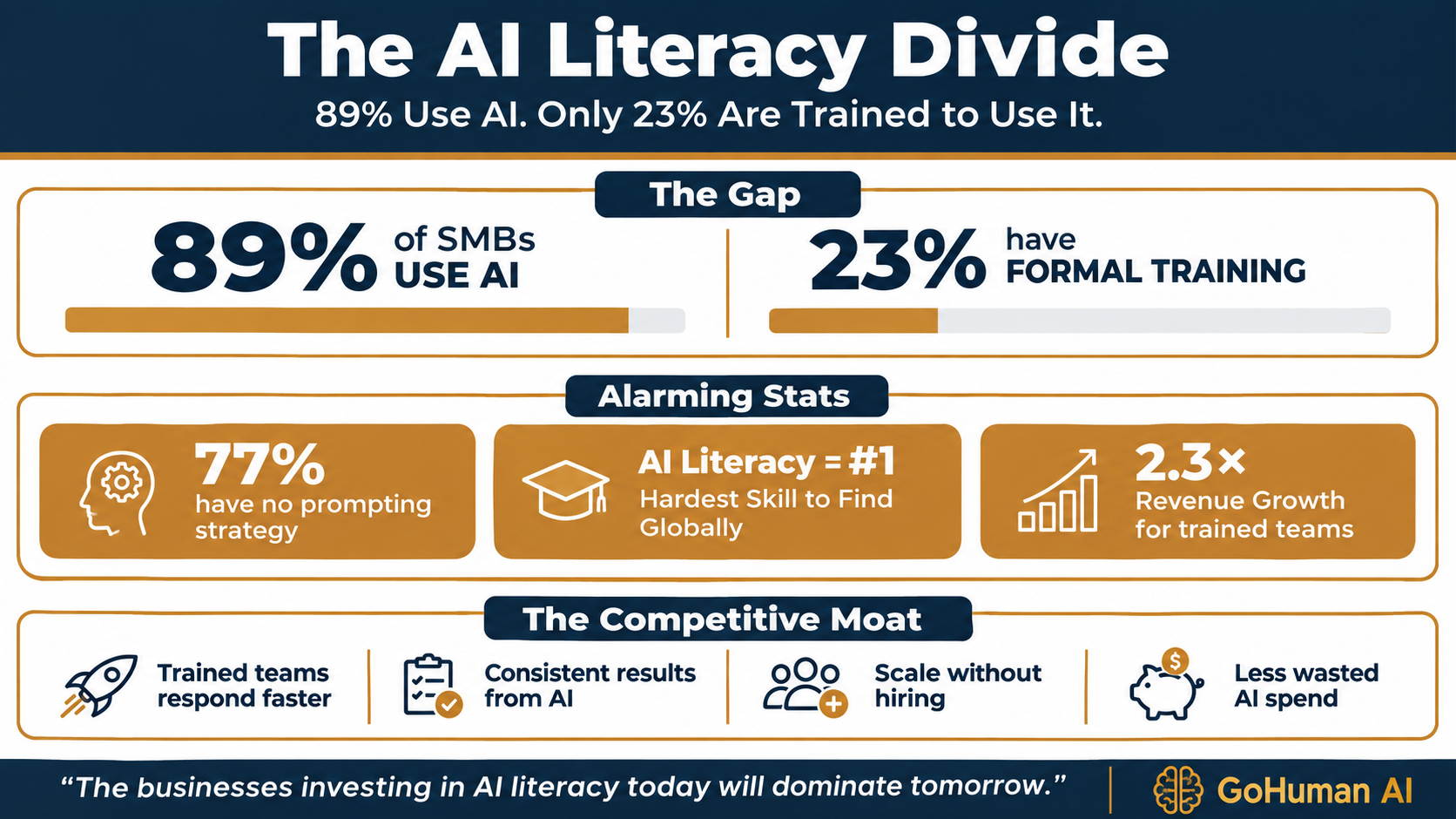
The AI Literacy Divide: 89% of Small Businesses Use AI, But Only 23% Are Actually Trained to Use It
The skills side of the same gap — and why it creates a competitive moat.
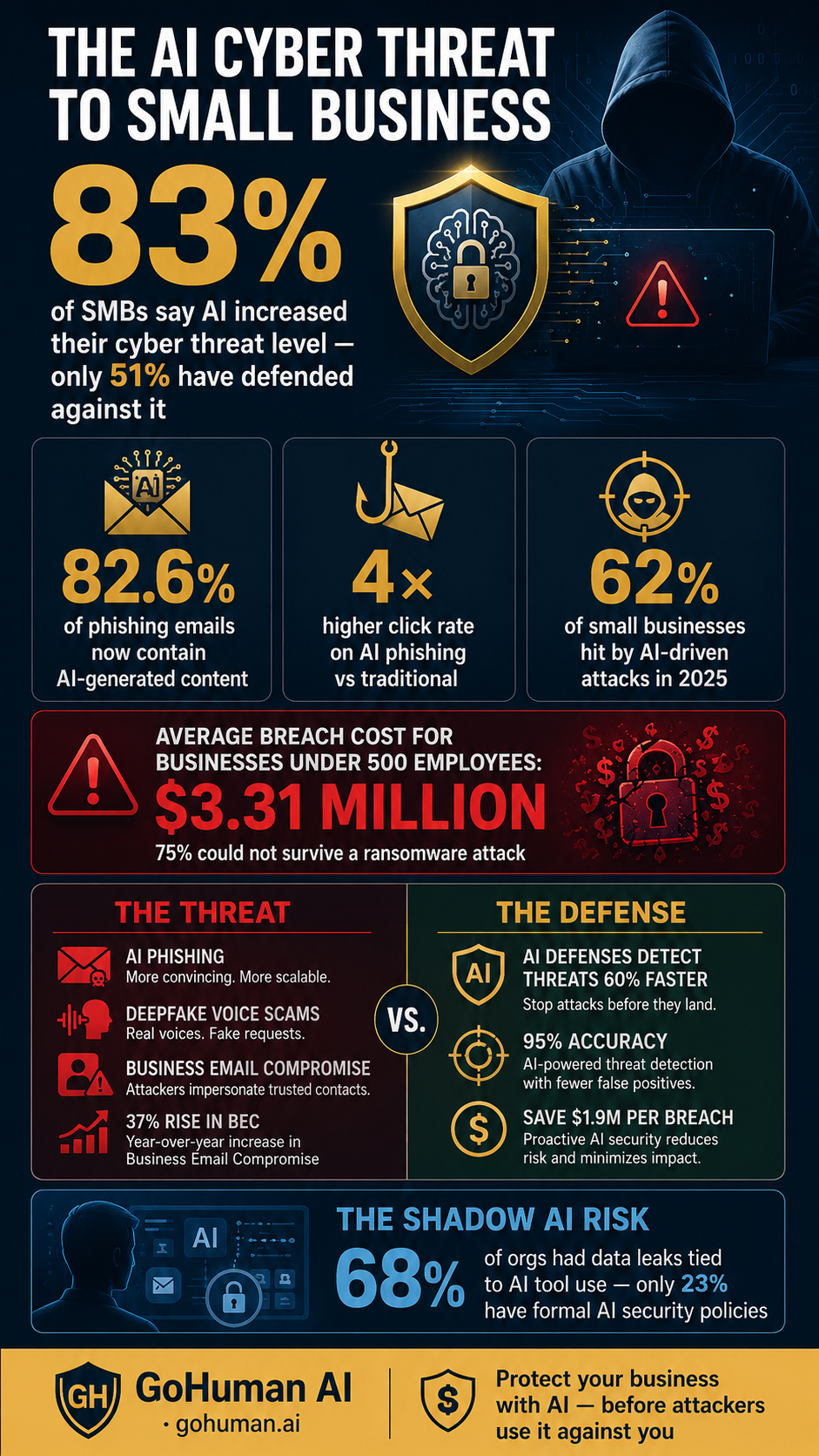
The 83% Warning: AI Is Supercharging Cyber Attacks on Small Businesses
The security fundamentals that address the report's #1 barrier.
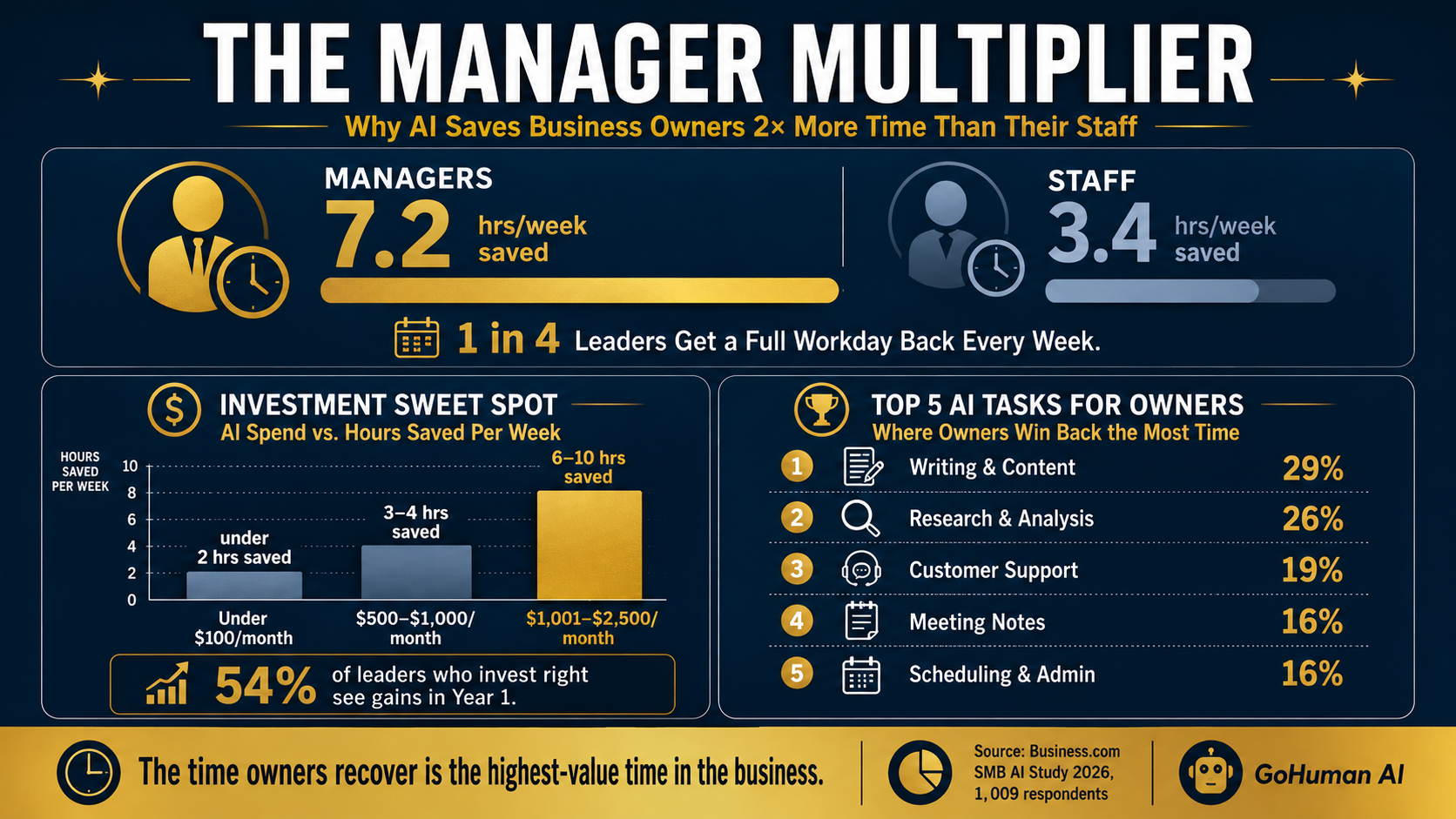
The Manager Multiplier: AI Saves Business Owners 2× More Hours Per Week Than Their Staff
What confident, embedded AI use actually returns in hours.
Using AI for emails but nothing else? Book a free automation audit and we'll map one safe, high-value workflow end to end — with human review built in.