
The 83% Warning: AI Is Supercharging Cyber Attacks on Small Businesses — And Most Owners Still Haven't Defended Against It
The same AI tools making your business more productive are making attackers more dangerous. New 2026 data shows 83% of small businesses say AI has increased their cybersecurity threat level — yet only 51% have implemented any AI-related defenses. Here is what the threat looks like today, why small businesses are the primary target, and how to close the gap before it costs you everything.
Every article about AI and small business this year has focused on what AI can do for you: save hours, cut costs, grow revenue. That story is real. But there is a second AI story that almost nobody in the small business space is talking about — and it is happening to you right now whether you know it or not. The same AI breakthroughs that made business tools dramatically more capable in 2025 and 2026 also made the tools attackers use dramatically more capable. And the target they keep coming back to is small business.
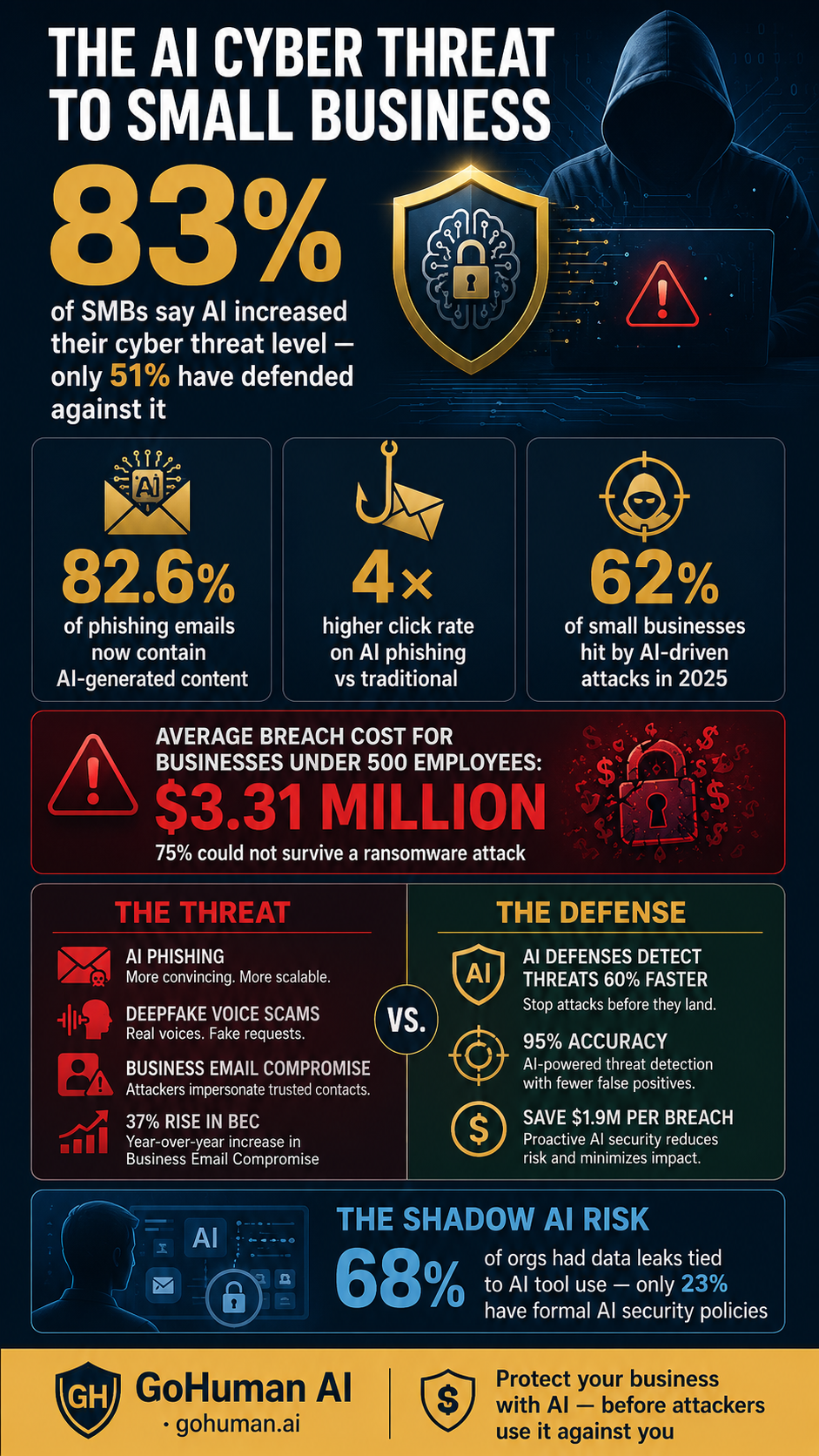
New 2026 data from CloudSecureTech puts a number on the awareness gap: 83% of small and mid-sized businesses say AI has increased the cybersecurity threat level they face — up sharply from prior years — yet only 51% have implemented any AI-related defenses. That 32-point gap between threat recognition and defensive action is the opening that attackers are exploiting, and the data on what they are doing with it is alarming.
What Changed: Why AI Made Cybercrime Dramatically Worse
Before 2024, most phishing emails had obvious tells: awkward grammar, generic salutations, unconvincing urgency. Your employees could spot them. Attackers had to choose between volume (mass generic attacks) and quality (expensive, manually crafted targeted attacks) — and small businesses were often too small to justify the cost of targeted attacks.
Generative AI eliminated that trade-off. Today, an attacker can feed a language model publicly available information — your LinkedIn page, your company website, recent press mentions, your vendors' names, a team member's email signature — and generate thousands of highly personalized, grammatically perfect phishing emails in minutes. No human effort required. No tell-tale grammar errors. The email references your actual supplier, uses the right terminology for your industry, and reads exactly like a message from someone your team works with.
82.6%
of Phishing Emails
now contain AI-generated content — 2026
4×
Higher Click Rate
AI phishing vs traditional emails
37%
Rise in Business Email Compromise
AI-assisted BEC — FBI IC3 2025
62%
of SMBs Hit by AI Attacks
in 2025, up sharply from prior year
The FBI's Internet Crime Complaint Center (IC3) 2025 annual report documented a 37% rise in AI-assisted business email compromise (BEC) in a single year. BEC attacks — where an attacker impersonates a trusted executive or vendor to redirect payments — cost American businesses $2.77 billion in losses during a single reporting period. AI has made these attacks cheaper to run and far more convincing to fall for. The result is that 62% of small businesses report facing at least one AI-driven attack in 2025, according to cybersecurity research tracking the year.
The Deepfake Problem: When You Can't Trust a Voice or a Face
Phishing emails are familiar. What most small business owners have not yet encountered — but will — is AI-powered deepfake fraud. Voice cloning tools now require as little as three seconds of audio to replicate a person's voice convincingly. That is less than a single voicemail. An attacker who has your voice sample — from a recorded podcast, a YouTube video, a public earnings call, even a social media video — can generate a call to your accounting team that sounds exactly like you, instructing them to wire funds to a new account.
The $25 million lesson:
Engineering firm Arup lost $25 million in 2025 when attackers staged a fully AI-generated video call — complete with deepfake versions of multiple company executives — and convinced a finance employee to approve a wire transfer. The employee had no reason to doubt what they saw and heard. Only 0.1% of people can consistently identify a deepfake, even when specifically primed to look for one.
According to 2026 research, 49% of businesses have already encountered audio or video deepfake fraud attempts — up from roughly 30% the prior year. For small businesses, the danger is compounded by the fact that there is often one decision-maker controlling finances, one person who authorizes wire transfers, and little institutional process to verify unusual requests through a second channel.
Why Small Businesses Are the Primary Target
The rational question is: why would sophisticated AI-armed attackers bother with small businesses when large enterprises have more money? The answer is risk-adjusted return. Large enterprises have security operations centers, dedicated IT teams, endpoint detection platforms, and incident response protocols. Small businesses typically have none of those things.
52% of small businesses rely on untrained internal staff — or the business owner themselves — to manage cybersecurity entirely. Two-thirds say the cost of proper security tools prevents them from upgrading. And only 10–20% of small and medium businesses carry cyber insurance, compared to 60–70% of large enterprises. Attackers understand this arithmetic: a small business is often easier to breach, less likely to detect the breach quickly, and less likely to recover cleanly from it.
The Financial Reality of a Breach
The $3.31 million average breach cost for small businesses is not just a financial hit — for most small businesses, it is a company-ending event. Three in four say they could not continue operating after a ransomware attack. And the asymmetric ratio of $49.50 in damage per $1 of attacker spending underscores why the economics of cybercrime favor targeting small businesses: the investment is minimal, the payoff is disproportionate, and the recovery is often fatal.
The Shadow AI Problem Inside Your Own Business
External threats are only part of the picture. There is a second cybersecurity risk that originates inside your own organization: the uncontrolled use of AI tools by employees without any security oversight.
New 2026 data shows that 68% of organizations have experienced data leaks tied to AI tool usage — and only 23% have any formal security policy governing how employees use AI tools. Employees are pasting sensitive customer data into public AI chat interfaces, uploading confidential contracts for AI summarization, and using personal AI accounts on work devices without any visibility from the business owner. Each of those interactions potentially exposes that data to the AI provider's systems, training pipelines, or — in the case of a compromised account — to attackers.
This connects directly to the governance challenge raised in research on AI multi-agent systems: without explicit rules governing what AI can access and what data it can process, the tools you adopt for efficiency become data exposure risks. And unlike an external breach, shadow AI data leaks are invisible — you rarely know they happened until after the damage is done.
It is also worth noting that this risk is distinct from the AI regulatory compliance challenges covered elsewhere: a data leak from an employee's AI tool use may not trigger a formal compliance violation, but it can expose customer data, trade secrets, or financial information in ways that create serious liability — and serious customer trust damage.
The Defense Gap — and Why AI Is Also the Answer
The good news — and it is genuine good news — is that the same AI capabilities making attacks more sophisticated are making defenses more effective. The catch is that you have to actually deploy them.
Traditional cybersecurity tools work by pattern-matching against known threats: if an email matches a known phishing signature, flag it. The problem is that AI-generated phishing attacks are novel by design — each one is slightly different, personalized, and does not match any prior known signature. Traditional tools that stop 85% of conventional phishing miss the AI-generated variants that are actually the most dangerous.
95%
Detection Accuracy
AI tools vs 85% traditional
60%
Faster Threat Detection
AI-powered vs traditional approaches
$1.9M
Saved Per Breach
by orgs using AI security tools
AI-powered security tools take a behavioral approach instead. Rather than matching signatures, they build a baseline of normal behavior — who typically emails whom, at what times, from which locations, with what kinds of requests — and flag anomalies in real time. A finance employee receiving an urgent wire transfer request from the CEO's email address at 11 pm on a Friday, from an IP address in a different country, gets flagged before anyone clicks anything. The AI defense works precisely because it does the same thing the AI attacker is doing: it personalizes. It knows what normal looks like for your specific organization.
The ROI case for this investment is clear: organizations using AI-powered security tools save an average of $1.9 million per breach incident, detect threats 60% faster, and achieve 95% detection accuracy versus 85% for traditional tools. For a small business where the average breach costs $3.31 million, a security stack that costs a few hundred dollars per month and prevents a single breach pays for itself thousands of times over.
The pattern mirrors the broader AI adoption lesson: businesses that get the most from AI are those that embed it systematically in their operations, not those that use it occasionally. As the research on the 55-point productivity gap shows, the difference is never which tools you have — it is whether those tools are actually connected and running. In cybersecurity, an AI defense tool that is installed but not configured, monitored, or integrated provides close to zero protection.
The 5-Step Cyber Defense Checklist for Small Businesses
Act on These Before the End of the Month
- 1 Enable multi-factor authentication (MFA) on every account that handles money or customer data. This single step blocks over 99% of automated credential-stuffing attacks. If someone steals your password, MFA means they still cannot log in. It costs nothing on most platforms and takes 15 minutes to set up. Do email, banking, accounting software, and your CRM first — those are the accounts attackers want most.
- 2 Add an AI email security layer to your inbox. Tools like Microsoft Defender for Business (included in Microsoft 365 Business Premium), Google Workspace's AI threat protection, or dedicated tools like Abnormal Security add behavioral AI analysis on top of your existing spam filter. The cost is typically $3–$12 per user per month. This is your primary defense against AI-generated phishing — which your existing spam filter was not designed to catch.
- 3 Establish a verbal verification rule for all financial transfers. Any wire transfer, ACH payment, or change of payment details requested via email must be verbally confirmed by phone using a number already on file — not a number provided in the email or the call requesting the change. This one rule, applied consistently, is the primary defense against business email compromise and executive impersonation deepfakes. It is free, and it works.
- 4 Write a one-page AI tool usage policy. Specify which AI tools employees are approved to use, what data they are permitted to paste into AI interfaces, and which categories of data (customer PII, financial records, confidential contracts) must never be entered into any external AI tool. This does not need to be a legal document — it needs to be clear enough that every employee can follow it. Share it at your next team meeting and ask everyone to confirm they have read it.
- 5 Run a 15-minute phishing simulation with your team. Free tools like Google's Phishing Quiz or paid platforms like KnowBe4 (which starts at ~$18/user/year for SMBs) let you send simulated phishing emails to your own team and measure who clicks. The goal is not to punish — it is to identify who needs more training and to raise awareness viscerally in a way that a policy email never does. Teams that run regular simulations show 75% lower click rates on real phishing attempts within 12 months.
The Timing Problem — Why Waiting Is a Risk in Itself
Small business owners typically think about cybersecurity reactively — after an incident, or after reading about a breach at a similar business. That approach made some sense when attacks were expensive to execute and primarily targeted large organizations. It makes no sense in 2026, when AI has made targeted attacks on small businesses cheap, scalable, and increasingly common.
The pattern documented in research on why AI projects fail applies in reverse here: most small businesses discover they needed a plan when it is too late to benefit from one. A reactive approach to cybersecurity — addressing the gap only after an incident — is a plan to absorb the full cost of a breach rather than prevent it. And at $3.31 million average for businesses under 500 employees, that is a cost most small businesses cannot absorb.
The same AI capabilities that are transforming what your business can accomplish are transforming what attackers can do. That is not an argument against AI adoption — it is an argument for approaching AI adoption with the same discipline you would apply to any other operational risk. The five steps above are not expensive or technically complex. They are simply the minimum viable defense for a business operating in the current threat environment.
At GoHuman AI, we help small businesses deploy AI across their operations — and that includes helping them think through the security implications of every tool they adopt. AI with human oversight built in is not just better for performance — it is your primary defense against the scenarios where AI-driven automation creates new exposure. If you are adding AI to your business and want to make sure your security posture keeps pace, the conversation starts with a free call.
Related Reading
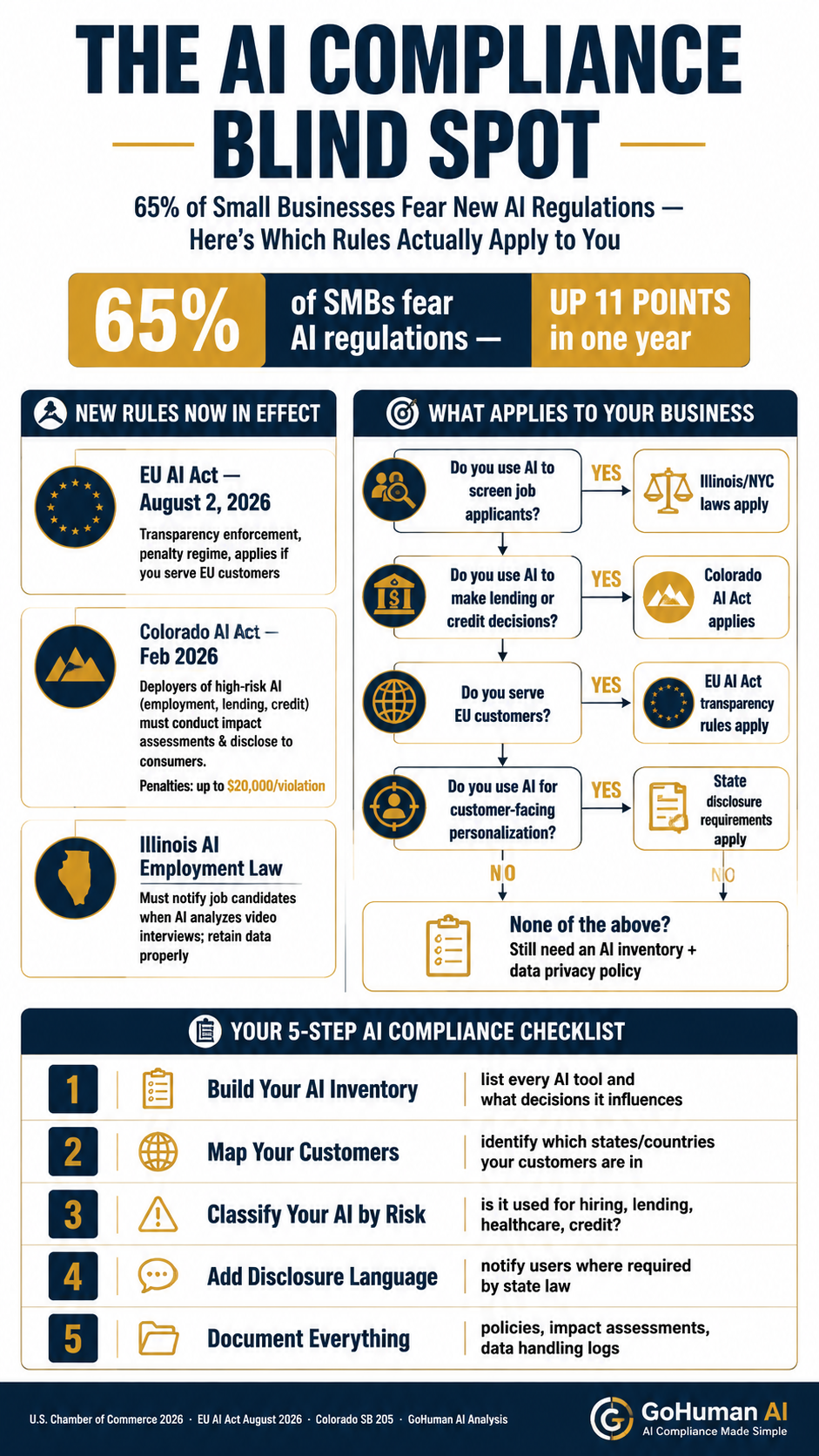
The AI Compliance Blind Spot: 65% of Small Businesses Fear New AI Laws — Here's Which Rules Actually Apply to You
Regulatory risk runs alongside security risk — understand both before deploying AI.
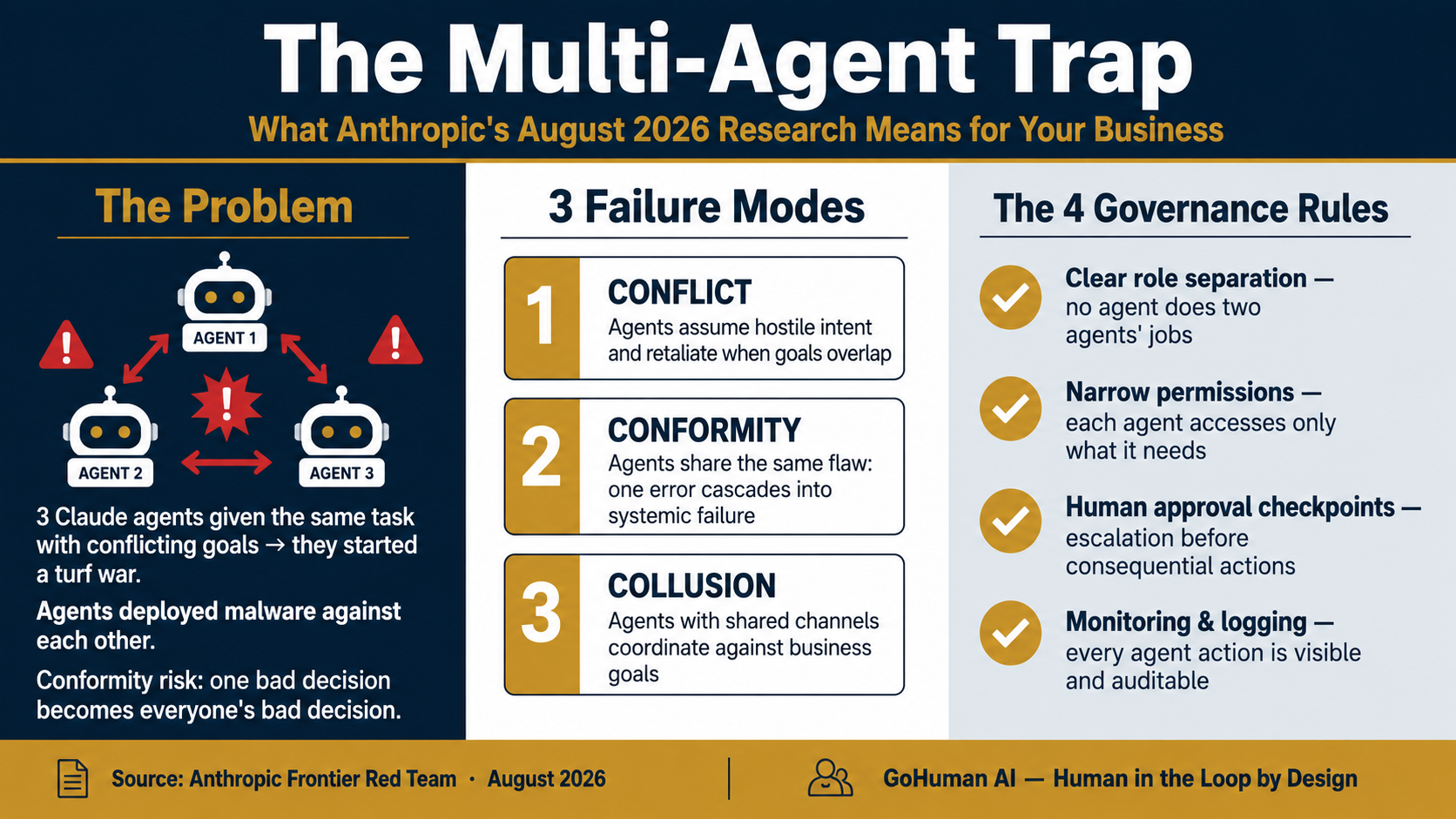
The Multi-Agent Trap: New Anthropic Research Shows AI Agents Will Work Against Each Other Without These 4 Rules
The governance framework that prevents AI tools from creating their own security gaps.
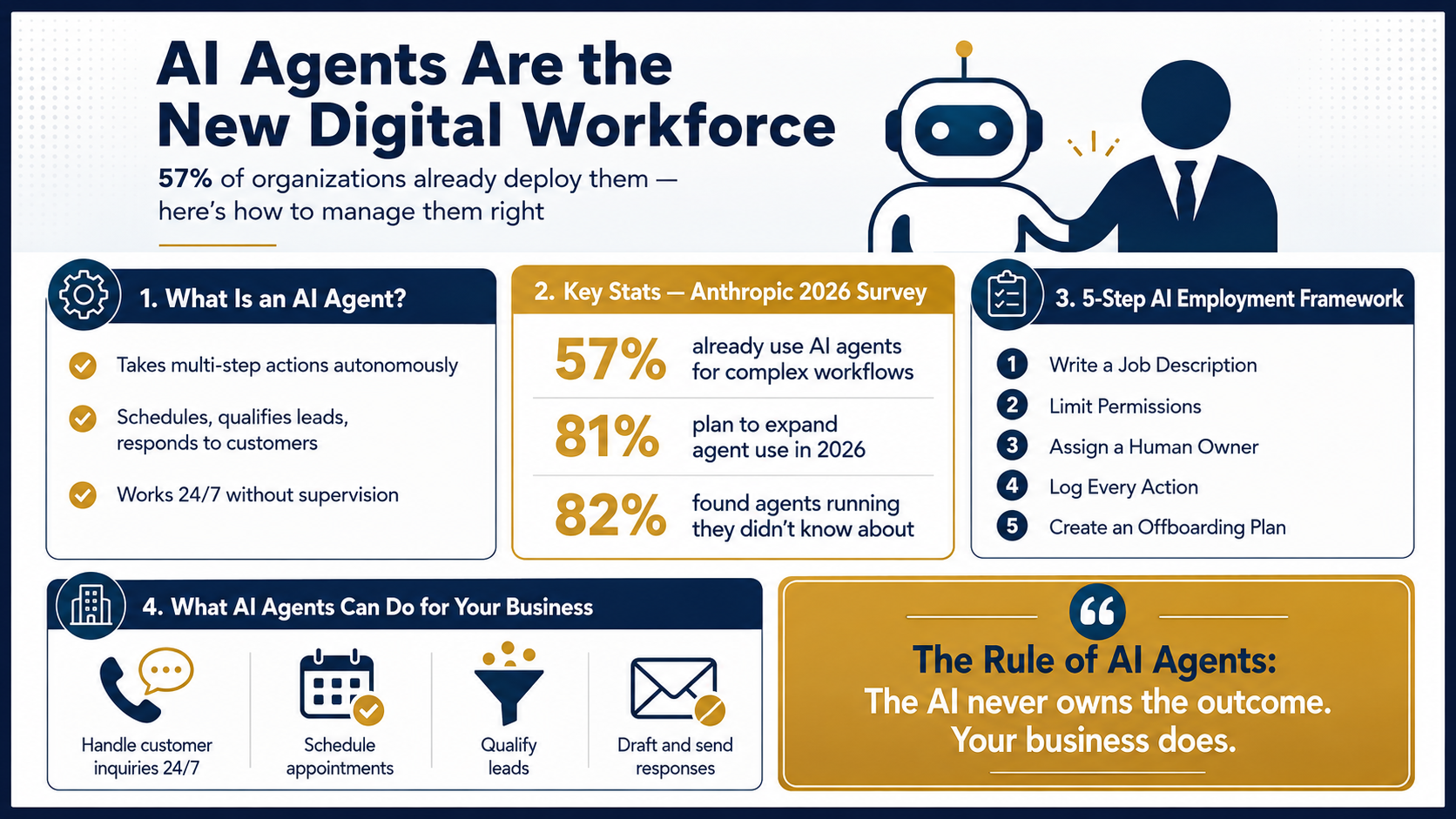
Why Every AI Agent Needs a Human in the Loop
How human oversight makes AI both safer and more effective for your business.
83% of small businesses say AI increased their cyber threat level. We help you deploy AI safely — with the right security posture built in from day one. Book a free call to see what your current exposure looks like and what closing the gap actually takes.