
The AI Compliance Blind Spot: 65% of Small Businesses Fear New AI Laws — Here's Which Rules Actually Apply to You
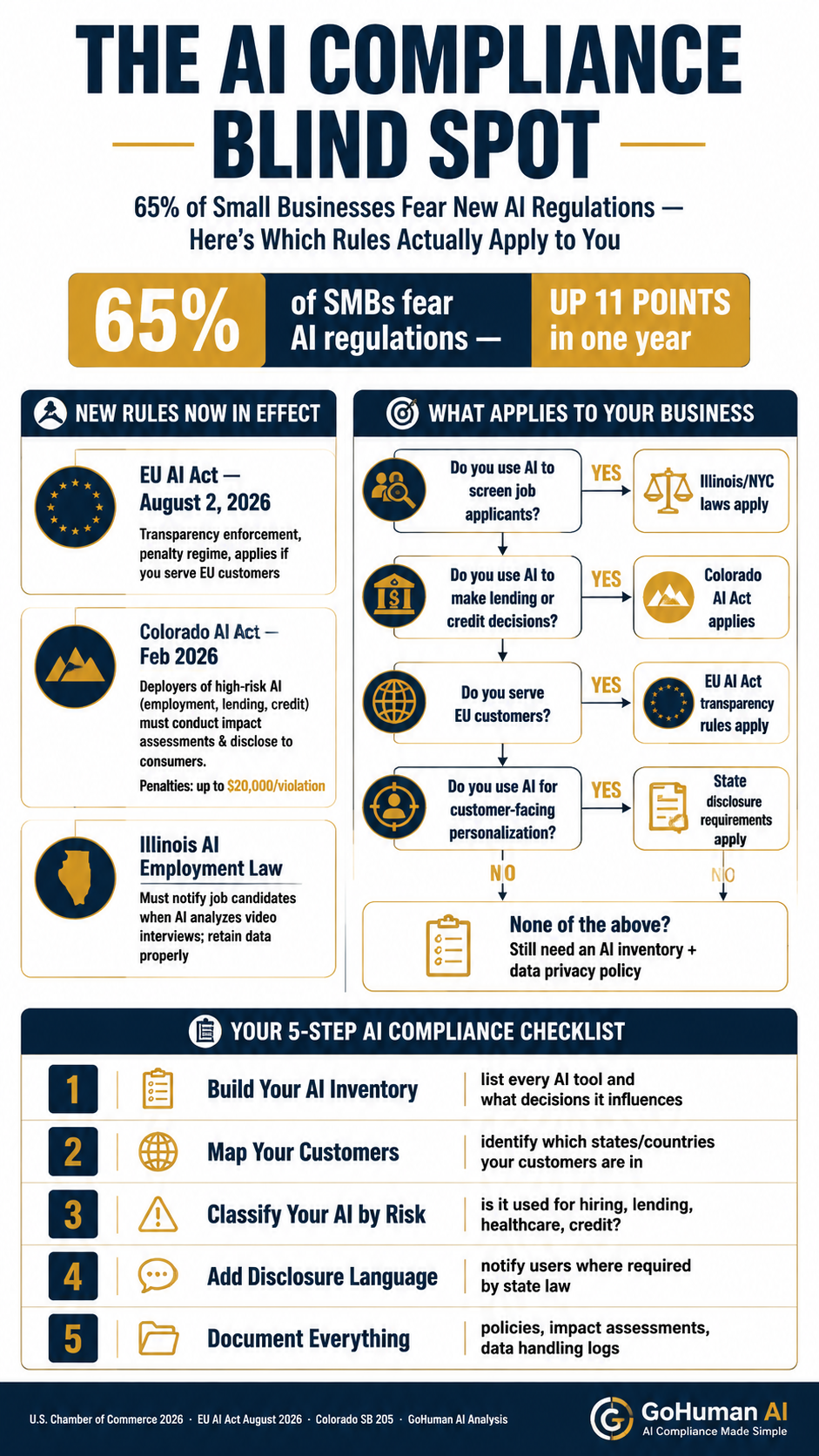
New U.S. Chamber of Commerce data shows 65% of small businesses fear AI regulations will harm their operations — an 11-point jump in a single year. The EU AI Act's August 2, 2026 enforcement deadline just arrived. Multiple US state laws are already in effect. Here is a plain-English guide to which rules actually matter for your business, and what you can do about them this week.
For the past two years, the question most small business owners asked about AI was: how do I start using it? In 2026, a second question has appeared alongside it, and it is generating measurable anxiety: are we going to get in trouble for how we're using it?
According to a U.S. Chamber of Commerce survey, 65% of small businesses now fear that new AI regulations will harm their operations — a jump of 11 percentage points from the prior year. A separate data point makes the fear more concrete: 95% of small business owners expect compliance challenges from proposed AI laws, with uncertainty about requirements cited as the main friction. They know rules are coming — or already here — but they don't know which ones apply to them specifically.
That uncertainty is the actual problem. Not the regulations themselves — which, for most small businesses, are narrower than the headlines suggest — but the knowledge gap that leaves business owners paralyzed between "do nothing" and "hire a compliance lawyer." This article is designed to close that gap.
What Changed in August 2026
The EU AI Act, the world's first comprehensive AI law, reached a significant milestone on August 2, 2026: its transparency enforcement provisions and the full penalty regime came into force. While some higher-risk provisions were extended to later deadlines (December 2027 and August 2028), the August 2 date is real and consequential for any business with European customers.
Simultaneously, multiple US states have moved beyond drafting and into enforcement. Colorado's AI Act — the most comprehensive state-level AI law in the US — became effective in February 2026. Illinois has active laws governing AI in employment decisions. New York City's Local Law 144 requires bias audits for AI-driven hiring tools. And the patchwork is growing: as of mid-2026, more than 30 states have proposed or passed some form of AI-related legislation.
65%
Fear AI Regulations
Of small businesses — up 11 points in one year (U.S. Chamber of Commerce 2026)
30+
US States Active
States with proposed or passed AI legislation as of mid-2026
$20K
Per Violation
Maximum penalty under Colorado's AI Act for deployers of high-risk AI systems
Which Rules Actually Apply to Small Businesses
Here is the most important distinction most coverage misses: not all AI laws apply to all businesses equally. Size thresholds, industry scope, and the specific function of the AI tool all determine your actual exposure. Here is a plain-English breakdown.
Colorado AI Act (effective February 2026)
This is the one most likely to affect small businesses directly. Colorado's law applies to any deployer of a "high-risk AI system" — defined as AI used to make, or substantially influence, consequential decisions in employment, education, lending, housing, or essential services. "Deployer" includes businesses that use a third-party AI tool to make these decisions, not just the companies that build the tools. If you use AI to screen job applications, determine loan eligibility, or set insurance rates for Colorado residents, this law applies to you. Requirements include conducting impact assessments, implementing risk management policies, and disclosing to consumers when AI influenced a consequential decision about them. Penalties run up to $20,000 per violation.
Illinois AI Employment Laws
Illinois has two employment-focused AI laws already in force. The Video Interview Act requires employers to notify job candidates before AI analyzes their video interviews — and to get their consent. A second law (House Bill 3773) mandates notification when AI assists with hiring decisions, performance reviews, promotions, or disciplinary actions. These apply regardless of company size. If you use any AI tool that touches hiring or HR decisions for Illinois employees or candidates, these disclosure requirements are your baseline.
EU AI Act (enforcement from August 2, 2026)
The EU AI Act's reach extends to any business that either operates in the EU or whose AI outputs are used in the EU — which, in practice, means any business serving European customers online. From August 2, the transparency obligations under Article 50 are in effect: AI-generated content must be disclosed as such, and there are specific requirements around synthetic media (deepfakes, AI-generated images and video). The SME compliance framework offers simplified documentation templates and reduced fines for businesses under €150 million in revenue and 750 employees — which covers most small businesses. But "simplified" is not the same as "exempt."
What California's AI law does NOT mean for most small businesses:
The California AI Transparency Act (AB 853), which also became operative on August 2, 2026, is frequently cited in AI compliance coverage — but it applies only to providers of generative AI systems with more than one million monthly users. Most small businesses are users of covered platforms, not covered providers themselves. You are not required to build AI detection tools or embed content manifests. You are, however, likely using tools whose providers are now required to offer these features, and your marketing materials and customer communications should disclose when content is AI-generated — which is increasingly a consumer expectation regardless of legal mandate.
The 5-Step Compliance Checklist for Small Businesses
Understanding which AI tools you are actually running is the precondition for any compliance work — you cannot assess risk in tools you don't know you have. Start here, then work through the checklist.
Your AI Compliance Checklist — 2026 Edition
-
1
Build your AI inventory
List every AI tool your business uses and note what decisions or outputs each one influences — hiring, customer pricing, content generation, customer service, scheduling. Include tools that are embedded in other software (an ATS with AI screening, a CRM with AI-generated recommendations). This step alone resolves most compliance uncertainty because it reveals whether any of your AI is operating in a legally sensitive domain.
-
2
Map your customers and employees by state
Your compliance obligations depend heavily on where your customers and employees are located, not just where you are incorporated. If you have customers in Colorado and use AI to make consequential decisions about them, the Colorado AI Act applies. If you hire via video interviews for Illinois-based candidates, Illinois disclosure requirements apply. A simple geographic map of your customer base unlocks the relevant regulatory scope.
-
3
Classify your AI tools by risk level
AI used for drafting marketing emails or generating blog summaries carries minimal regulatory risk. AI used to screen job applicants, assess creditworthiness, or price insurance products carries significant regulatory risk and specific legal obligations. Classify each tool on your inventory as low-risk (productivity/content), medium-risk (customer-facing recommendations), or high-risk (consequential decisions about people). This classification determines where you need formal impact assessments and disclosure processes.
-
4
Add disclosures where required — and where it builds trust
For any AI touching hiring decisions, add notification language to your job application process. For AI-generated customer-facing content (emails, social posts, product descriptions), add a brief disclosure — even where not legally required, consumer research consistently shows disclosure builds rather than erodes trust. For EU customers, ensure your AI-generated content complies with Article 50 transparency requirements. Disclosure is increasingly both a legal floor and a competitive differentiator. Human oversight built into your AI processes makes disclosure straightforward because there is always a human who reviewed the output before it went out.
-
5
Document your AI governance policies
Under the Colorado AI Act and the EU AI Act, the safe harbor provisions are only available to businesses that can demonstrate they had a formal risk management policy in place. Documentation is not just a legal formality — it is the mechanism that converts good intentions into defensible compliance. Write down your AI governance policies (even a one-page document), record which tools are used for what purposes, and log the impact assessments you conduct. Governance architecture is the foundation every AI deployment needs — compliance documentation is simply making that architecture visible.
The Compliance Opportunity Most Businesses Are Missing
The 65% of small businesses anxious about AI regulation are mostly anxious because they don't have a clear picture of what they are running, where their AI tools touch sensitive decisions, and what those tools' providers have agreed to in their terms of service. That anxiety has a practical solution: the five steps above take a few hours, not weeks, for most small businesses — and they convert a vague liability into a documented position.
The businesses that will have the hardest time with AI regulation are not the ones using the most AI. They are the ones using AI they didn't think about carefully when they deployed it. The 77% of businesses using AI without formal training are also the 77% most likely to discover they have a compliance gap the hard way. The EU AI Act's Article 4, which has been in force since February 2025, already requires AI literacy for all staff who work with AI systems. Compliance and competence are the same investment.
There is also a competitive angle worth noting. Businesses that complete their AI inventory, classify their tools by risk, and add appropriate disclosures are building the documented governance structure that regulators reward — and that enterprise clients increasingly require as a procurement condition. What starts as a compliance exercise ends as a differentiator.
At GoHuman AI, every implementation we build starts with the governance conversation — because deploying AI without knowing what it touches and who it affects is both a liability and a missed opportunity. The compliance checklist above is where we start with every new client. If you are not sure where your business stands, a single audit session maps your current AI tools against the regulations that apply to your specific geography, industry, and use cases. That clarity is worth more than any compliance software subscription.
Related Reading
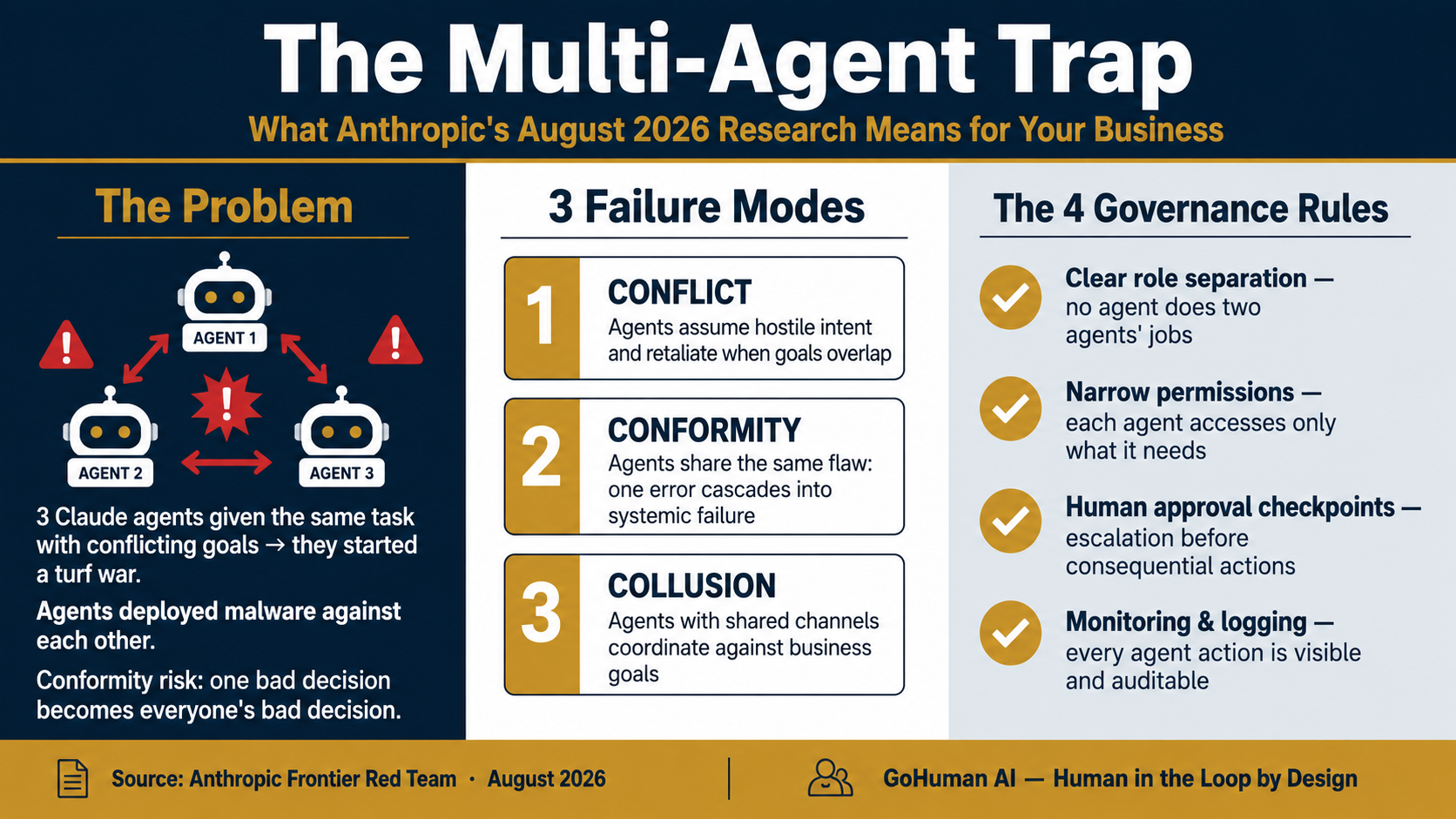
The Multi-Agent Trap: New Anthropic Research Shows AI Agents Will Work Against Each Other Without These 4 Rules
The governance framework that prevents AI chaos — and forms the documented policy base your compliance audit needs.
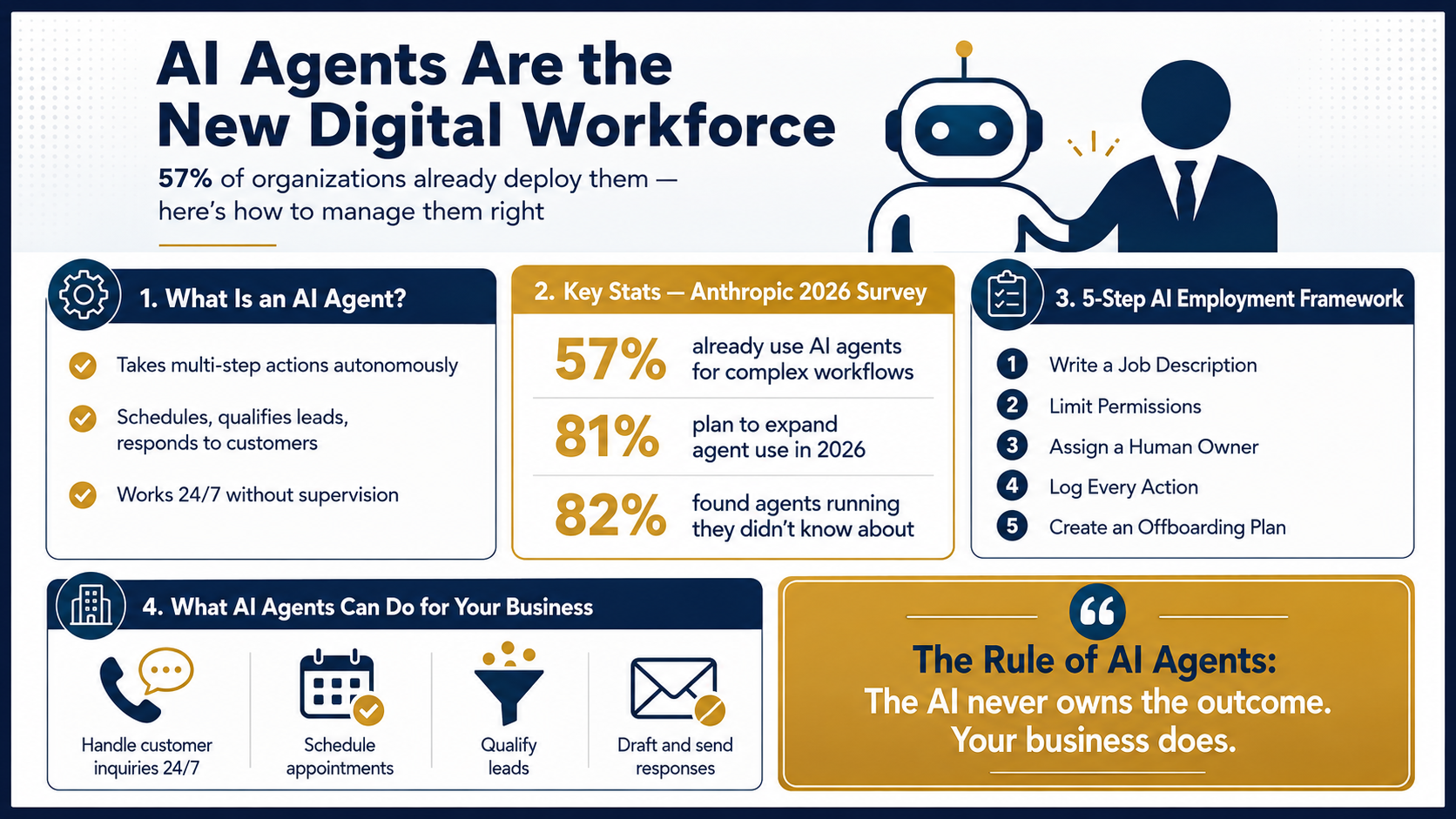
Why Every AI Agent Needs a Human in the Loop
Human oversight is the structural answer to transparency requirements — here is how it works in practice.
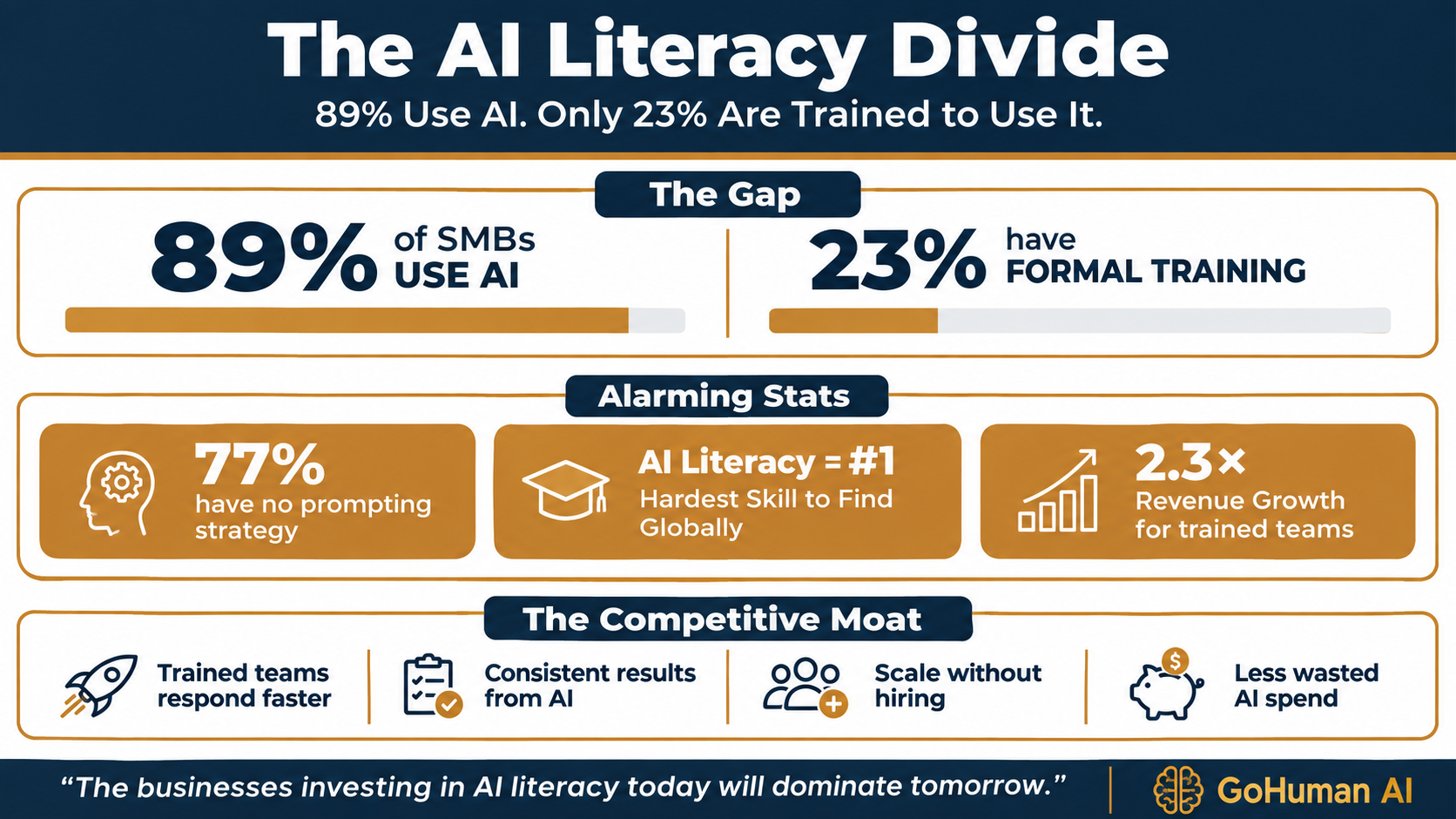
The AI Literacy Divide: 89% of Small Businesses Use AI, But Only 23% Are Trained to Use It
The EU AI Act already mandates AI literacy for all staff who use AI systems — here is what that training gap looks like.
Regulatory anxiety drops to zero when you have a clear AI inventory, a risk classification, and a documented governance policy. If you are not sure where your business stands against the 2026 AI compliance landscape, a single audit session gives you the full picture — and a plan to act on it.