
The 60-Hour Payment Problem: New AI 'Super Agents' Just Turned Back-Office Payment Ops Into a 45-Minute Job — Here's How Small Businesses Copy It
The most invisible job in a small business is getting paid. Failed payments retried by hand, invoices chased one email at a time, disputes filed the day someone remembers — Cashfree Payments just made this problem official by putting an AI agent on it. Their new "Relay" agents don't flag payment work for a human; they execute it, with approval required before any money moves and before any customer is contacted. Here is what launched, what the late-payment data says it's worth, and the 4-step checklist to copy the pattern in your business.
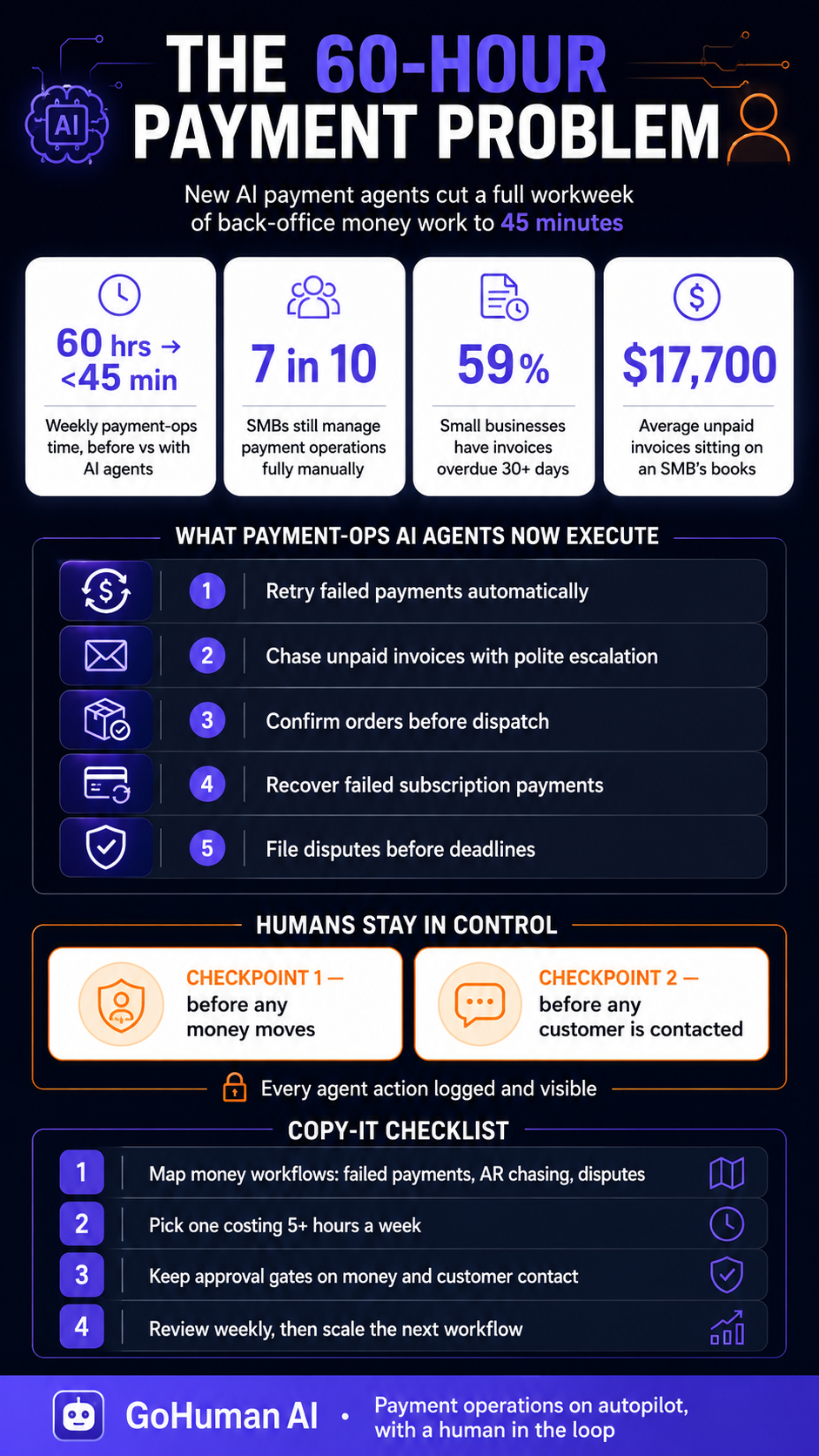
Last week, the India-based payments platform Cashfree Payments — which processes over $80 billion in transactions a year for more than a million businesses — moved its new AI "Super Agent", Relay, from invite-only beta to general availability. It matters far beyond one company's customer list, because of what the agent does: end-to-end payment operations — back-office money work that, by Cashfree's research, consumes an average of 60 hours a week for a typical SMB. Relay's design goal is to compress that to under 45 minutes. It also shows how the next wave of AI agents for small business is meant to work: not answering questions or flagging tasks, but executing defined money workflows end to end.
What Actually Launched
Relay automates the five jobs that eat a lean team's week: retrying failed payments, following up on abandoned carts, confirming cash-on-delivery orders before dispatch, recovering failed subscriptions, and filing payment disputes before their deadlines. Unlike point tools that merely flag a task for a human, the agent reads the merchant's transaction records and completes each action directly. Setup is plain language — describe the outcome by typing or speaking, and a turnkey agent deploys in minutes. Cashfree projects the platform can recover up to ₹20,000 crore — roughly US$2.3 billion — in lost revenue annually across its merchants, purely from money already earned but leaked through unprocessed follow-ups. It's free at launch, with outcome-based pricing planned as adoption grows.
The context data is the real headline. Cashfree reports that 7 in 10 SMBs in its home market manage payment operations entirely manually, with most of the rest stitching together fragmented single-channel tools that never share context. Co-founder Reeju Datta put the small-team reality plainly: "Until now, the only way to get it done was to put a person on it, and a five-person team does not have a person to spare." That quote isn't really about India — it describes the back office of almost every small business everywhere.
60h → 45m
Weekly Payment-Ops Time, Before vs With Agents
Cashfree Payments, 2026
7 in 10
SMBs Managing Payment Operations Fully Manually
Cashfree Payments research
59%
SMBs With Invoices Overdue 30+ Days (Up From 47%)
Intuit QuickBooks 2026 Late Payments Report
$17,700
Average Unpaid Sitting on an SMB's Books
Intuit QuickBooks, 2026
Why the Money Back Office Pays First
Payment operations are the ideal first target for executing agents — the data explains why. In the US, 92% of businesses are typically paid after their invoice due date, and small businesses waited an average of 29.1 days to be paid in June 2026 — 8.3 days late on average (Xero Small Business Insights). QuickBooks' 2026 report found 39% of owners say a single late payment made it hard to cover payroll, and 38% of businesses with overdue invoices lean harder on credit cards to bridge the gap. This is earned money, sitting in other people's bank accounts, collected by hand.
The work is also perfectly shaped for an agent: high-volume, rule-based, and time-sensitive in ways humans are bad at. Nobody remembers to retry a failed card payment on day three, or to file a dispute the morning before a deadline. Collection-industry research puts the odds of recovering a delinquent account at roughly 69% when it's three months past due — falling to about 51% at six months and 21% after a year. Every follow-up that slips quietly converts revenue into bad debt, and the admin burden is real: Xero's research finds owners spend about 10% of their workweek — five hours — chasing money they've already earned. Getting that cash in on time is what makes forecasts real — our cash flow forecasting breakdown showed AI forecasting hits 85–92% accuracy, but only if the money actually arrives. The categorization and reconciliation half of this stack is already automated at 78% lower cost.
The Design Detail Worth Copying: Approval Gates
The most instructive part of the Relay launch is where Cashfree refuses to let the agent act alone. It must stop and ask the merchant at exactly two points: before any money moves, and before any customer is contacted. Every action remains visible to the merchant, and transaction data never leaves the company's own infrastructure.
That is textbook human-in-the-loop design: full autonomy on the read-and-prepare work, hard approval gates on anything irreversible. The agent watches, drafts, and queues; the human makes the final call on spending money and talking to customers.
A 4-Step Checklist to Copy the Pattern
- 1 Map your money workflows. Failed-payment recovery, invoice follow-up, dispute filing, subscription dunning, order confirmation. Time each one for a week — the 60-hour figure is a payments-heavy average, so measure yours. The quick-win method in our workflow ROI breakdown structures this.
- 2 Pick the one eating 5+ hours a week or leaking revenue. Recurring late payments, abandoned carts, expired cards on subscriptions — start where volume and money overlap.
- 3 Set your two approval gates before day one. Money moves and customer contact always wait for a human sign-off; everything else gets logged. That combination is what makes payment agents safe to run unattended.
- 4 Pilot, review weekly, then scale. Track recovery rate, DSO change, and hours saved — the always-on running costs are now manageable, as our agent cost breakdown shows, with long-running agent work up to 45% cheaper since September 1.
One caution before you delegate the cash register. Cashfree's 60-hour figure describes a high-volume, COD-heavy e-commerce market — most service businesses sit far lower, so treat step 1 as a measurement exercise, not a copy-paste. And agents amplify whatever process they're given: unclear invoice terms or stale customer records just get executed faster. Fix the definition first, or you're polishing one of the 95% of AI projects that fail on process, not technology.
At GoHuman AI, we build exactly this class of agent for small and medium-sized businesses — payment follow-ups, invoice chasing, and dispute workflows that run continuously, with human approval gates on anything irreversible and audit logs on everything else. Let the agent execute the repetitive 95%; keep the human decision where the money and the customer are. The 60-hour payment problem was never a technology problem — it was a person-hours problem, and person-hours are what agents just stopped needing.
Related Reading
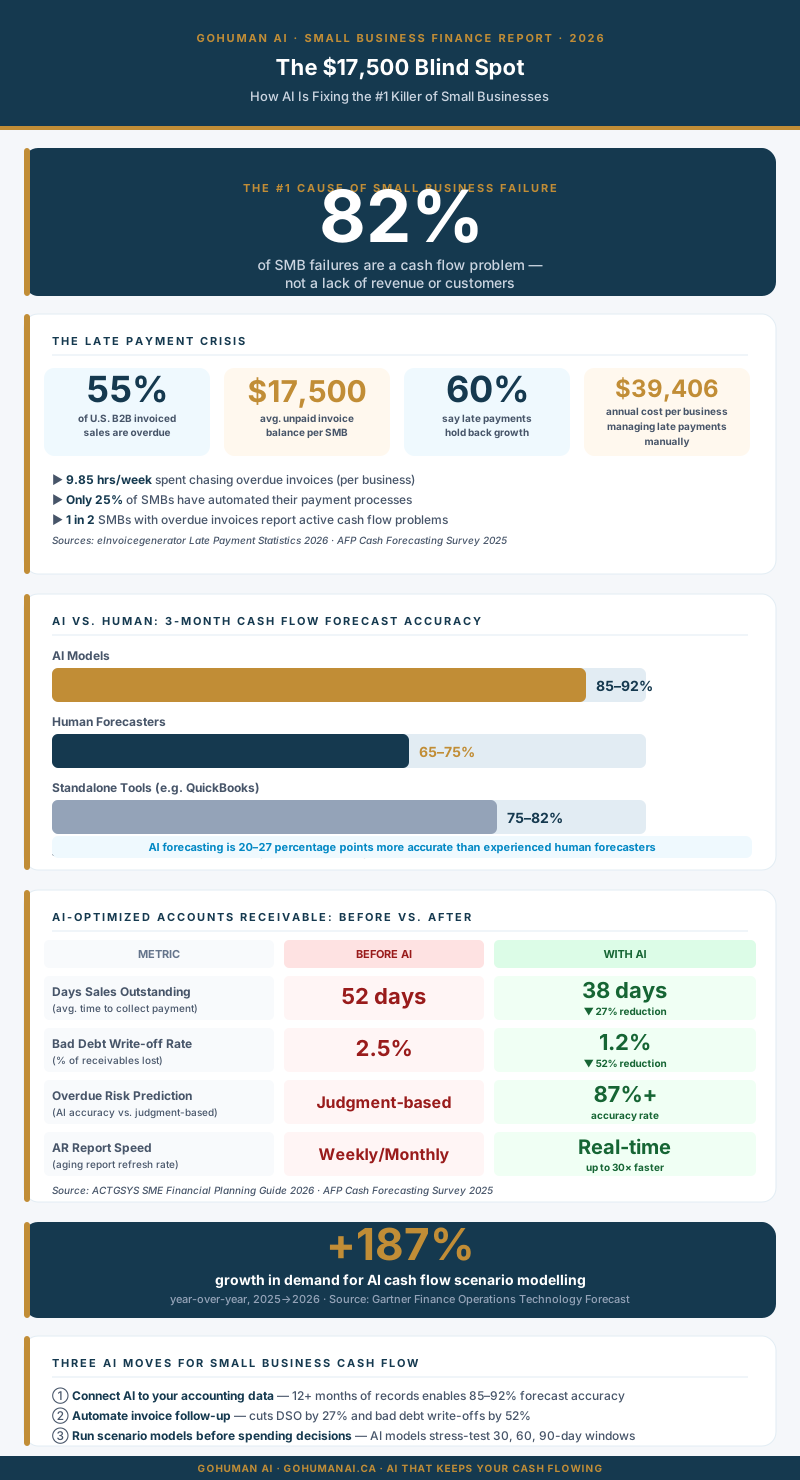
The $17,500 Blind Spot: New Data Shows AI Fixes the #1 Killer of Small Businesses
Why 82% of SMB failures are cash flow — and how AI forecasting fixes it.
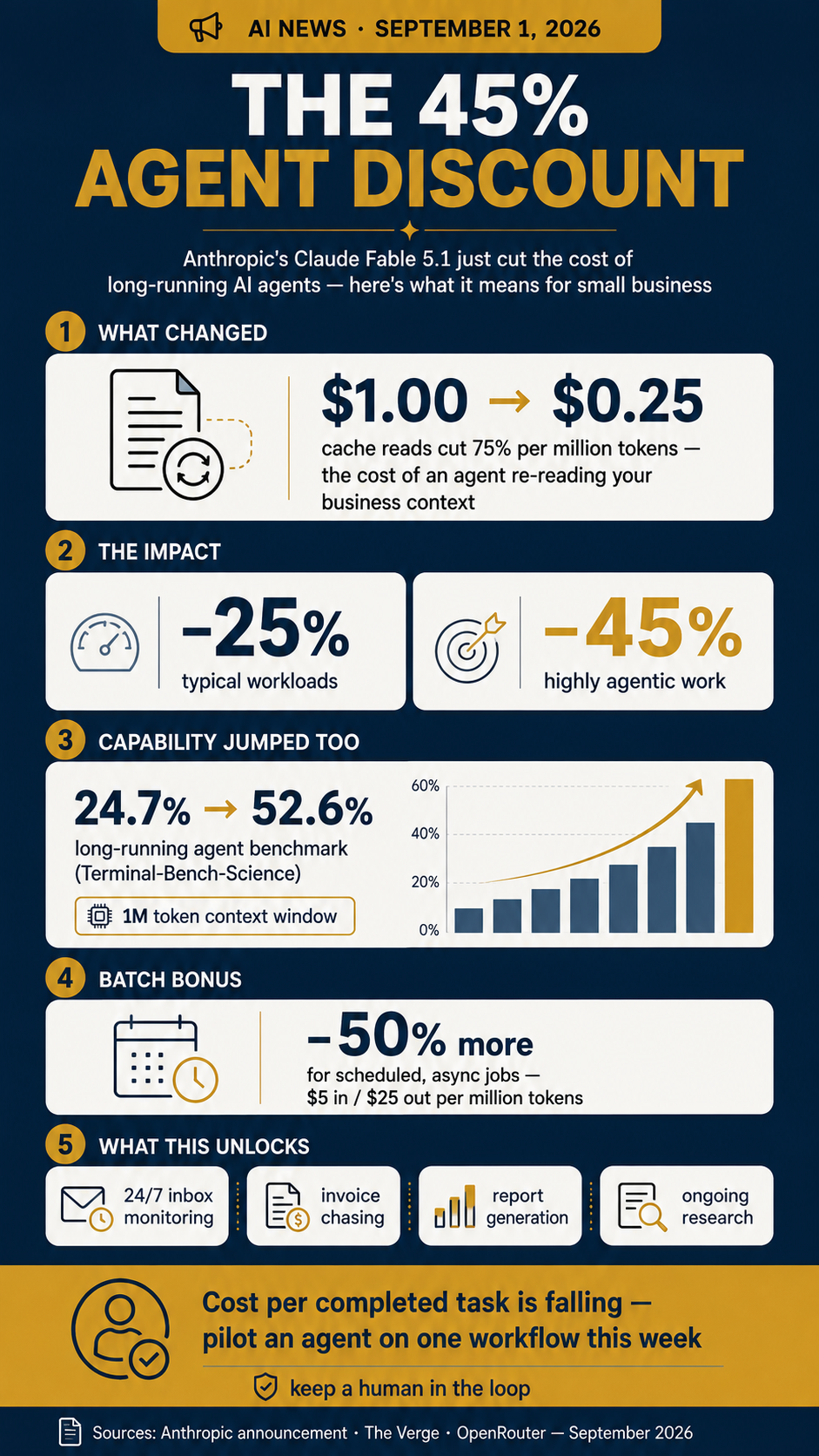
The 45% Agent Discount: Anthropic Just Made Long-Running AI Employees Affordable
The always-on agents that chase payments just got cheaper to run.
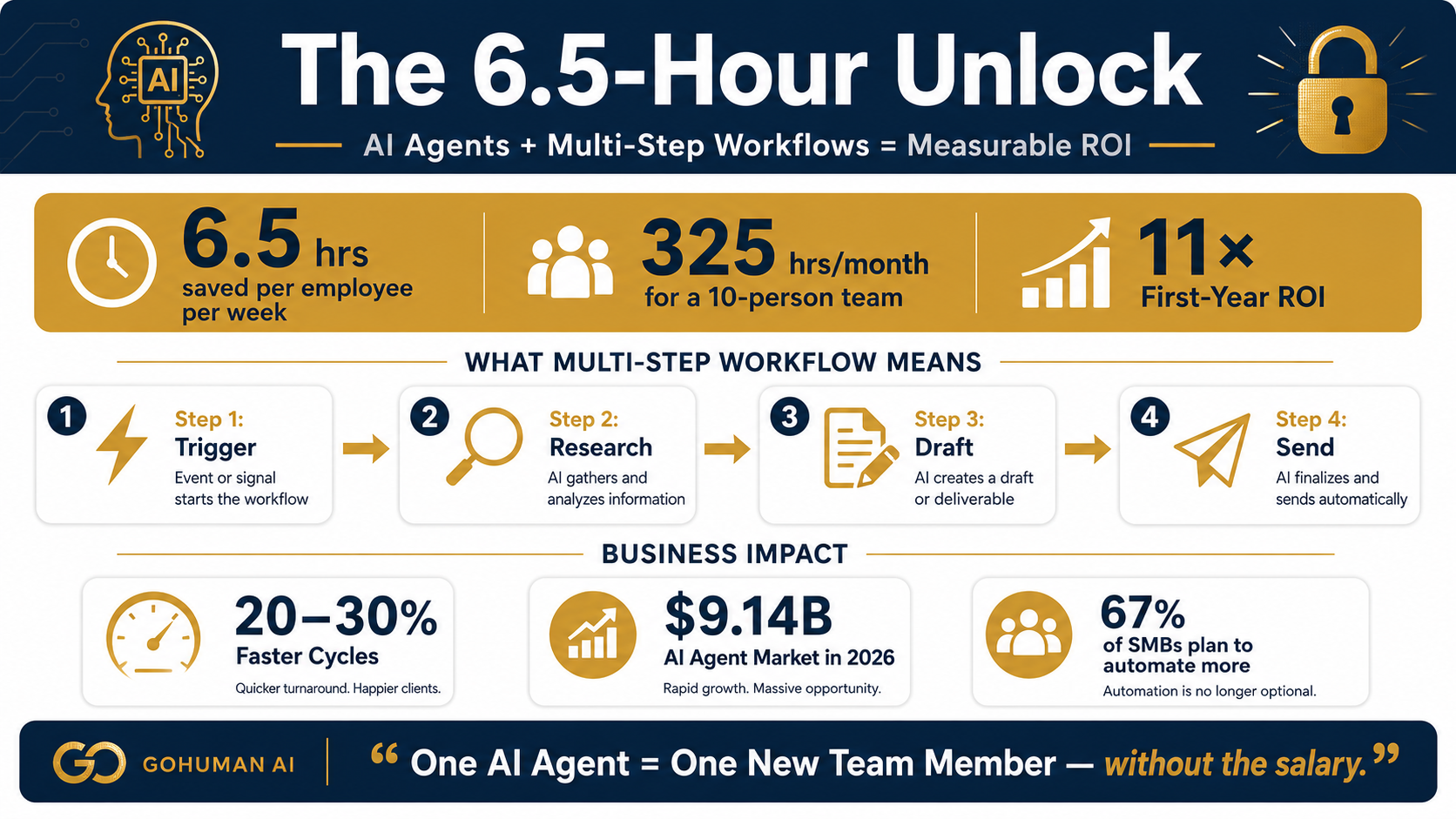
The 6.5-Hour Unlock: How Small Businesses Are Using AI Agents for Multi-Step Workflows
Find the quick-win workflow worth automating first.
Your team is spending hours every week chasing money you've already earned. Let us show you which payment workflow an AI agent can take over first — safely, with approval gates on every dollar and every customer message.