
The 340,000 Problem: How the Accountant Shortage Is Making AI Bookkeeping a Small Business Survival Skill
The U.S. accounting profession has lost 340,000 licensed practitioners since 2019 — and 75% of remaining CPAs are approaching retirement age. Small businesses are absorbing the consequences: longer hiring timelines, higher costs, and growing backlogs of unreconciled books. AI bookkeeping is emerging as the practical response, and the data on what it actually saves is clearer than most business owners realize.
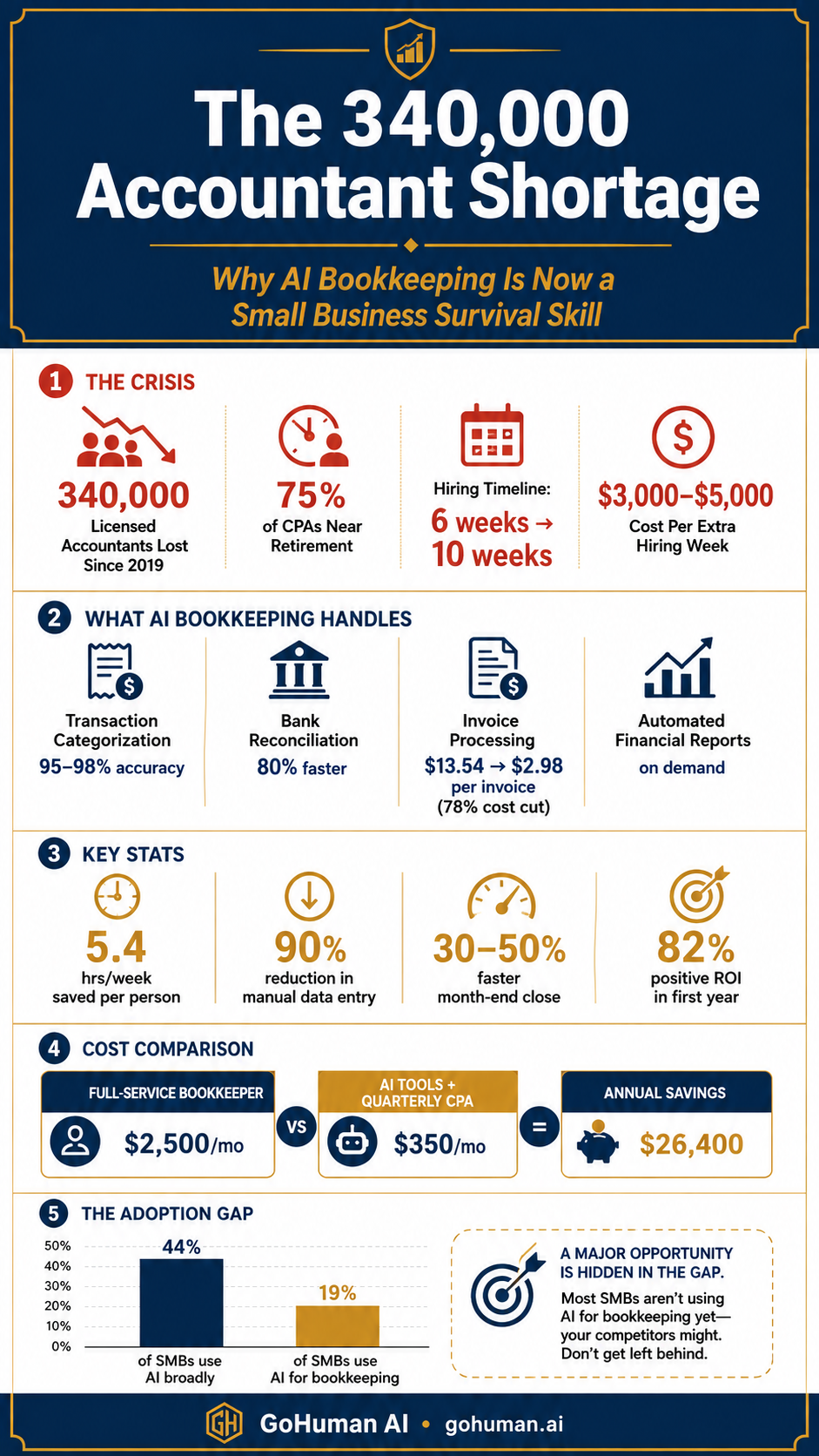
In August 2025, the U.S. had 653,408 licensed accountants — down from nearly 1 million at the profession's peak. The pipeline is not recovering: CPA exam candidates dropped 22.5% between 2017 and 2024, accounting degree completions are down 30% from their 2014–15 high, and each year the profession posts roughly 124,200 job openings while universities award only around 55,000 accounting degrees. The math does not work — and small businesses are standing at the wrong end of it.
For a Fortune 500 company, an accounting shortage is an HR problem with a solution: pay more, recruit internationally, or absorb higher costs. For a small business owner, it is something more immediate. It means your bookkeeper just handed in her notice and it will take ten weeks to replace her — up from six weeks two years ago. It means each extra week of that search costs you $3,000 to $5,000 in productivity and recruitment expenses. And it means that during those ten weeks, your books are falling behind.
The timing is forcing a decision. Small businesses that have historically relied on a part-time bookkeeper or a monthly visit from a local CPA are now reconsidering the model — not because they want to, but because the supply of affordable accounting help is contracting at the exact moment that the complexity of running a business is increasing. AI bookkeeping is filling the gap, and the results are more concrete than most business owners expect.
What the Shortage Actually Costs a Small Business
The visible cost is recruitment. When it takes ten weeks instead of six to fill a bookkeeping role, and each week of delay costs the business $3,000 to $5,000 in staff time, external recruiter fees, and productivity drag, a single open position can cost $30,000 to $50,000 before the new hire has processed a single invoice.
The invisible cost is the lag in financial visibility. Small businesses that run behind on reconciliation are making pricing decisions, inventory calls, and hiring choices based on financial data that is two to six weeks old. That lag is where costly errors live — and it is exactly what cash flow forecasting AI is designed to help with, but only works when the underlying bookkeeping is current and accurate.
340K
Licensed Accountants Lost
Since 2019 — ReceiptsAI 2026
10 wks
Avg Time to Hire Bookkeeper
Up from 6 weeks in 2024
75%
of CPAs Near Retirement
Pipeline not replacing them
19%
Use AI for Bookkeeping
vs 44% using AI elsewhere
That last figure is the most revealing. According to 2026 data, 44% of small businesses use AI on a weekly basis across their operations — but only 19% use it specifically for bookkeeping. The gap suggests that most business owners have adopted AI for customer communication, marketing, or scheduling, but have not yet applied it to the one area where the human labor shortage is most acute. That asymmetry will not last.
What AI Bookkeeping Actually Does
The clearest way to understand what AI bookkeeping handles is to look at the specific tasks that consume a bookkeeper's week. Modern AI accounting tools automate four of them with high reliability:
Transaction categorization. Every bank and credit card transaction that hits your accounts needs to be coded to a category — operating expense, cost of goods, owner's draw, utility, and so on. For a business running 200–500 transactions a month, this is the single most time-consuming bookkeeping task. AI tools categorize transactions at 95–98% accuracy using machine learning trained on your transaction history. A task that takes a bookkeeper six to eight hours a month becomes a 20-minute review-and-approve step.
Bank reconciliation. Matching your ledger to your bank statement, identifying discrepancies, and flagging duplicates or missed entries — this used to take two to four hours per account per month. AI tools complete the match in minutes, flagging only the exceptions that need human review. Businesses using AI report 80% faster transaction processing and a 30–50% reduction in month-end close time overall.
Invoice processing. Accounts payable automation is where the cost reduction is most visible. Processing a vendor invoice manually — data entry, approval routing, payment scheduling — costs an average of $13.54 per invoice. AI-automated invoice processing reduces that to $2.98 per invoice, a 78% cost reduction. For a business receiving 100 invoices a month, that is a saving of over $1,000 monthly from a single workflow change.
Automated reporting. Monthly profit-and-loss statements, cash position summaries, and accounts receivable aging reports that previously required a bookkeeper to pull and format are now generated on demand. This is the upgrade that has the most direct impact on decision-making: when your financial data is current and your reports are available in real time, you make better calls on pricing, inventory, and hiring — the exact decisions that compound into the manager-level productivity advantages the data consistently shows.
The Numbers on What It Saves
The time savings from AI bookkeeping are measurable and consistent across studies. The average is 5.4 hours saved per week per person involved in financial administration. For a 10-person business where two or three people share bookkeeping duties alongside their primary roles, that is 10–20 recovered hours per month — hours that return to revenue-generating work.
The cost comparison:
A full-service bookkeeper costs $2,500/month. AI bookkeeping software runs $25–$50/month, with a quarterly CPA review adding $300/month for judgment and compliance. The hybrid model saves $26,400 per year — and in most cases, the books are more current and accurate than they were with full human coverage.
Accuracy improves significantly as well. Human bookkeepers operate at a 1–4% error rate on data entry — which sounds small but compounds when applied across thousands of transactions annually. AI bookkeeping systems achieve 95–98% accuracy on routine transactions, with error rates improving further as the system learns your specific business patterns. For tax preparation and compliance, where small errors become expensive corrections, this accuracy differential matters.
ROI in the first year of AI bookkeeping adoption is positive for 82% of small businesses, according to 2026 platform benchmarking data, with a typical payback period of six to twelve months. The businesses that see the fastest payback are those with high invoice volumes or those currently paying for more human bookkeeping coverage than their transaction volume actually requires.
What AI Bookkeeping Does Not Replace
The case for AI bookkeeping is not a case for eliminating your accountant. The tasks AI handles well are the repetitive, high-volume, rules-based ones: categorization, matching, data entry, and report generation. The tasks it does not handle well are the judgment-intensive ones: tax strategy, entity structure decisions, audit representation, complex depreciation elections, and the kind of proactive planning that a good CPA brings to a quarterly review.
The model that is working for most small businesses is a hybrid: AI handles the daily and monthly mechanical work, and a CPA or senior accountant handles the strategic and compliance layer on a quarterly or annual basis. This is exactly the human-in-the-loop model that makes AI deployments reliable — the AI takes care of the volume, and a qualified professional reviews what matters. It also means your CPA spends your billable hours on work that actually requires their expertise, rather than cleaning up data entry that a machine handles faster and more accurately.
This pattern mirrors what the data shows across AI implementations broadly: the 95% of AI projects that fail tend to be ones where businesses tried to replace human judgment entirely rather than augment human capacity. Bookkeeping is one of the clearest examples of where that distinction plays out in practice.
Where to Start: The 3-Step Migration
A Practical Starting Point
- 1 Audit your current bookkeeping hours. Count how many hours per month your team spends on transaction categorization, reconciliation, invoice entry, and report preparation — including your own time. This baseline determines your ROI math before you spend a dollar on a new tool. Most business owners discover the true number is higher than they estimated, because bookkeeping labor is often invisible within broader administrative roles.
- 2 Connect your bank feeds to an AI-native accounting tool. QuickBooks, Xero, and Digits all offer bank feed integration that begins auto-categorizing transactions from day one. Spend the first 30 days reviewing and correcting AI categorizations — this is how the model learns your business. After 60 days, the correction rate drops sharply and the time investment becomes minimal. This is also the step that makes your existing CPA significantly more efficient, since they inherit clean, categorized data rather than a raw feed.
- 3 Automate your invoice intake. Route all vendor invoices to a single email inbox monitored by your accounting software. Tools like QuickBooks and Xero extract the vendor, amount, due date, and category automatically — eliminating manual entry for the task that drives the highest per-unit cost reduction. Set a 30-day target: zero manual invoice data entry by the end of the month.
The accountant shortage is a structural trend, not a temporary disruption. The graduation pipeline is not recovering on a timeline that helps small businesses in 2026. What is available now is a generation of AI bookkeeping tools that handle the mechanical layer accurately, cost far less than human equivalents, and free up qualified CPAs to focus on the work only they can do. The 19% of small businesses already using AI for bookkeeping are not early adopters chasing a trend — they are ahead of a gap that is widening every quarter.
This connects to the same pattern behind the broader SaaS replacement wave: small businesses that audit their software stack and human-labor allocation together consistently find that the cost reduction available through AI-native tools exceeds what they expected. Bookkeeping is one of the highest-confidence starting points because the tasks are well-defined, the savings are measurable, and the risk is low.
At GoHuman AI, accounting workflow automation is among the most requested implementations we build — precisely because the labor market is making it urgent. If your books are running behind, your reconciliation is overdue, or you are facing a bookkeeper search in a market with 340,000 fewer practitioners than it had five years ago, the conversation is worth having now.
Related Reading
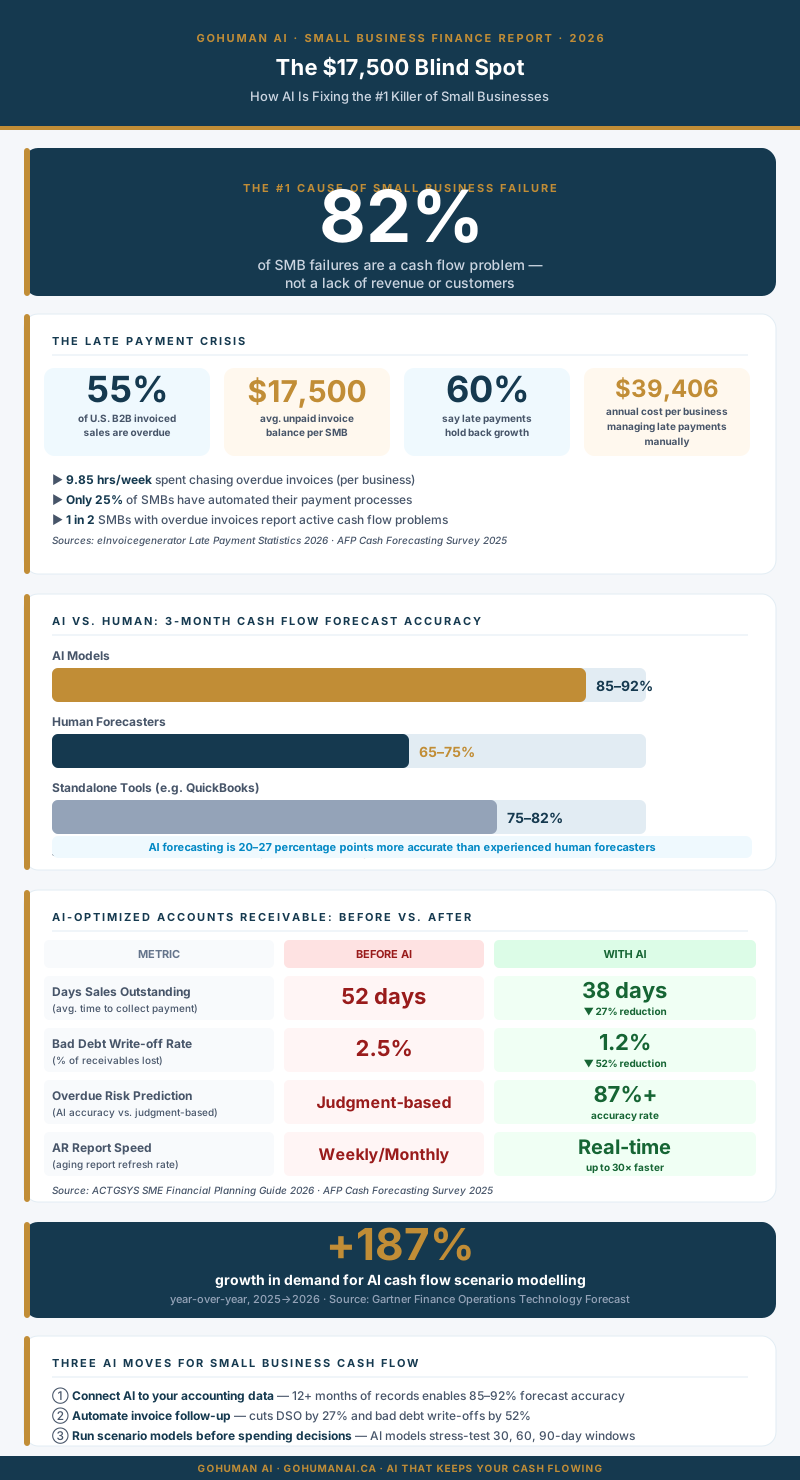
The $17,500 Blind Spot: New Data Shows AI Fixes the #1 Killer of Small Businesses
Current books are the foundation — here is how AI turns them into forward-looking cash flow intelligence.
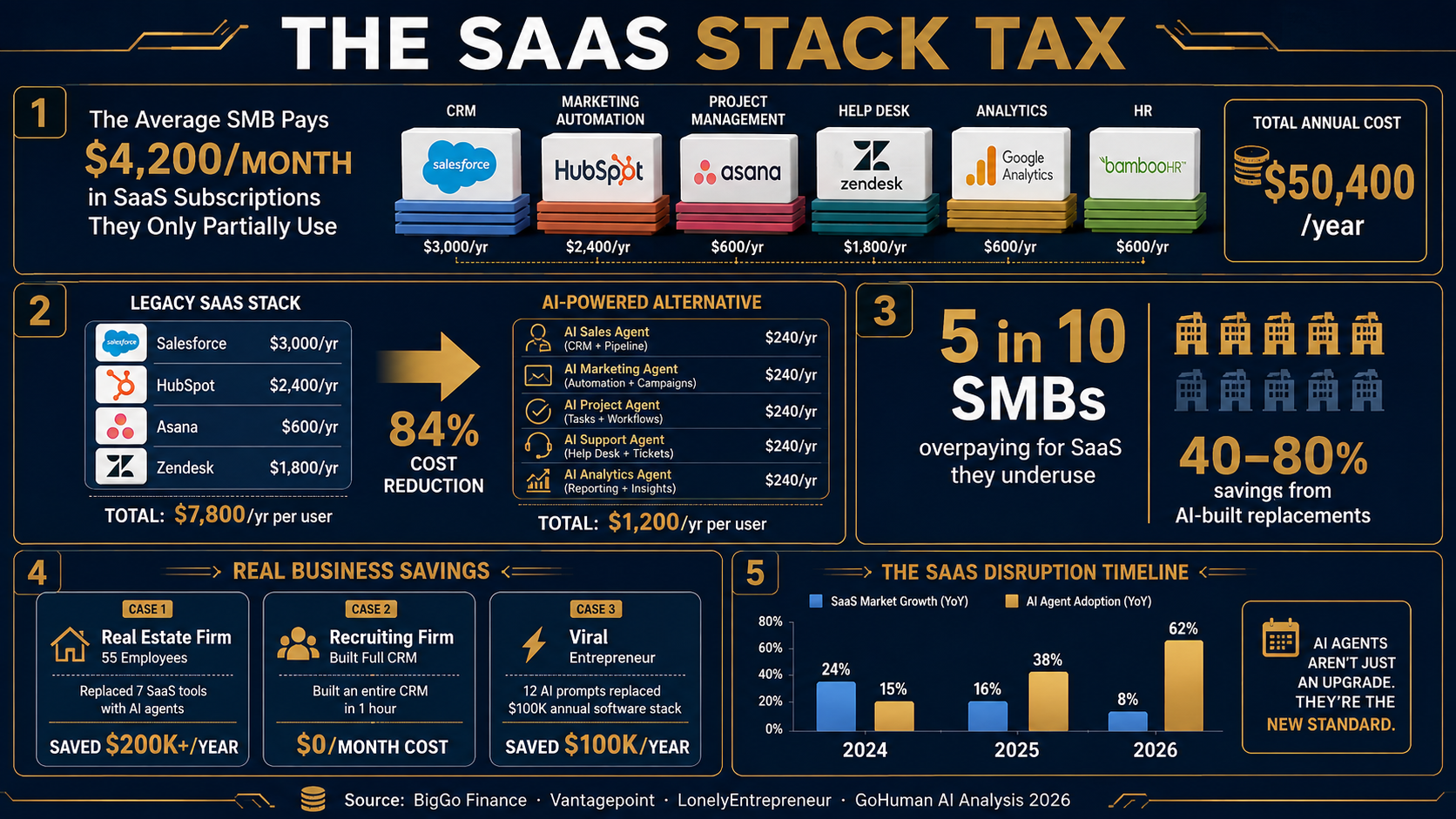
The SaaS Stack Tax: How Small Businesses Are Cutting $50,000–$200,000 a Year by Replacing Legacy Software With AI
Bookkeeping is one piece — here is the full cost reduction picture across the software stack.
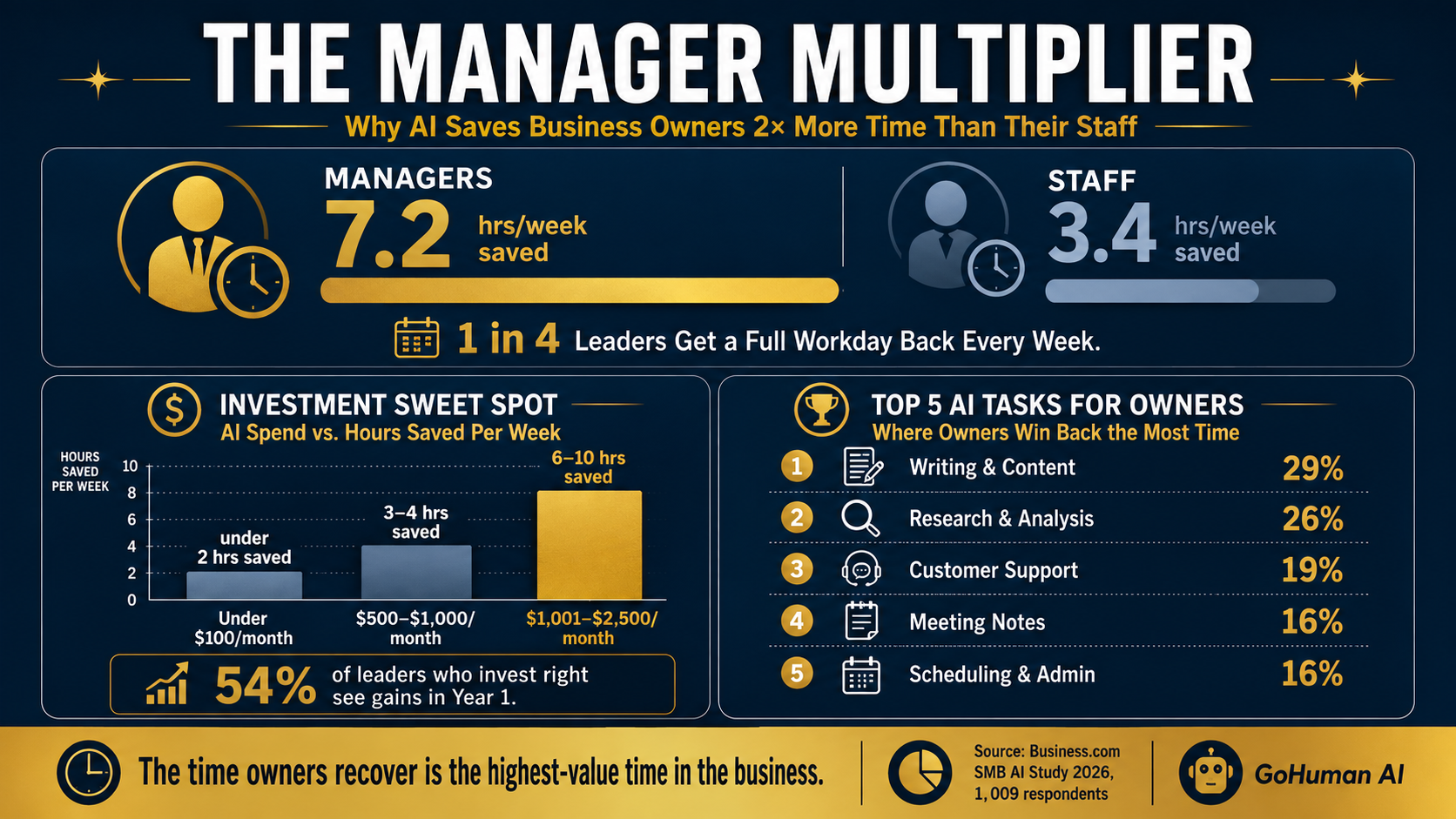
The Manager Multiplier: New Data Shows AI Saves Business Owners 2× More Hours Per Week Than Their Staff
Bookkeeping hours are among the highest-leverage hours to recover — here is the broader productivity case.
With 340,000 fewer accountants than five years ago, the bookkeeping gap is only getting wider. Let us show you how AI bookkeeping automation handles the mechanical layer — and what the numbers look like for your specific business.