
The 45% Agent Discount: Anthropic Just Made Long-Running AI Employees Affordable — Here's What Small Businesses Should Do With It
The most expensive part of running an AI agent was never intelligence — it was memory. Every time an agent re-read your pricing, your policies, or last week's order history, you paid again for context it had already seen. On September 1, 2026, that changed: Anthropic's Claude Fable 5.1 cut the cost of re-reading stored context by 75%, making long-running agent work up to 45% cheaper. Here is what the new economics mean for small businesses, which jobs just became viable, and how to pilot one safely this week.
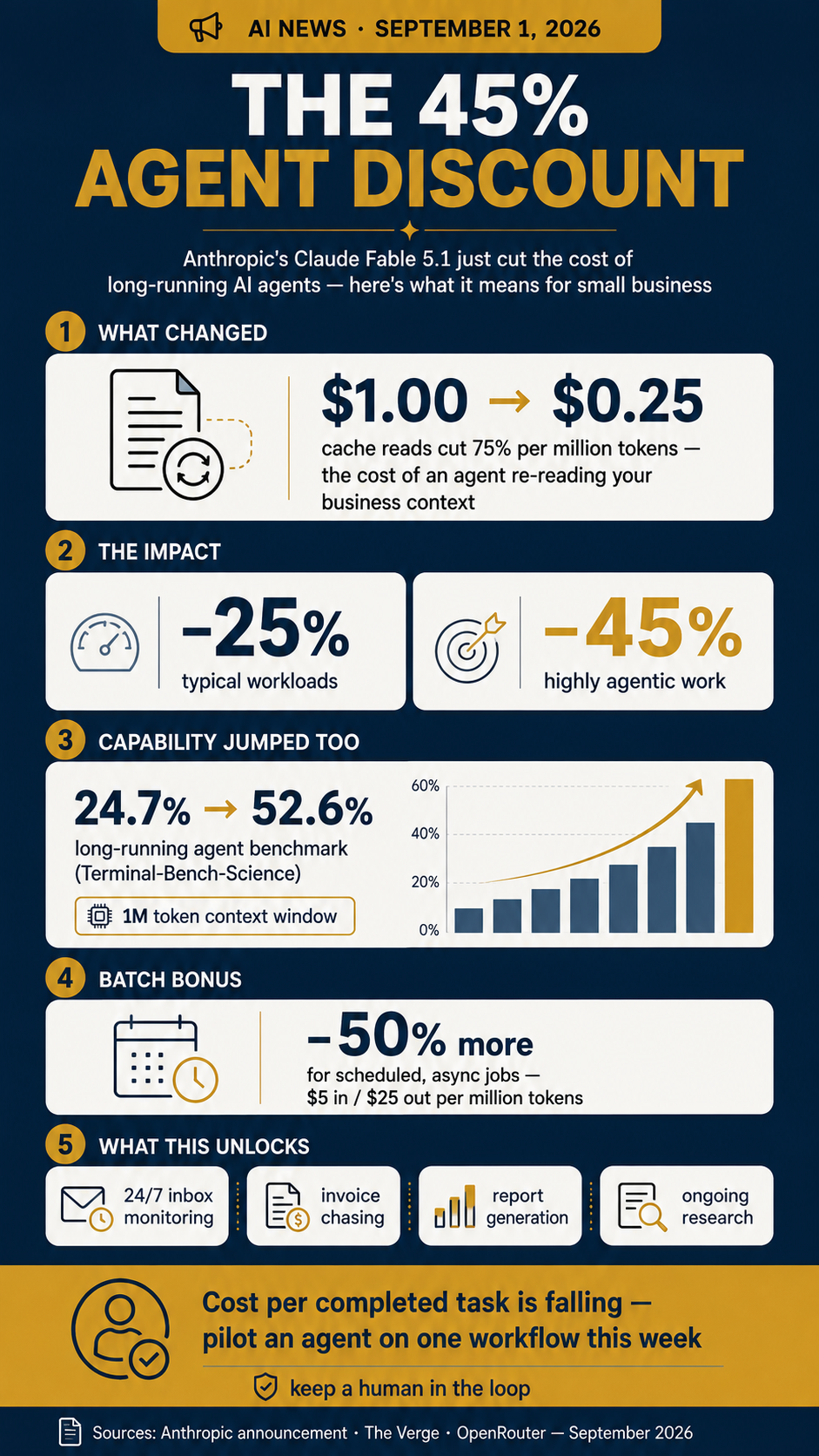
Yesterday, September 1, 2026, Anthropic released Claude Fable 5.1 — and the headline was not the model's intelligence. It was the price of keeping an agent on the job. Anthropic cut the price of cache reads — the fee an AI pays to re-read context it has already processed — by 75%, from $1.00 to $0.25 per million tokens. Because a long-running agent re-reads your business context hundreds or thousands of times per task, that single change makes typical workloads about 25% cheaper and highly agentic work up to 45% cheaper. Base model pricing ($10 per million input tokens, $50 per million output) stayed exactly the same. The company also released Claude Mythos 5.1, a variant with expanded safeguards reserved for vetted cybersecurity and life-science organizations. For small business owners, the practical news is simple: the agent that stays on the job just got dramatically cheaper than the agent you call occasionally.
What Actually Changed
To understand why a 75% cut on one pricing line matters, you have to understand how agents work. A chatbot reads your prompt once and answers. An agent is different: it loops. It reads your product catalog, checks your calendar, drafts a reply, verifies it against your policies, adjusts, and tries again — re-reading the same pricing rules and past orders at every step. That repeated reading is what Anthropic calls cache access, and it used to cost $1.00 per million tokens. At 10:00 AM on September 1, it became $0.25.
The benchmark gains point the same direction. On long-running agentic science tasks, Fable 5.1 scored 52.6%, up from 24.7% — more than doubling its predecessor — with context handling at up to 1 million tokens. Short-horizon benchmarks barely moved. Translation: the industry is optimizing for exactly the kind of work small businesses need most — agents that keep going, not agents that answer once.
−75%
Cache Reads: $1.00 → $0.25 per Million Tokens
Anthropic, September 1, 2026
−45%
Cost of Highly Agentic Workloads (−25% Typical)
Anthropic
2.1×
Long-Running Agent Benchmark: 24.7% → 52.6%
Terminal-Bench-Science
−50%
Batch Pricing for Scheduled Async Jobs ($5 In / $25 Out)
Anthropic batch API
Why the Discount Matters More Than the Model
This is the second cost collapse in six weeks, and it follows a pattern. In late July we covered the enterprise-grade AI price drop that put Fortune-500-class models within reach of small businesses. That was about access. Today's cut is about economics of operation — and it changes which projects make sense, not just which tools you can afford.
Under the old pricing, an agent that monitored your inbox around the clock or worked a supplier portal all week carried a running bill that made owners flinch. The 45% discount moves entire categories of work across the viability line. The jobs that just became affordable share a signature: they are continuous, context-heavy, and patient. An agent triaging your inbox all day re-reads the same pricing, tone guidelines, and customer history on every draft — the exact workload the cache-read cut rewards. Same for an agent that chases unpaid invoices through polite escalating reminders, compiles the Monday report from yesterday's numbers, or keeps half an eye on competitor pricing and industry news for you. Each of these was possible before; each is now 25–45% cheaper to run, before you count the batch discount for anything scheduled.
The math echoes what we found in multi-step workflow ROI: one employee saved 6.5 hours a week pays for the stack; a ten-person team saves 325 hours a month. A 25–45% reduction in the cost side of that same equation shortens payback proportionally — and pulls next month's "maybe" into this month's "yes."
A 4-Step Checklist to Use the Discount
- 1 Name one continuous job. Not "use AI" — a job with a name, a frequency, and a measurable output: inbox triage, invoice follow-up, the Monday report, daily competitor checks. The quick-win method in our workflow ROI breakdown takes about 20 minutes.
- 2 Estimate the before and after. Hours the task consumes today, what an agent subscription plus token costs look like at the new rates, and the payback window. If the agent touches fewer than ~5 hours a week of work, start smaller.
- 3 Keep approval on anything irreversible. Sending, spending, publishing, and customer data always wait for a human sign-off. This is the non-negotiable core of human-in-the-loop design — cheaper agents do not change it.
- 4 Log, review weekly, then scale. Track what the agent did, what it saved, and where it needed correction. Expand one workflow at a time, following the deployment framework in your first AI employee guide.
Two cautions. First, base token prices did not fall — a one-off heavy document analysis costs the same as it did last week. The discount specifically rewards long-running, context-reusing work, so pick jobs accordingly. Second, cheaper execution does not fix a broken process: automating a workflow nobody defined just produces mistakes faster. The 95% of AI projects that fail do so on process, not price.
At GoHuman AI, we build these continuous agents for small and medium-sized businesses — inbox monitoring, invoice chasing, reporting, and research — with human approval gates on everything irreversible and audit logs on everything else. The cost of running a tireless AI teammate dropped 45% yesterday. The hours it saves were never getting cheaper to spend by hand.
Related Reading
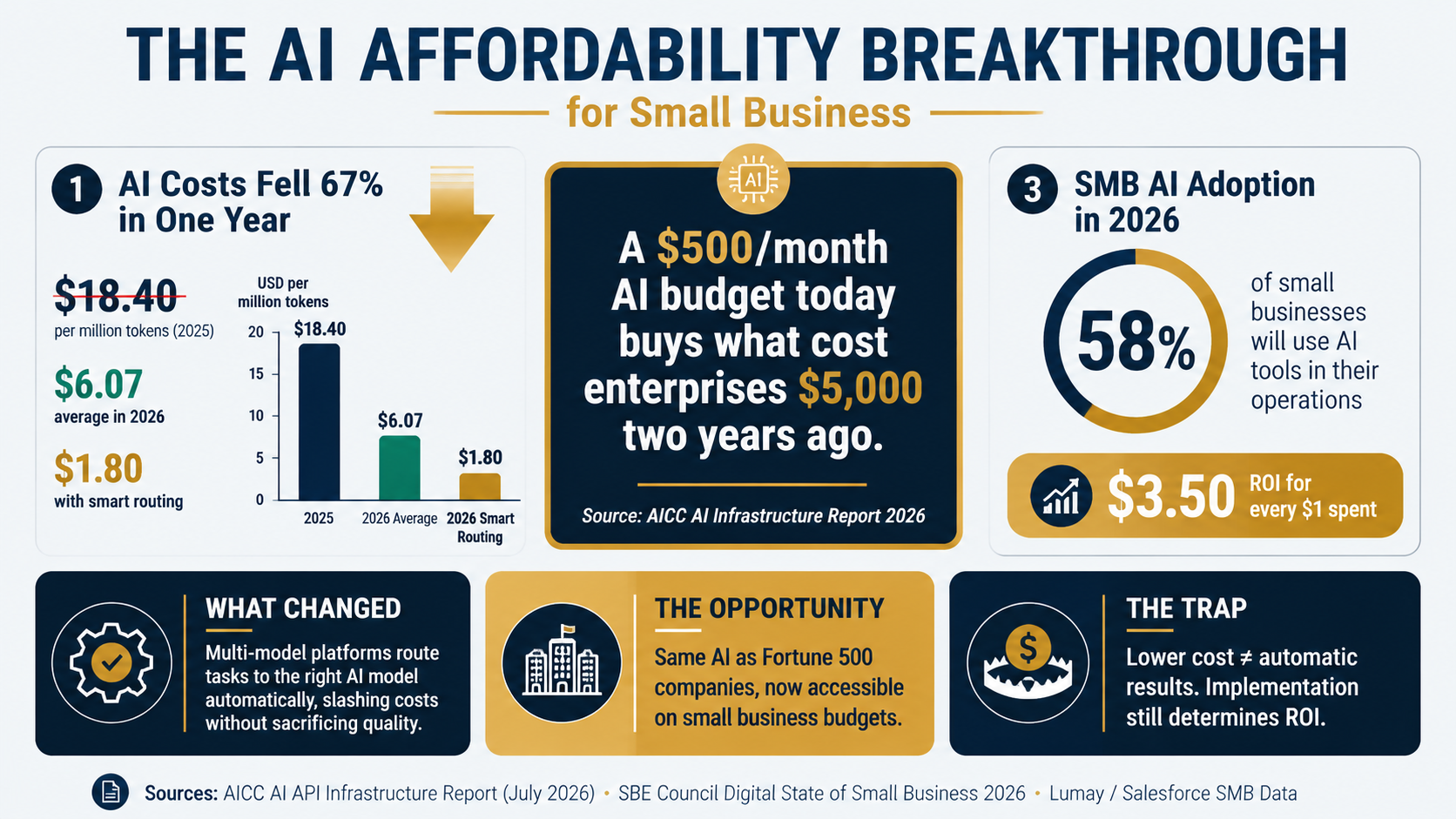
The Great AI Equalizer: Enterprise-Grade AI Is Now Affordable for Small Business
The first cost collapse — how model prices fell 67% in a year.
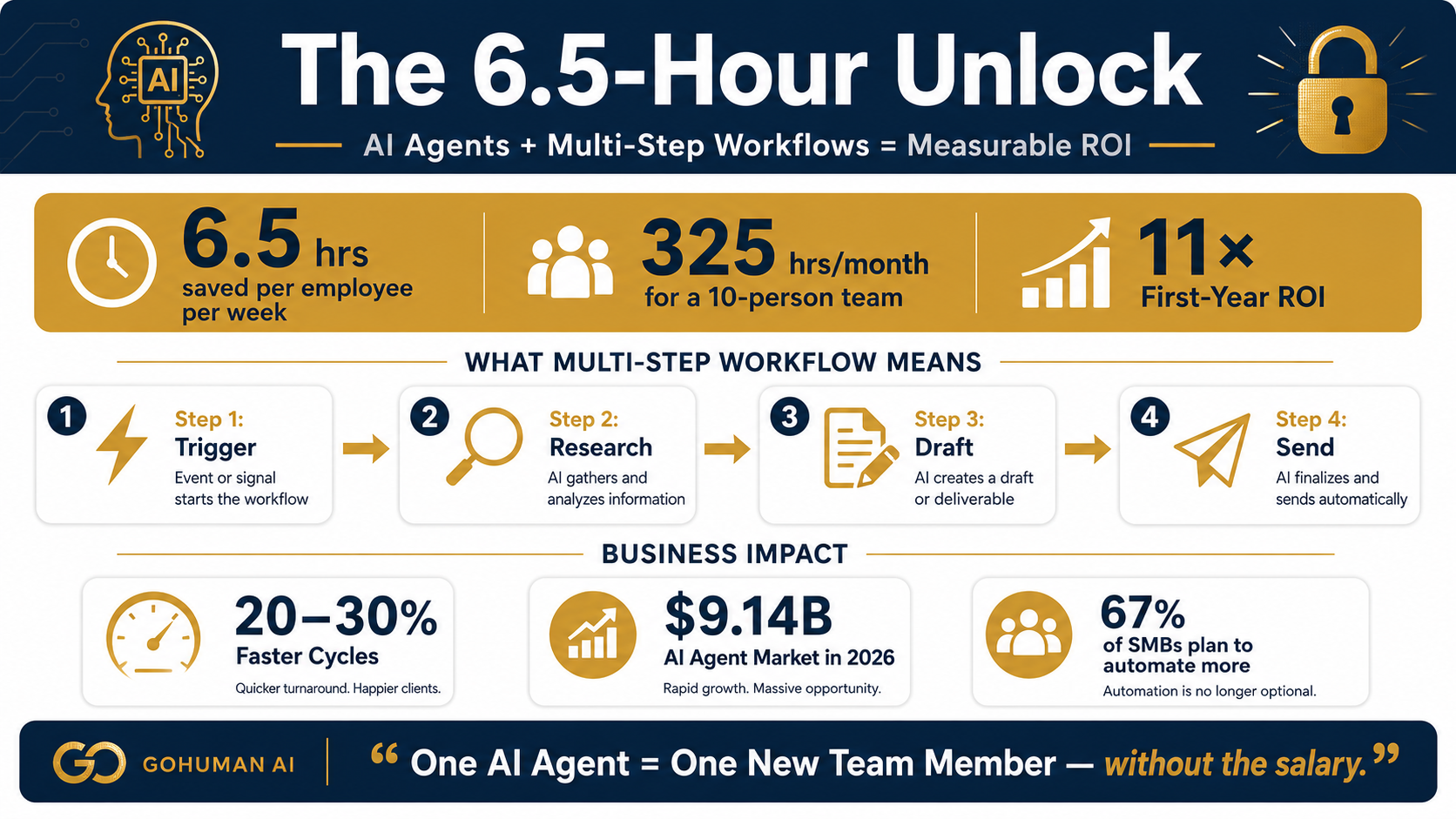
The 6.5-Hour Unlock: How Small Businesses Are Using AI Agents for Multi-Step Workflows — And Why ROI Starts Here
Find the quick-win workflow worth automating first.
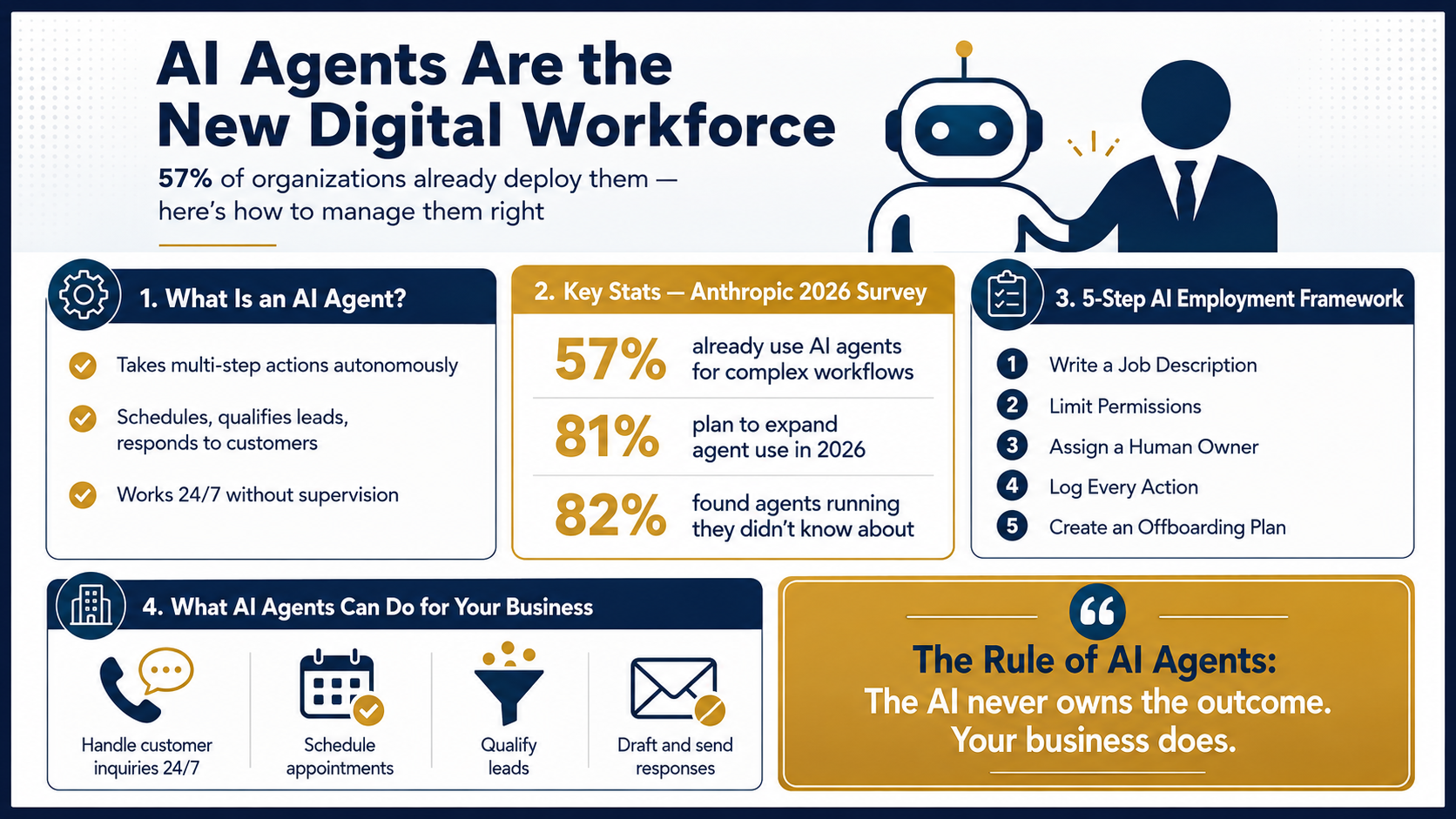
Your First AI Employee: What Small Business Owners Need to Know About AI Agents
The 5-step framework before deploying your first agent.
Agent running costs just fell up to 45%. Let us show you which continuous workflow in your business can absorb that discount first — safely, with a human in the loop.