
The 81% Tipping Point: New Data Shows AI Marketing Automation Delivers 544% ROI — But Most Small Businesses Are Leaving It on the Table
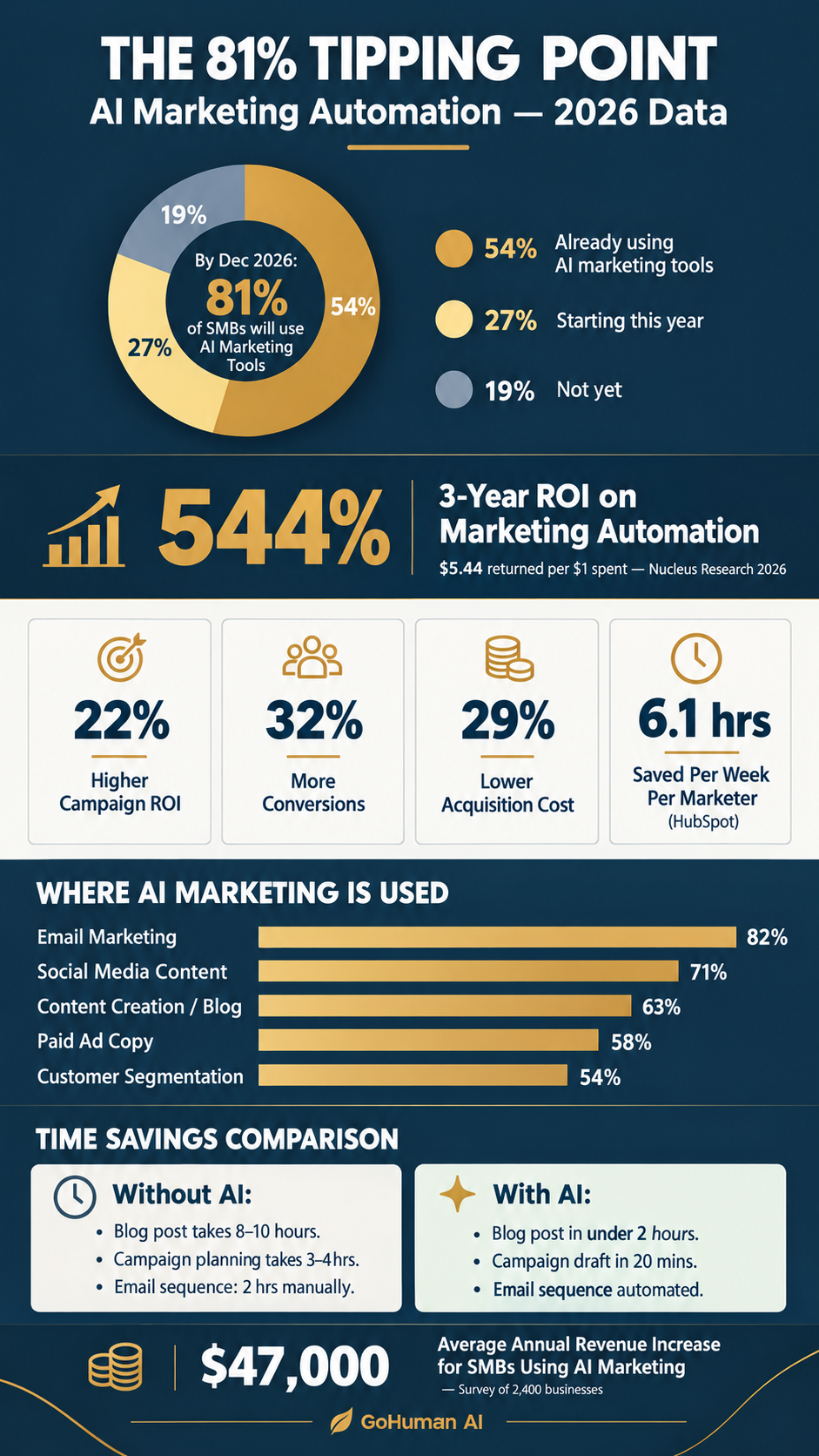
Constant Contact's Q1 2026 Small Business Now report found that 54% of SMBs already use AI marketing tools — and another 27% plan to start this year. By December, 81% of small businesses will have adopted AI for marketing. The tools are spreading. But the results are not. Here is the gap between using AI for marketing and actually getting 544% ROI from it.
Think about the last time you wrote a marketing email for your business. How long did it take from blank page to send? Most small business owners — being honest — will say an hour or two for a decent one. A full campaign sequence takes a day. A month of social media content takes most of a weekend. AI marketing automation compresses all of that by a factor of four to five — and the businesses that have made that shift are reporting campaign results that are materially better, not just faster.
The adoption data is striking. Constant Contact's Q1 2026 Small Business Now survey found that 54% of small businesses already deploy AI marketing tools, with another 27% planning to adopt within the year. By December 2026, 81% of small businesses will use AI for some part of their marketing. But adoption and effectiveness are not the same thing. The same research that documents widespread adoption also reveals a significant performance gap between businesses that use AI reactively — as a quick-content shortcut — and those that have wired it into the full marketing workflow. The difference in ROI between those two groups is not marginal.
What 544% ROI Actually Looks Like
Nucleus Research's 2026 analysis of marketing automation returns found a three-year ROI of 544% — or $5.44 returned for every $1 invested. That figure comes from businesses that have systematically embedded AI into their email, content, social, and campaign workflows — not from companies that use an AI writing tool occasionally.
544%
3-Year Marketing ROI
$5.44 per $1 spent — Nucleus Research
22%
Higher Campaign ROI
AI vs traditional methods
32%
More Conversions
AI-driven campaigns vs manual
29%
Lower Acquisition Cost
AI targeting vs broad spend
These numbers are not from enterprise deployments with eight-figure marketing budgets. They represent the median impact across businesses of varying sizes — including small businesses that began with a single email automation and expanded from there. The 22% campaign ROI lift and 32% conversion improvement come from the same source: AI's ability to personalize at a scale that is simply impossible to replicate manually. A marketer running personalized segments manually can handle 4–5 variations. An AI-driven system runs hundreds of micro-segments simultaneously, each tuned to behavioral signals from that subset of contacts.
For small businesses, the 29% reduction in acquisition cost is particularly meaningful. Every dollar spent attracting a new customer is money not available for product development, service delivery, or keeping your existing customers — the group that data consistently shows is 5–25× cheaper to grow revenue from than new acquisitions. AI targeting does not just improve campaign performance — it makes your marketing budget go further by concentrating spend on the audiences most likely to convert.
The Time Equation: Where AI Marketing Actually Saves Hours
HubSpot's AI Trends 2026 survey found that marketers save an average of 6.1 hours per week using AI tools — with senior practitioners recovering 8 to 10 hours. For a small business owner who handles their own marketing alongside everything else, that is the equivalent of reclaiming a part-time employee's worth of output.
The biggest savings are in content creation. A single blog post that previously required 8–10 hours of research, drafting, and editing now takes under 2 hours with AI assistance. That is not because AI writes the post for you — the most effective implementations use AI as a first-draft and research tool, with the business owner adding the expertise, voice, and specific examples that make content genuinely useful. A campaign email sequence that took a full day to build from scratch now takes a morning. Monthly social media planning, once a Sunday-killing exercise, becomes a two-hour session.
The compounding effect:
A business owner who recovers 6 hours per week on marketing tasks gets 312 hours back over a year. At an owner's effective hourly value of $75–$150, that is $23,400–$46,800 in recaptured time — on top of the revenue impact from better-performing campaigns.
The aggregate revenue effect of this time saving shows up clearly in the survey data: small businesses using AI marketing automation report an average annual revenue increase of $47,000, based on a survey of 2,400 businesses. That figure reflects both better campaign performance and the capacity freed up to focus on the work that drives revenue rather than the work that enables it.
The Five Channels Where AI Marketing Pays Off First
Not all AI marketing applications deliver equal returns. Based on 2026 adoption data and reported impact, these five channels consistently produce the fastest payback for small businesses.
1. Email marketing personalization. Email remains the highest-ROI marketing channel for small businesses — and AI's impact here is dramatic. AI-driven email campaigns generate 41% more revenue than non-AI email, and personalized emails produce 6× higher transaction rates than generic blasts. The mechanism is behavioral segmentation: AI sorts your contact list into micro-segments based on purchase history, engagement patterns, and lifecycle stage, then sends each segment messaging calibrated to where they are in their relationship with your business. A customer who bought six months ago and has not returned gets a different email than a first-time buyer who opened your last three campaigns. The difference in response rates between the two approaches is large enough to be visible in a single campaign send.
2. Social media content at scale. For businesses that know social presence matters but struggle to maintain it consistently, AI content tools are the most immediately practical solution. 47% of small businesses now use automation for social media management. AI generates post drafts, suggests hashtags, identifies optimal posting times for each platform, and repurposes existing content (a blog post into a carousel, a case study into a series of quotes) — creating a consistent presence that previously required either a dedicated staff member or sustained personal effort.
3. Content creation and SEO. 44% of small businesses use AI to compose content, and the quality floor has risen significantly in 2026. The businesses seeing the best results are using AI not as a ghostwriter but as a research and structure tool: AI pulls together data points, competitor positioning, and frequently asked questions, which the owner or a team member then shapes into content that reflects genuine expertise. This approach produces content that outperforms generic AI output in search visibility and reader retention — a distinction that matters as AI search increasingly surfaces content based on demonstrated expertise rather than keyword density.
4. Ad copy and creative testing. AI ad tools now generate and test dozens of copy variations simultaneously — headlines, body copy, calls to action, image concepts — and surface the performers within days rather than weeks. For small businesses running paid social or search advertising, this eliminates the manual A/B testing cycle that previously required an agency or significant in-house expertise. The result: 47% higher ad click-through rates with AI-assisted creative, and 29% lower cost per acquisition from smarter targeting. These improvements do not require a larger ad budget — they require the same budget deployed more precisely.
5. Lead nurturing and follow-up sequences. The research on lead follow-up is consistently striking: 80% of sales require five or more touchpoints, but most businesses stop after one or two. AI-driven nurture sequences automate the entire follow-up arc — triggered by behavior (opened but did not click, downloaded a resource, visited the pricing page) — and keep leads warm through a defined journey without anyone manually tracking who needs what follow-up. Businesses using automated nurturing sequences generate 80% more qualified leads and see 77% higher conversion rates from those leads. This connects directly to the sales automation picture — AI marketing feeds a better-quality pipeline into the sales process.
Why 46% Are Not Getting the ROI
If 81% of small businesses will use AI marketing tools by year-end, but only the minority are generating results at the 544% ROI level, something is breaking down between adoption and outcome. The pattern is consistent with what the broader AI productivity research shows: a 55-point gap separates businesses that integrate AI into core workflows from those that use it as an isolated add-on.
In marketing, the common failure modes are three:
Treating AI as a content shortcut rather than a system. Using ChatGPT to draft an occasional post is not marketing automation. The businesses getting 544% ROI have built workflows: a consistent content calendar driven by AI research, email sequences triggered by behavioral signals, and campaign data flowing back into the AI system to improve future targeting. The tool is the same; the architecture around it is completely different.
Running AI without a data foundation. AI personalization is only as good as the data it personalizes against. A contact list with no segmentation, no behavioral tagging, and no purchase history gives the AI nothing to work with — the output is generic, and generic underperforms every time. Building the data foundation (proper CRM setup, email engagement tracking, website behavior capture) is the unglamorous prerequisite that determines whether AI delivers 22% better ROI or no improvement at all.
Automating without a human editorial layer. The Forbes analysis of the 81% adoption wave makes a point worth noting: as AI access becomes universal, competitive advantage shifts from producing more content to producing better content. Businesses that use AI to flood channels with generic output will find diminishing returns as every competitor does the same. The businesses building durable marketing moats are using AI for efficiency while applying genuine expertise, original perspective, and authentic voice at the editorial layer — the part AI cannot replicate.
The 4-Step Implementation Checklist
Start Here — In This Order
- 1 Clean and segment your email list. Tag contacts by how they found you, what they have purchased, and when they last engaged. This is the data layer AI personalization runs on. Without it, you are automating at the generic level — and generic performs like generic.
- 2 Build one automated email sequence. Start with a welcome sequence for new subscribers or leads — 5 emails over 10 days, each triggered by behavior. This single sequence will outperform a month of manual email sends, and building it teaches you the logic that scales to every other campaign.
- 3 Set up an AI content calendar. Use AI to research your top 12 content topics for the quarter — based on questions your customers actually ask, search trends in your category, and competitor gaps. Block one session to create drafts for all 12. Spend the rest of the quarter on editorial polish and promotion rather than blank-page creation.
- 4 Connect your marketing data. Your email platform, CRM, website analytics, and ad accounts should share data — so a prospect who clicks an email ad and visits your pricing page triggers an appropriate follow-up, not a generic newsletter. This integration is where AI goes from reactive to predictive.
The 6-Month Window That Still Matters
AI marketing tools are moving from early adopter territory to mainstream fast — 76% of businesses that implement marketing automation see ROI within a year, with 44% of teams seeing it within six months. But the window before AI marketing becomes table stakes — the period when being ahead generates a disproportionate competitive advantage — is closing.
The businesses that systematize AI marketing now will have 12–18 months of compounding data advantage over those who wait: better-tuned segments, more refined nurture sequences, and A/B test results from hundreds of campaigns that tell them exactly what messaging works with their specific audience. That accumulated learning does not transfer. A competitor who starts the same process in 2027 starts from zero.
This pattern is consistent with every other AI adoption curve observed in small business. The McKinsey AI maturity research shows most small businesses stuck at Horizon 1 — using AI for isolated tasks. Marketing is one of the highest-leverage places to move from Horizon 1 to Horizon 2, because the returns are measurable in a single campaign cycle and the tools are now priced at levels that make sense for businesses of any size.
At GoHuman AI, marketing automation is one of the core workflows we build for small business clients — connecting email, content, social, and CRM data so that AI works as a system rather than a collection of individual tools. If your current marketing output does not reflect the hours you put into it, the gap is almost certainly in the workflow architecture, not the effort.
Related Reading
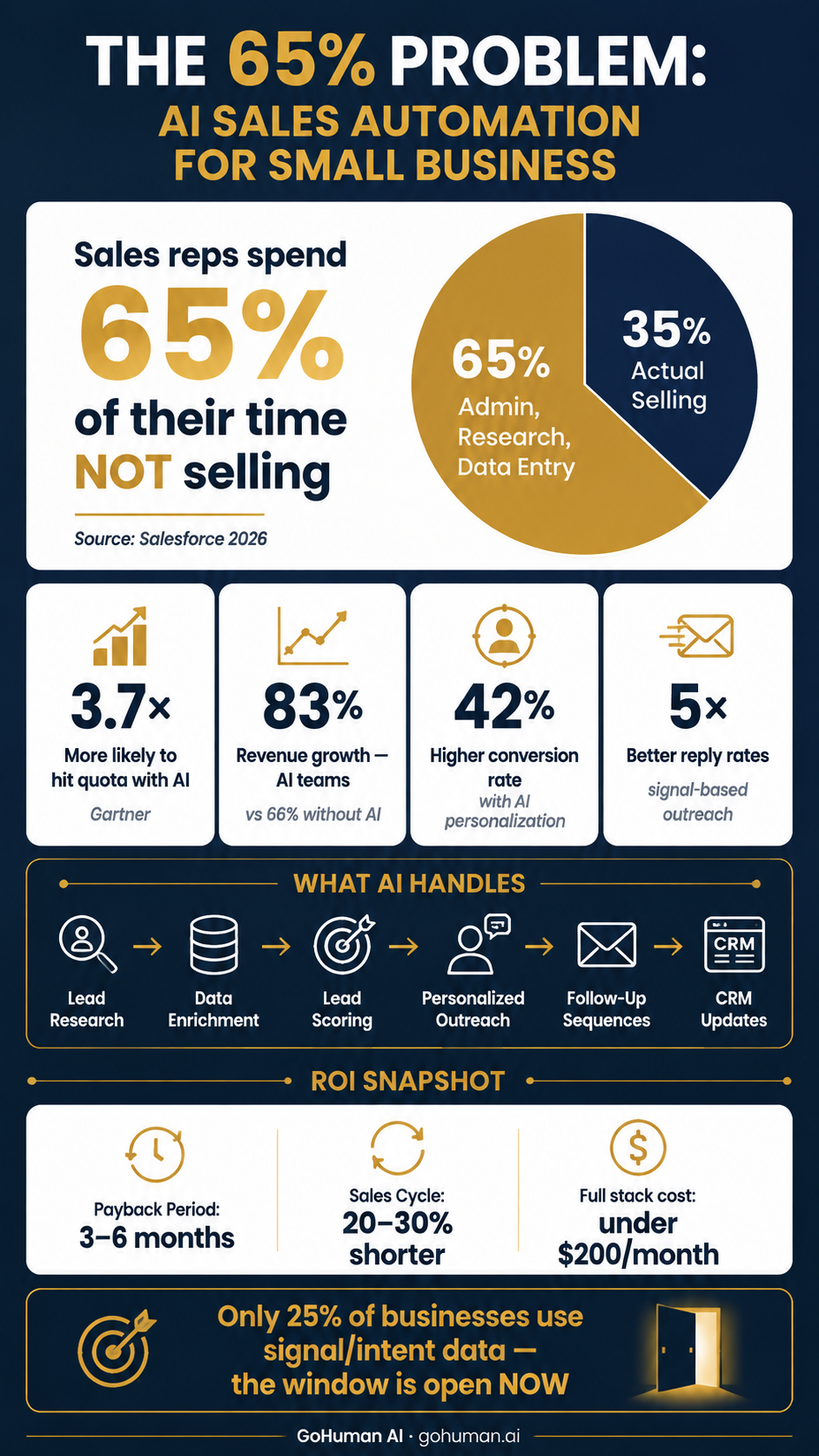
The 65% Problem: New Data Shows AI Is Making Small Business Sales Teams 3.7× More Likely to Hit Quota
How AI marketing feeds a better pipeline into your sales process.
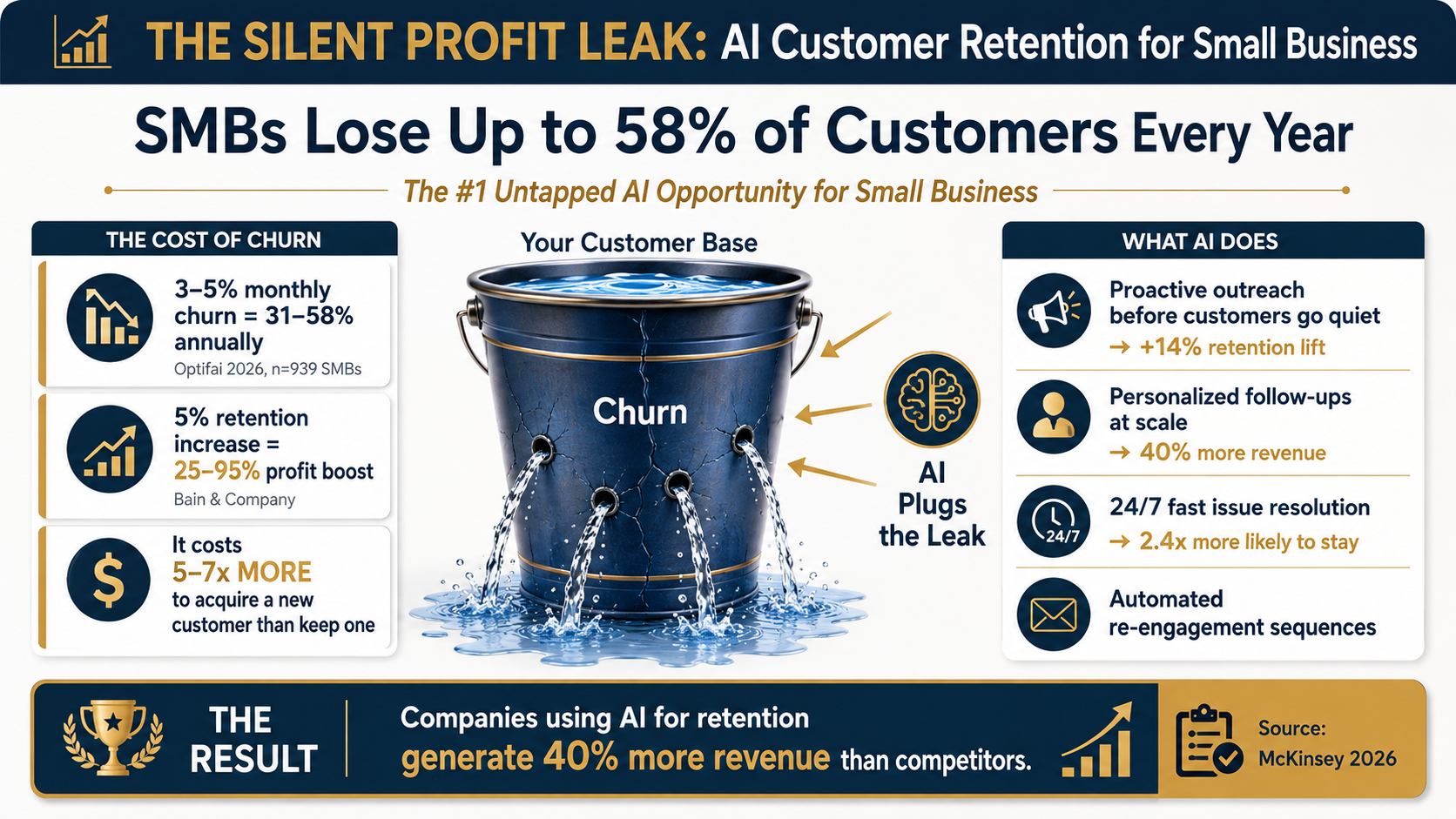
The Silent Profit Leak: How AI Is Helping Small Businesses Stop Losing the Customers They Already Have
Use AI marketing to win customers — then keep them with AI retention.
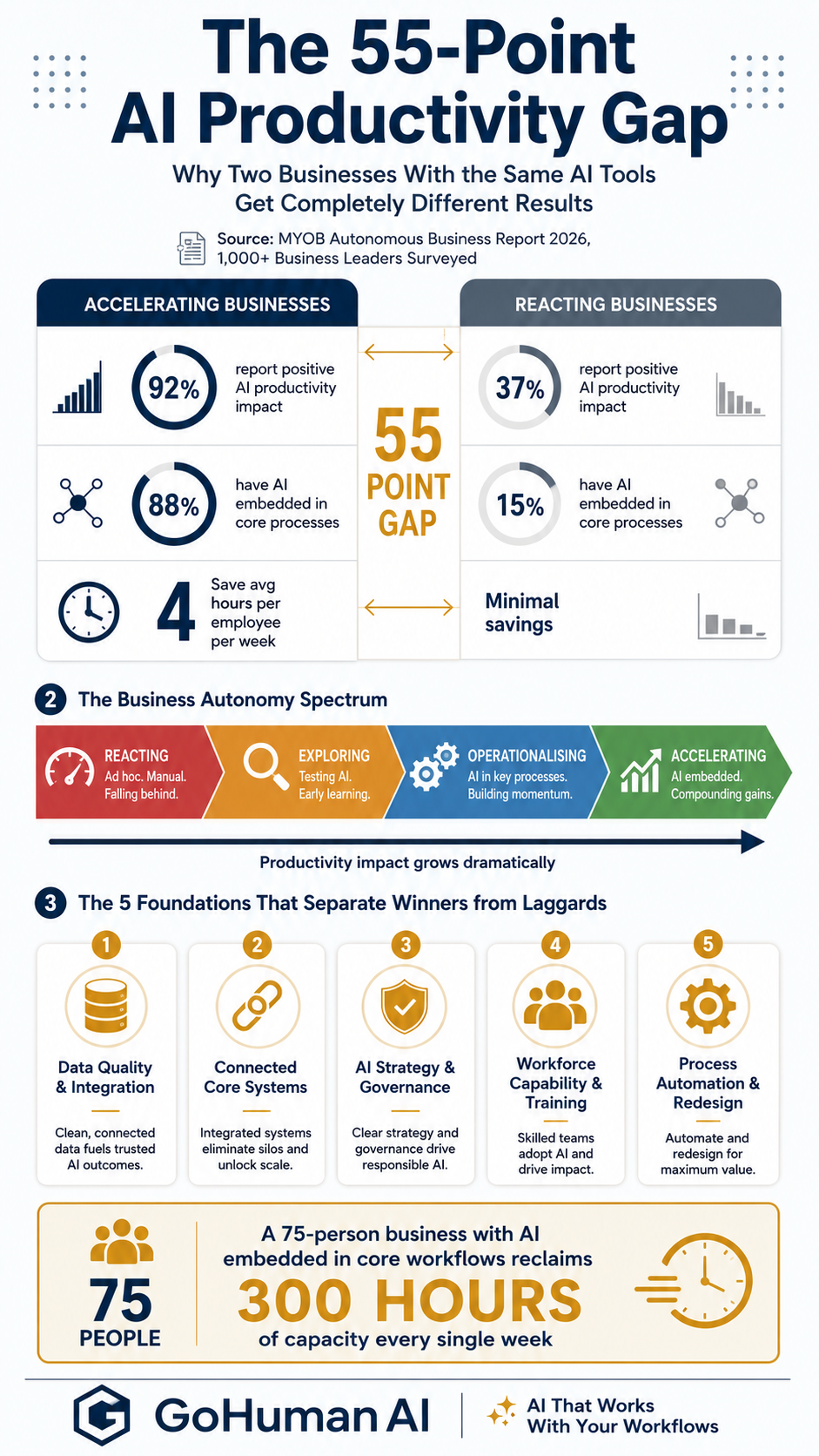
The 55-Point Productivity Gap: Why Two Businesses With the Same AI Tools Get Completely Different Results
Why AI marketing systems outperform AI marketing tools.
81% of small businesses will use AI marketing tools by year-end. The question is whether yours will be generating 544% ROI or just another content shortcut. Let us show you what a connected AI marketing system looks like for your specific business.