
The Zero-Click Shift: Why AI Search Is Changing Where Customers Find Small Businesses
Gartner predicts traditional search engine volume will drop 25% by 2026 — and the data shows it is already happening. If your website traffic has been falling without an obvious explanation, this is likely the reason. Here is what AI search is doing to customer discovery, why it hits small businesses hardest, and the practical moves that keep you visible when the rules have changed.
Something unusual has been happening to small business websites over the past twelve months, and most owners have not yet worked out what is causing it. Traffic from Google is falling — not because their rankings dropped, not because of a penalty, not because their business has declined. It is falling because the way people search for products and services has fundamentally changed. AI-powered search is quietly redirecting the customer discovery journey, and most small businesses are not set up to follow it.
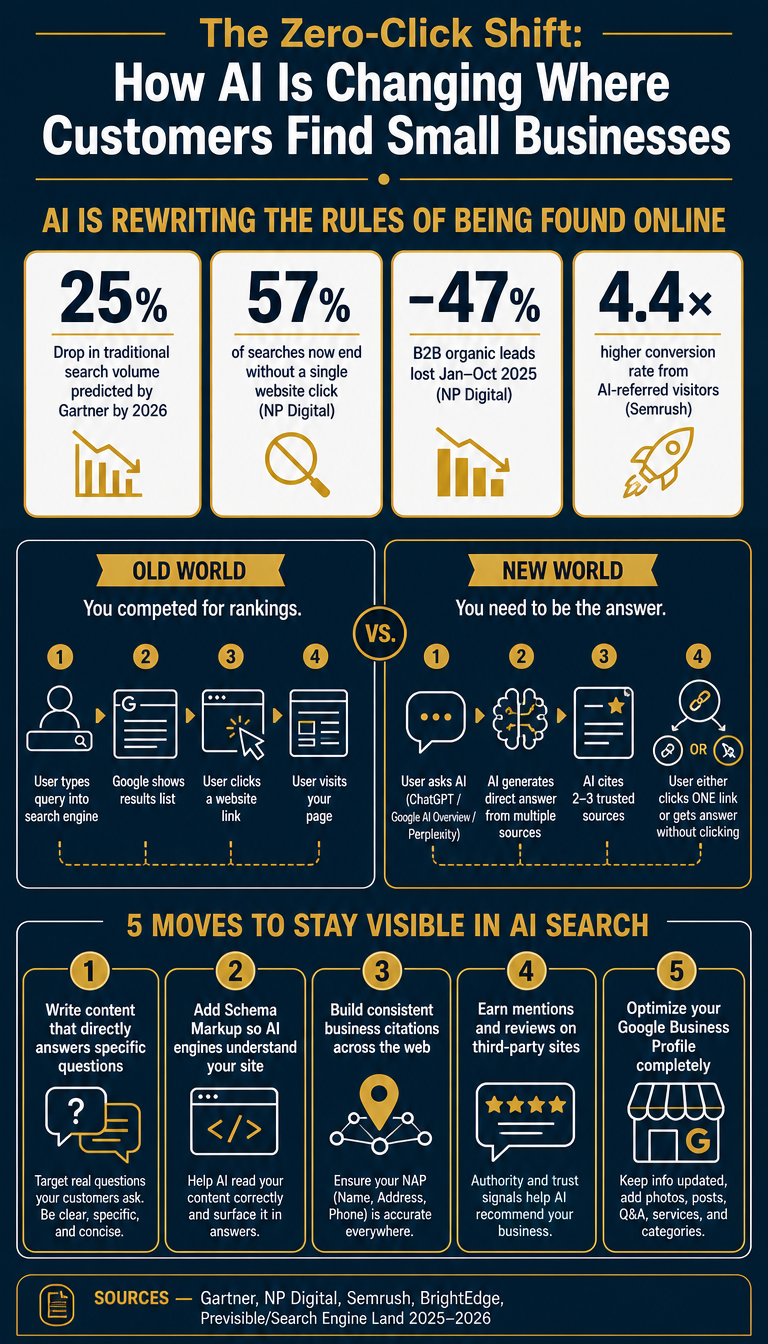
Research firm Gartner has forecast that traditional search engine volume will drop 25% by 2026 as users migrate toward AI assistants and chatbots for their queries. They also predict that 60% of all commercial research queries will be AI-assisted by the end of this year. Neither of these numbers is speculative. The traffic data is already showing up in dashboards across the SMB sector: NP Digital's analysis found that 57% of searches now end without a user ever clicking through to a website — up from just 35% in 2024. In a single year, the percentage of searches that convert to website visits dropped by more than a third.
If your website analytics show declining organic traffic despite stable or growing rankings, this is almost certainly what you are seeing. Understanding it — and adapting to it — is one of the most important visibility decisions a small business can make in 2026.
What AI Search Actually Does to Customer Discovery
The mechanism is straightforward but its implications are significant. When a potential customer types a question into Google today, they are increasingly likely to see an AI-generated answer at the very top of the results page — before any links to websites. According to Stackmatix, 58% of all Google search results pages now include one of these AI Overviews. The AI synthesizes an answer from multiple sources and presents it directly. The user reads the answer, gets what they need, and in the majority of cases never clicks through to any website at all.
The same pattern plays out on standalone AI tools. When someone asks ChatGPT "what is the best accounting software for a small retail business" or asks Perplexity "which local plumbers in [city] have the best reviews," those AI systems are not returning a list of links. They are generating direct answers — and citing two or three specific businesses or resources as their sources. If your business is not one of those citations, you do not exist for that customer in that moment.
This is the core shift: search used to mean competing for a position on a list. In 2026, it increasingly means competing to be the answer the AI picks. Those are two entirely different games, with different rules and different winners.
25%
predicted drop in traditional search volume by 2026 — Gartner
57%
of searches now end with zero website clicks — NP Digital, 2025
−47%
B2B organic leads lost Jan–Oct 2025 — NP Digital
4.4×
higher conversion rate from AI-referred visitors vs. organic — Semrush 2025
Why Small Businesses Feel This First — and Hardest
Large brands have SEO teams watching their traffic data in real time. They spotted this shift early, adjusted their content strategy, and started building for AI search visibility months ago. Small business owners are running a business, checking their analytics every few weeks, and typically interpreting a slow traffic decline as a seasonal dip or an algorithm change they can wait out.
The content hit at the top of that decline is also exactly what most SMB websites are built around. Blog posts explaining how things work, FAQ pages, how-to guides, product explainers — these are precisely the content types that AI Overviews were designed to replace. Google no longer needs to send a user to your post explaining "how to choose a business accounting system." It generates the answer on the page. If that page does not cite you as a source, you get none of the traffic and none of the credibility signal.
Tabula Agency's 2026 analysis found that news publishers — who have professional SEO teams and large content budgets — are projecting a 43% drop in search referral traffic by 2029. For a small business with limited content resources and no dedicated SEO function, the exposure is proportionally larger. You cannot afford to ignore it while enterprise competitors adapt around you.
"Informational content took the first hit. Blog posts, how-to guides, product explainers, FAQs — the content most SMB sites are built around — are exactly what AI Overviews were designed to replace."
— Tabula Agency, 2026 SMB Traffic Analysis
The Silver Lining Hidden in the Data
Here is where the story gets more interesting — because the traffic data that looks alarming on the surface contains a second set of numbers that points toward significant opportunity.
Semrush's June 2025 research found that visitors who arrive at a website from an AI referral — a ChatGPT response, a Perplexity citation, a Google AI Overview source link — convert at 4.4 times the rate of traditional organic search visitors. AI referral traffic has grown 527% year over year. And according to Seer Interactive, brands that get cited inside Google AI Overviews see a 35% uplift in organic click-through rate and a 91% uplift in paid CTR compared to brands that are not cited at all.
What this tells you is that the visitors arriving from AI search are fundamentally different from the casual browsers who used to click through from a Google results page. They have already been pre-qualified by an AI that synthesized multiple sources, considered their specific question, and named your business as relevant. When they click through to your site, they are not browsing — they are close to a decision. The traffic numbers are lower, but the quality is dramatically higher.
The opportunity for a small business is to be the one that AI systems consistently cite and recommend. Getting there requires a different approach from traditional SEO — but it is not more complicated, and in some ways it levels the playing field. BrightEdge's January 2026 research found that pages with proper structured data markup are 2–3 times more likely to be cited in AI-generated answers. That is a technical advantage that a small business can implement just as easily as an enterprise.
AEO: The Discipline Small Businesses Need in 2026
The term for the emerging practice of optimizing for AI search is Answer Engine Optimization, or AEO. Where traditional SEO optimized your website to rank in a list of results, AEO optimizes your digital presence so that AI systems understand what you do, trust your information, and cite you when generating answers to queries relevant to your business.
The fundamentals of AEO are actually more accessible for small businesses than traditional SEO. In classic search, domain authority — built over years through link accumulation — was a massive structural advantage for large, established sites. In AEO, what matters most is content clarity, structured data, and entity recognition: is the AI's picture of your business accurate, complete, and consistent across every source it checks? Those are things a small business can fix quickly, while a large competitor with years of inconsistent content across hundreds of pages actually has more to clean up.
5 Practical Moves to Stay Visible in AI Search
Based on what the research shows about how AI engines select and cite sources, these are the five highest-leverage changes most small businesses can make:
-
1
Write content that directly answers specific questions. AI engines scan for content that matches the query structure of a question — "what is the best…", "how do I…", "which [type of business] in [location]…". Your blog posts, service pages, and FAQs should include direct, clearly worded answers to the exact questions your customers type. The article that walks readers through a topic in flowing prose is less likely to be cited than the page that gives a crisp, direct answer in the first paragraph and then expands from there. Think less essay, more definition-then-elaboration.
-
2
Add structured data (Schema Markup) to your key pages. Schema markup is code added to your website that explicitly tells AI engines what your content means — your business type, services, location, hours, reviews, pricing, and more. BrightEdge's research showing 2–3× citation likelihood for structured pages is not a small margin; it is the most measurable technical leverage available in AEO. Your home page, service pages, and any FAQ sections should all carry Schema. This is also where the pattern that separates AI implementations that work from those that fail applies: specific execution of a clear technical step beats vague "use AI" strategy every time.
-
3
Make your business entity completely consistent across the web. When an AI engine encounters your business name in multiple sources — your website, Google Business Profile, Yelp, industry directories, local news mentions, customer reviews — it builds a picture of who you are and what you offer. Inconsistencies in your name, address, phone number, service descriptions, or business category create ambiguity that AI engines resolve conservatively: they cite clearer, more consistent sources instead. A full citation audit — finding and correcting every variation of your business details across every platform where you appear — is one of the highest-value AEO moves available.
-
4
Build third-party mentions and reviews deliberately. AI engines weight signals from sources they already trust: authoritative review platforms, local news, industry associations, partner websites. A business that appears as a credible, cited entity across multiple trusted third-party sources is much more likely to be recommended in an AI-generated answer than one that exists primarily on its own website. Actively pursuing reviews, seeking press mentions, contributing expert quotes to industry publications, and joining relevant associations all build the external citation profile that AEO requires. Customers who stay engaged are also significantly more likely to leave reviews — making retention workflows a direct input to AEO visibility.
-
5
Treat your Google Business Profile as a primary digital asset. Google's AI Overview pulls heavily from Google Business Profile data when generating local answers. A complete, current, regularly updated profile — with detailed service descriptions, updated hours, recent photos, active Q&A responses, and a steady stream of review replies — signals to Google's AI that your business is active, trusted, and worth recommending. For local service businesses especially, this is non-negotiable: if your profile is sparse or outdated, you are invisible in the AI-generated local answers that are increasingly replacing the map pack results that used to drive leads.
The Compounding Advantage of Moving First
There is a timing element here that matters significantly. AI systems learn from the web as it exists now. Businesses that build strong, consistent, well-structured digital presences in 2026 are laying the foundation for the citations and recommendations those AI engines will generate in 2027 and 2028. The businesses that wait to adapt will find themselves competing against incumbents who already own the AI-recommended slot for their category and location — a position that is considerably harder to displace once established.
This mirrors the dynamic that played out with early SEO adoption in the 2010s. The businesses that invested in organic search visibility in 2010 and 2011 built domain authority that took competitors years to match. The same compounding effect is available now in AI search — and the window when early movers get a disproportionate advantage is open right now, not in two years.
It is also worth noting that AEO does not replace the other digital growth levers that matter for small businesses. Growing revenue without adding headcount requires the operational efficiency that AI automation provides. Capturing every inbound lead once you are discovered requires AI voice and communication tools. AEO is specifically the discipline of making sure you get discovered in the first place — which is the prerequisite for everything else in your growth strategy.
The visibility question worth answering this week:
"If a potential customer asked ChatGPT or Google AI for the best [your type of business] in [your city], does your name come up — and does the answer point to accurate, current information about what you offer?" That test, run right now, shows you exactly where you stand in the new search landscape.
The businesses that treat this shift as a threat will lose visibility slowly, without understanding why. The ones that treat it as an opportunity — getting their digital presence structured, consistent, and AI-ready while competitors are still waiting to see what happens — will find themselves in a stronger competitive position than traditional SEO ever put them in. The 4.4× conversion advantage of AI-referred visitors is real, measurable, and available to any business willing to optimize for it.
At GoHuman AI, helping small businesses get found — by the right customers, through the channels that are actually growing — is central to what we build. If you want to understand where your business currently stands in AI search and what the specific steps look like for your industry and location, the call below is the right starting point.
Related Reading
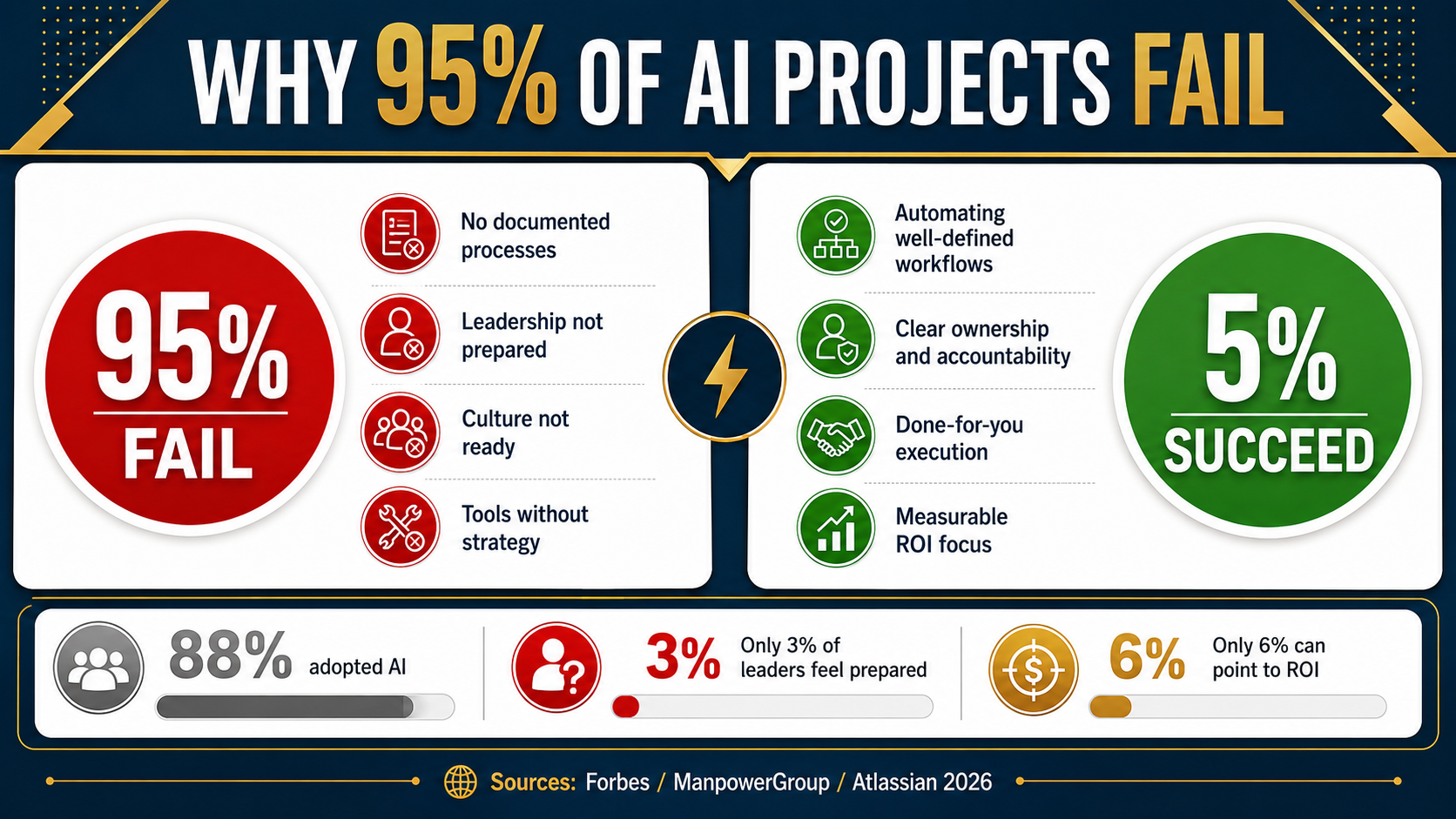
Why 95% of AI Projects Fail — And What the Successful 5% Do Differently
AEO implementation follows the same pattern: specific execution beats vague strategy every time.
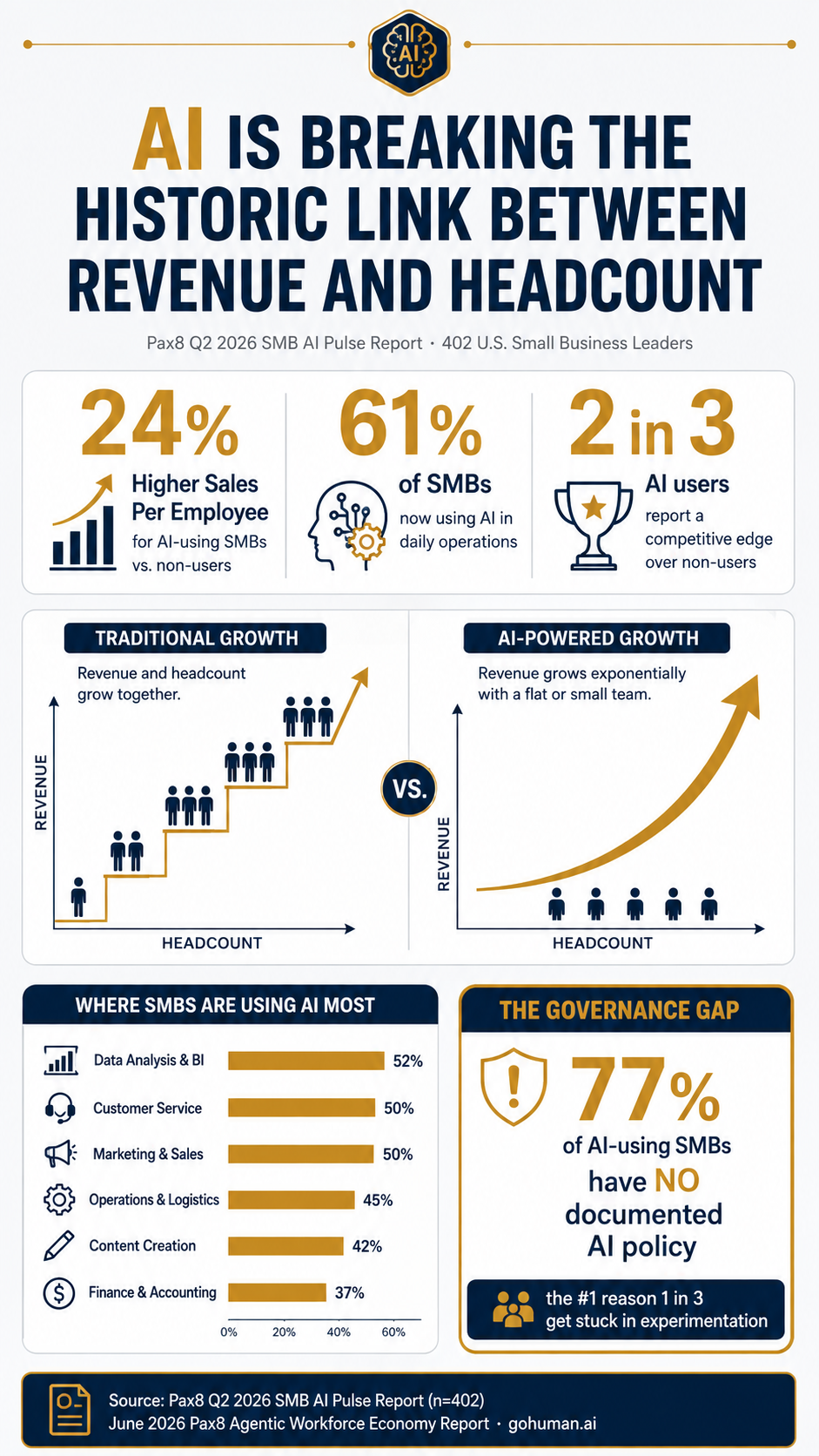
The End of Hire-to-Grow: New Data Shows AI-Using SMBs Generate 24% More Revenue Per Employee
Once AI search brings visitors to your site, operational AI determines how efficiently you convert them.
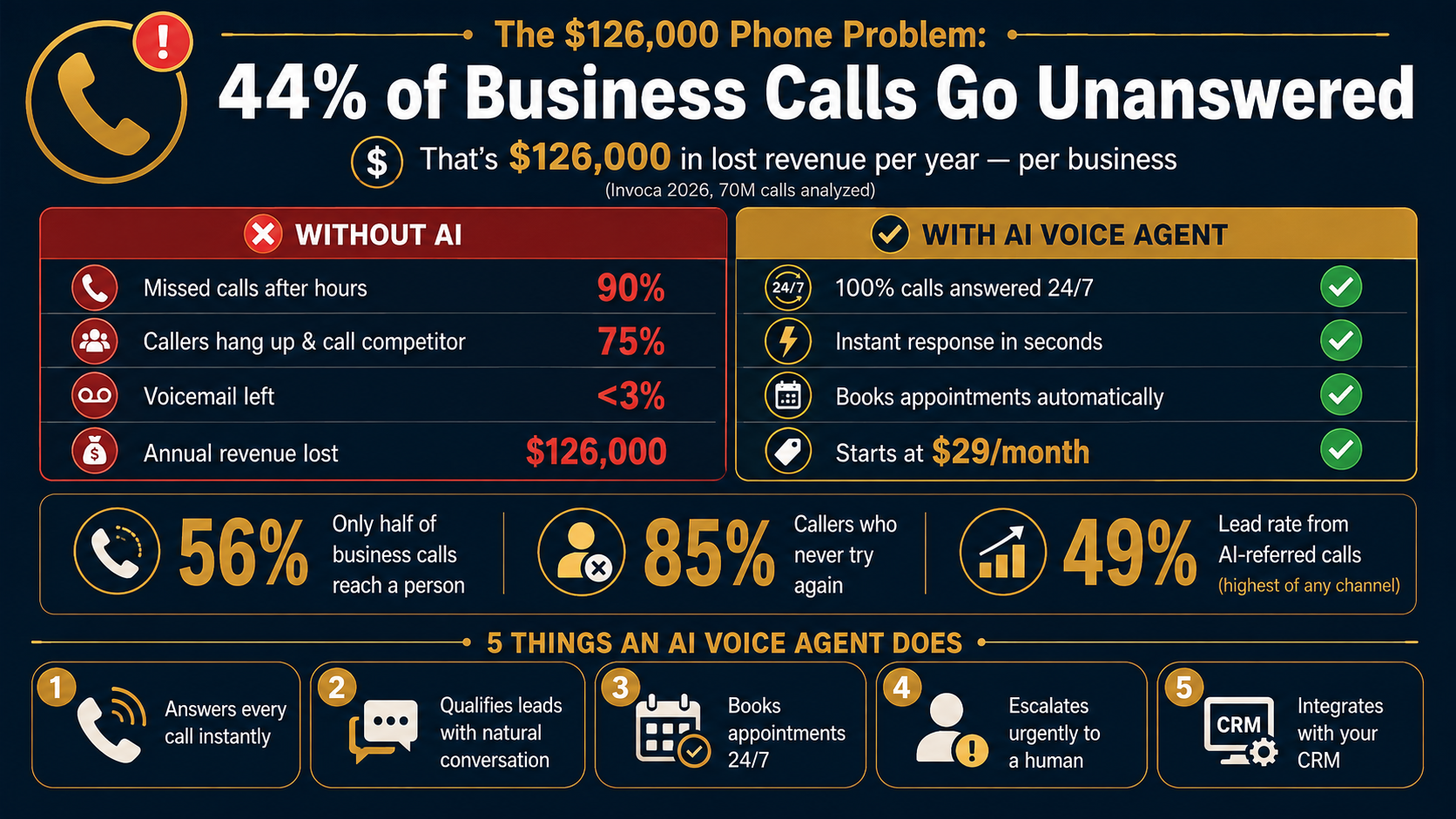
The $126,000 Phone Problem: What New Data on 70 Million Calls Reveals About Your Biggest AI Opportunity
High-intent AI search visitors who call and get no answer are the costliest discovery outcome of all.
Want to know exactly where your business shows up in AI search — and what it would take to become the recommended answer in your category?