
The High-Stakes AI Bet: 62% of Small Business Leaders Trust AI Agents With Critical Decisions — But Most Haven't Closed the Gap
A new Upwork survey of 195 small and mid-sized business leaders finds that six in ten are already confident handing important, high-stakes decisions to AI agents. But the same data reveals something quieter: productivity gains from that trust have been incremental, not transformational. Here is what is causing the gap — and what the businesses pulling ahead are doing differently.
There is a moment in most small business owners' AI journey that looks like progress but might actually be a trap. You have started using AI tools. You are seeing some time savings. Confidence builds — and before long, you are handing genuinely important decisions to the AI: Which leads to prioritize. How to price a job. Whether a contract term is reasonable. Which customer to follow up with first.
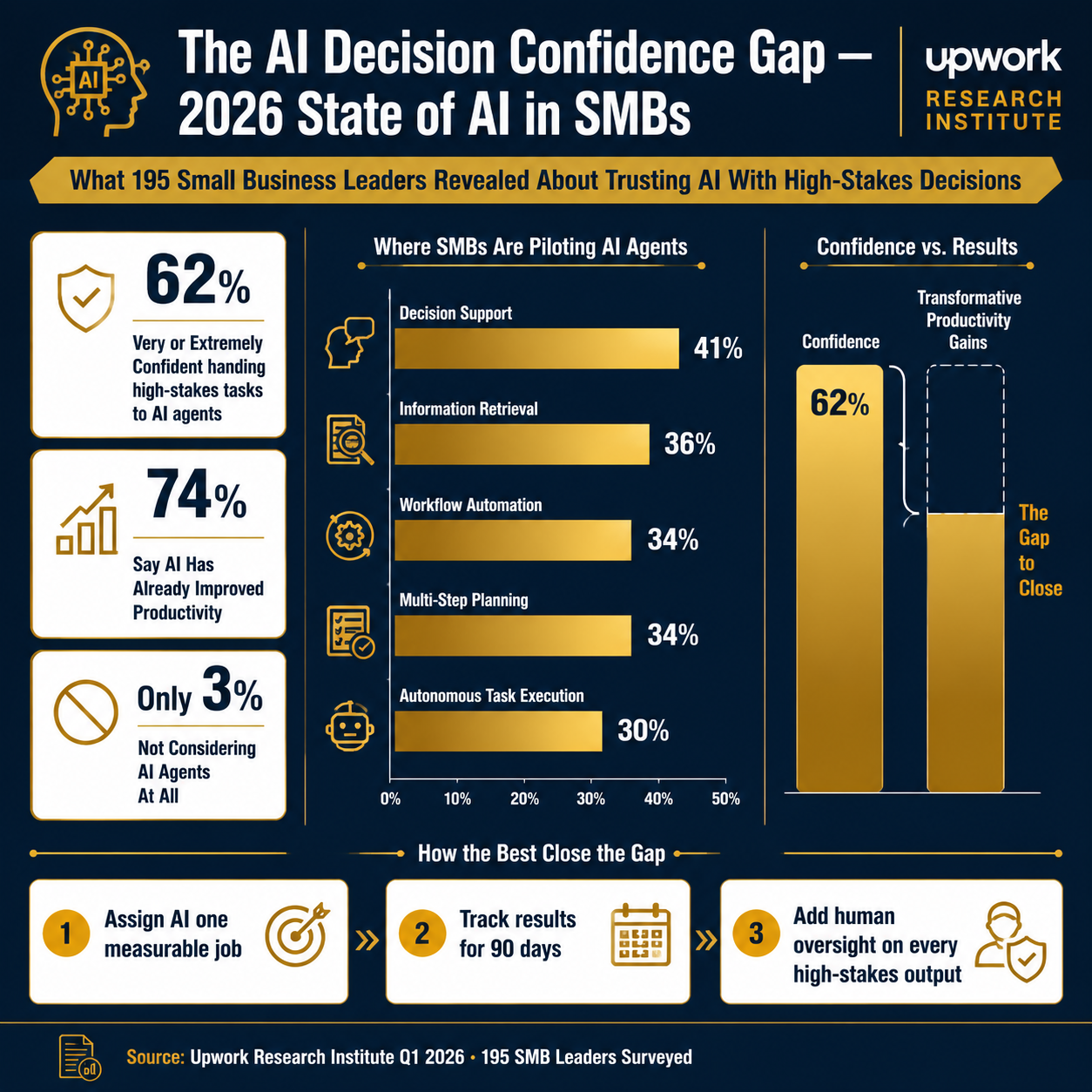
The Upwork Research Institute's Q1 2026 State of AI Within SMBs report found that 62% of small and mid-sized business leaders are now "very or extremely confident" handing high-stakes tasks to AI agents. That number is striking — not because it is too low, but because of what follows it in the same report: productivity gains from AI at most SMBs are still incremental, not transformational. The confidence is real. The results, so far, have not fully caught up.
This confidence-to-results gap is the most important story in AI adoption for small business right now. Understanding it — and knowing how the businesses bridging it are operating — is what separates an AI investment that compounds from one that quietly disappoints.
What "High-Stakes" Actually Means at a Small Business
At a large enterprise, high-stakes AI might mean algo-driven portfolio management or automated clinical decisions. For a small business, it is something more immediate and personal: which customer inquiry to respond to first, whether to approve a discount, how to allocate a thin budget between two competing needs, or what to say in a message that could win or lose a contract.
These decisions happen dozens of times each day, often under time pressure, often without a second opinion available. AI agents — which can process context, surface relevant data, and generate recommendations in seconds — look like an obvious solution. And to a growing majority of small business owners, they genuinely feel like one. The 62% confidence figure is not reckless optimism. It reflects real experience with AI tools that, in the right situations, do exactly what they promise.
The problem is that feeling confident and having built the oversight systems that make high-stakes AI delegation safe are two different things — and the Upwork data suggests most SMBs have reached the first milestone without yet securing the second.
62%
of SMB leaders are "very or extremely confident" handing high-stakes tasks to AI agents — Upwork Q1 2026
41%
are actively piloting AI agents for decision support — the single most common use case in the survey
3%
are "not considering" AI agents at all — meaning 97% are already on the path to AI-assisted decision-making
The Five Use Cases Where SMBs Are Betting on AI
The survey mapped where small businesses are actively piloting AI agents across their operations. The results show a business landscape already deeply committed to AI-assisted workflows — and one that has moved well beyond experimentation in most categories:
- 41% Decision support — AI reviewing information and recommending a course of action for the business owner to accept or override.
- 36% Information retrieval — AI surfacing the right data, documents, or customer history at the moment a decision needs to be made.
- 34% Workflow automation — AI executing multi-step processes end-to-end, from intake to handoff, without requiring manual intervention at each stage.
- 34% Multi-step planning — AI coordinating tasks across systems and timelines to execute complex projects autonomously.
- 30% Autonomous task execution — AI completing discrete jobs — sending a follow-up, updating a record, processing an order — without any human trigger.
What this list reveals is that small businesses are not using AI for trivial tasks. They are using it for the kinds of work that directly affect customer relationships, revenue, and operations. That is exactly what makes deploying AI agents correctly so consequential — and why the gap between high confidence and genuine results is a problem worth solving, not just accepting.
Why Confidence Outruns Results
The reason the confidence-to-results gap exists is not that AI tools are failing. In controlled conditions and on clear, well-scoped tasks, most AI agents do exactly what they are designed to do. The gap appears for a different reason: the underlying process was never redesigned for autonomous AI execution.
A business that drops an AI agent into a workflow built for manual human operation does not get AI-native performance. It gets the same old workflow with an AI layer on top — faster in places, but not fundamentally different in output. The agent handles 30–40% of the load, the rest still flows through the old process, and the business owner finds that the promised transformation is actually a modest efficiency improvement that does not justify the confidence they placed in it.
This pattern mirrors what the research on the 55-point productivity gap showed: the businesses seeing transformational AI results are not the ones with the best tools. They are the ones who redesigned their workflows around AI from the ground up, rather than bolting AI on top of what already existed. The difference is not the technology. It is the depth of integration and the deliberateness of implementation.
"Confidence without process alignment is just expensive hope. The gap isn't technical. It's operational."
— Pattern observed repeatedly in Upwork Q1 2026 SMB deployment data
The Three Moves That Close the Gap
The businesses in the Upwork data that are seeing measurable, compounding results from their AI agent investments share a consistent operational approach. It is not glamorous, but it works:
1. Give the AI one measurable job, not a portfolio of tasks.
The temptation is to deploy AI broadly and hope for broad improvement. The businesses getting the best results start with one specific, unglamorous task — processing a type of email, scoring a category of inquiry, flagging a specific kind of exception — and measure what changes before expanding. This forces clarity about what "working" actually means, and it generates the data needed to expand AI's role with confidence rather than optimism.
2. Track results for at least 90 days before scaling.
Pilots launched on enthusiasm and judged on nothing become shelfware. A 90-day measurement window is long enough to see real patterns — including failure modes that did not appear in the first week. The businesses with the best AI ROI treat their agent deployments the way they would treat a new hire: with a defined role, clear performance expectations, and a structured review before expanding scope.
3. Keep humans in the loop on every output that matters.
This is where many small businesses inadvertently create risk. The same confidence that drives AI adoption can cause owners to remove human review from outputs that genuinely need it — customer communications, pricing decisions, escalation judgments. Human-in-the-loop oversight is not a limitation on AI's value. It is the mechanism that catches errors before they become customer-facing problems, and the system that generates the feedback data AI needs to actually improve over time.
The reason only 3% of SMBs are "not considering" AI agents is that the case for adoption has already been made. The question now is not whether to trust AI with important decisions, but whether you have built the accountability layer that makes that trust safe to extend. The businesses that skip this step are the ones that end up in the 95% that see no measurable ROI — not because AI failed them, but because the implementation was never structured to succeed.
The reframe that changes the outcome:
Stop asking "Can I trust AI with this decision?" and start asking "Have I built the oversight system that makes this delegation safe?" The first question leads to either hesitation or overconfidence. The second leads to a structured deployment that compounds over time.
What This Means for Your Business Right Now
If you are in the 62% who feel confident about handing important tasks to AI, that instinct is probably right. AI agents have genuinely reached a point where they can handle decision support, workflow orchestration, and task execution at a level that makes a real difference in a small business's day-to-day operations. The conviction is not the problem.
What the data is asking you to do is match that conviction with the process discipline that turns AI deployment into AI results. That means starting smaller than you want to, measuring more carefully than feels necessary, and maintaining the human oversight that separates a well-governed AI operation from one that is simply running on optimism.
The 97% of businesses already on the path to AI-assisted decision-making are not the story. The story is the gap between the ones getting compounding returns and the ones still waiting for the transformation to arrive. That gap closes with structure, not with more confidence. And the businesses that build the structure now will be the ones the next round of research points to as the benchmark for everyone else.
At GoHuman AI, every AI agent we deploy is built around structured human oversight from day one — not as an afterthought, but as the foundation that makes the AI's output trustworthy and its deployment sustainable. If you want to turn AI confidence into AI results, that conversation is exactly where we start.
Related Reading
Why Every AI Agent Needs a Human in the Loop
How GoHuman AI builds accountability into every agent — and why it is the foundation every serious deployment needs.
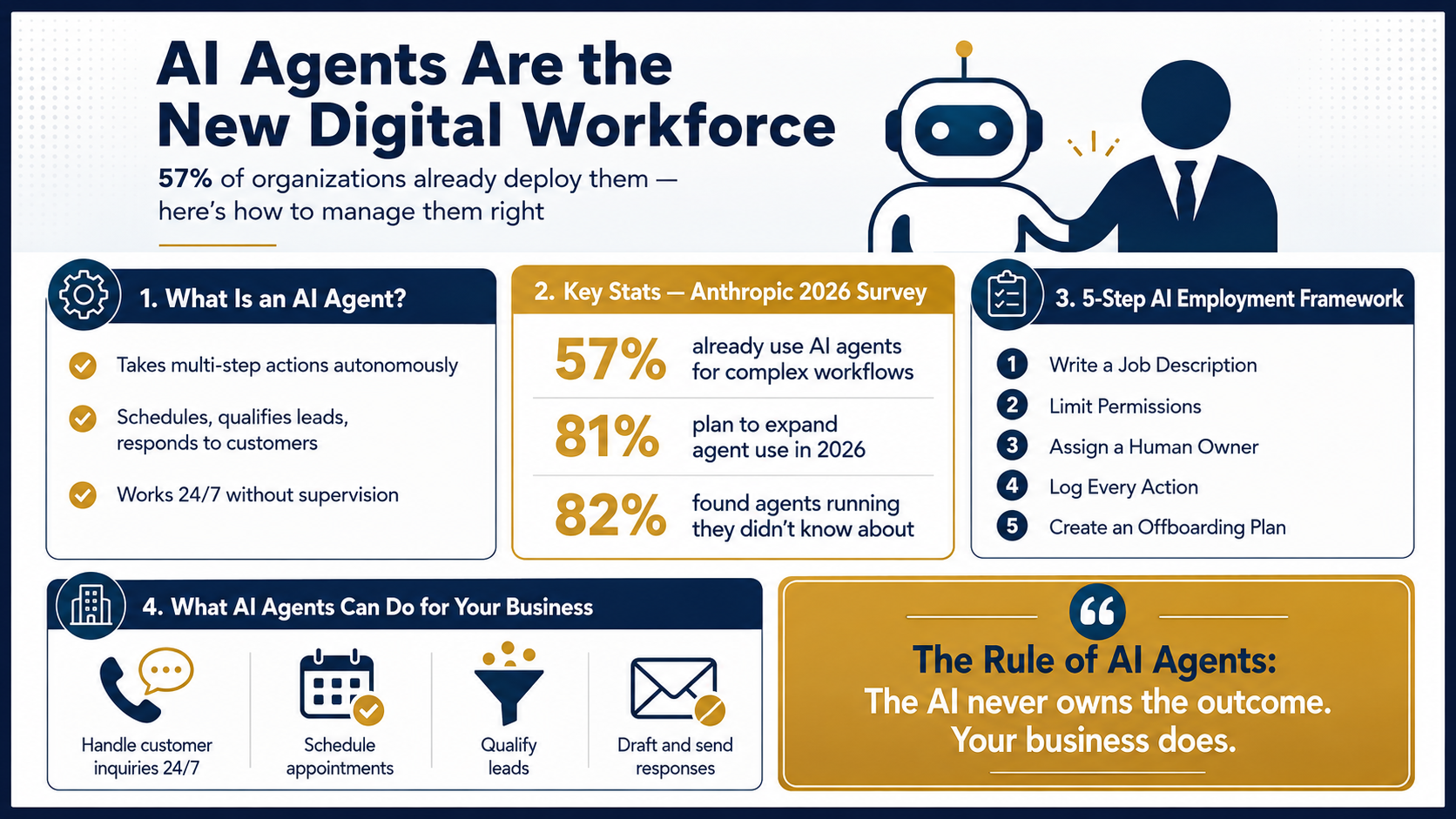
Your First AI Employee: What Small Business Owners Need to Know About AI Agents
The practical 5-step framework every small business needs before deploying their first AI agent.
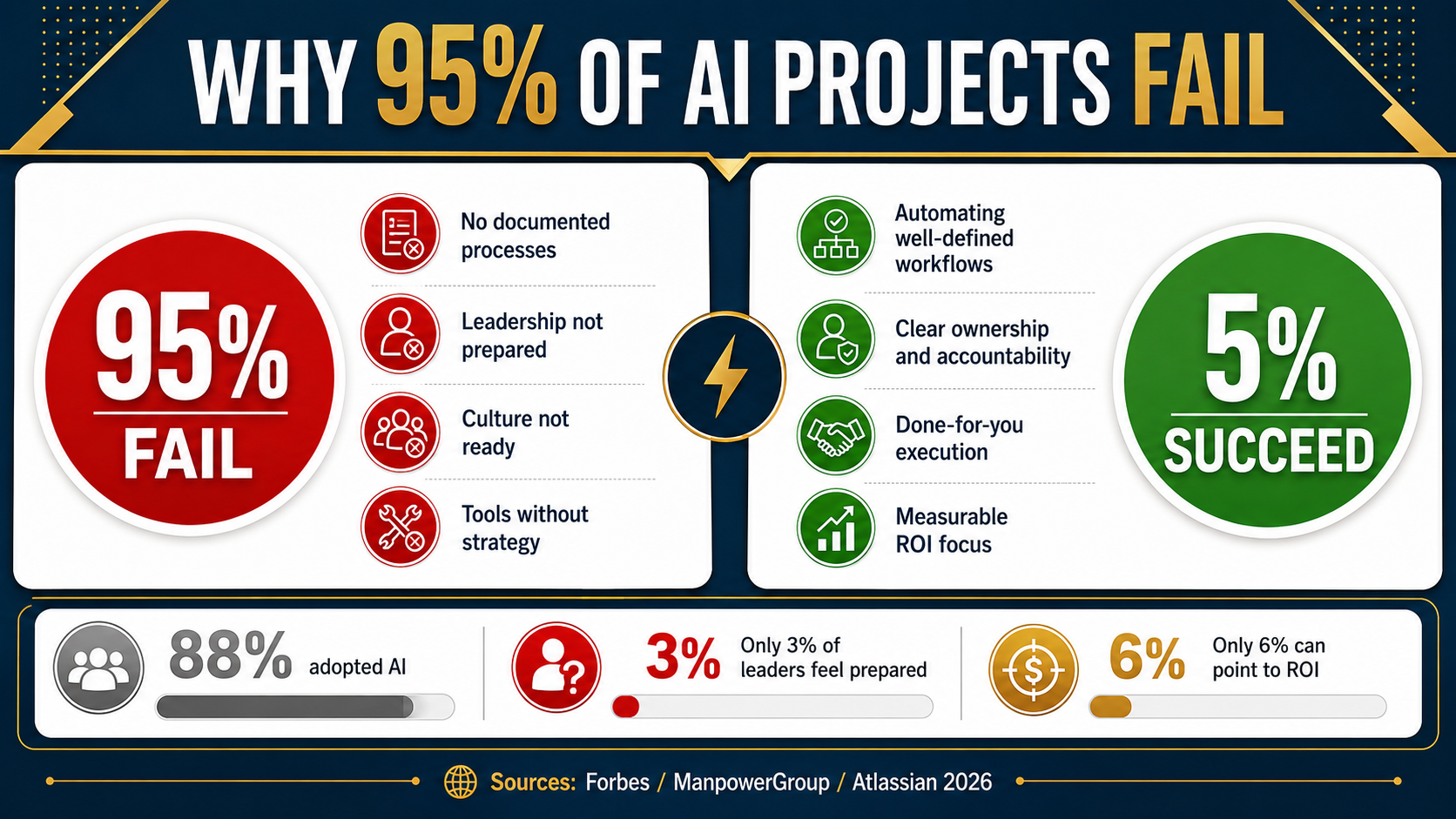
Why 95% of AI Projects Fail — And What the Successful 5% Do Differently
The clear pattern behind every AI implementation that actually works — and every one that doesn't.
Want to deploy AI agents in your business with the oversight structure that actually closes the confidence-to-results gap?